Semmes Man Killed After Entering Roadway on U.S. 98
A 46-year-old Semmes man died after entering the roadway on U.S. 98 west of Mobile and being struck by a passing pickup truck Tuesday night, troopers say.
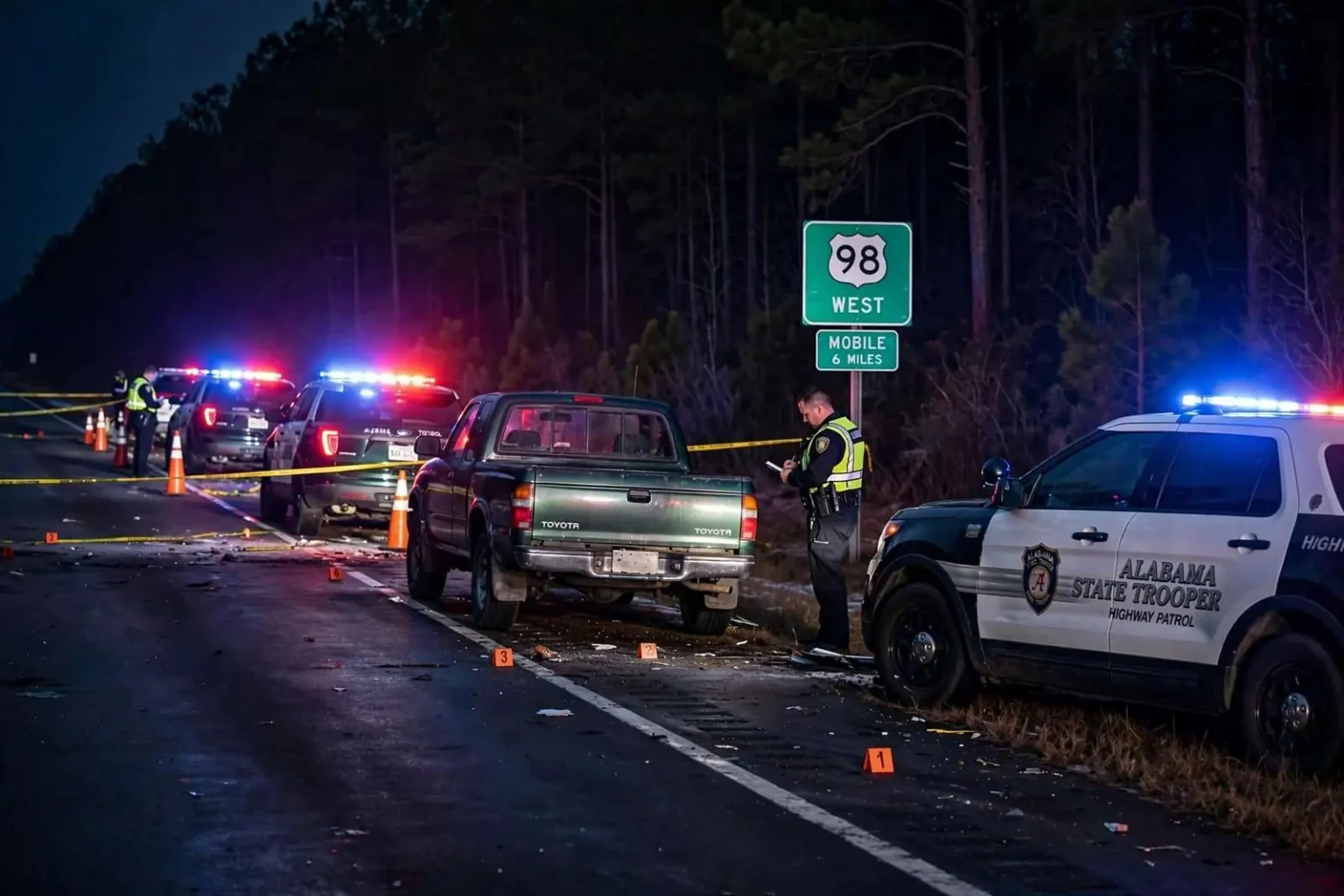
A Semmes man was killed Tuesday night after entering the roadway on U.S. 98 west of Mobile and being struck by a passing vehicle, according to Alabama State Troopers. The fatal crash added another entry to a grim tally of pedestrian deaths on the highways of south Alabama, where wide, fast-moving rural corridors pass through communities that have grown up around them. Authorities closed out their on-scene work late Tuesday after documenting the wreckage and speaking with witnesses, but the investigative work that follows such a crash was only beginning.
What troopers say happened
The crash happened at approximately 7:30 p.m. along U.S. 98, roughly six miles west of Mobile, when the 46-year-old man stepped into the path of a pickup truck. Troopers said the vehicle involved was a 1998 Toyota Tacoma. The man died at the scene as a result of his injuries. The timing placed the collision squarely in the evening darkness of midwinter, when visibility along unlit stretches of highway drops sharply and drivers may have only the reach of their headlights to reveal anything in the roadway ahead.
Trooper investigators with the Alabama Law Enforcement Agency’s Highway Patrol Division responded to the crash and said the case remained under investigation in the days that followed. Officials have not released additional details about why the man entered the roadway or whether any charges are anticipated against the truck’s driver. Investigators typically reconstruct such collisions by mapping the scene, examining the vehicle, and interviewing witnesses before determining whether any traffic violations contributed to the outcome, a process that can take days or weeks in fatal cases.
The identity of the victim was withheld in initial reports pending notification of family, a standard practice in fatal crashes. Troopers urged anyone who may have witnessed the collision or observed the man in the roadway beforehand to come forward, since even small details about his movements can help investigators complete their reconstruction of the moments before impact.
A busy corridor through growing communities
U.S. 98 is a heavily traveled corridor connecting Mobile with communities in western Mobile County, including Semmes and Wilmer, and carries significant commuter and commercial traffic throughout the day and into the evening hours. The route funnels traffic between the city and the fast-growing residential areas of the county’s western edge, mixing through commuter vehicles with delivery trucks, logging trucks, and farm equipment. Speed limits along much of the rural stretch are high, and the volume of traffic builds steadily as the region’s population growth pushes more drivers onto the highway each year.
The stretch where the crash occurred is known locally for limited lighting and few marked pedestrian crossings, conditions that safety advocates have periodically flagged as a concern for anyone on foot near the highway after dark. Residents who live along the corridor sometimes find themselves walking portions of it out of necessity, whether their vehicle is broken down, their driveway is far from their destination, or they are simply moving between nearby homes. Without streetlights or crosswalks, those walks put pedestrians in conflict with traffic traveling at highway speeds in darkness.
The seasonal danger
Pedestrian fatalities on rural and semi-rural highways like U.S. 98 tend to spike during the winter months, when darkness falls earlier and drivers have less time to react to people or obstacles in the roadway. The evening commute and the onset of darkness overlap during winter in a way they do not during summer, putting more drivers on high-speed roads at the precise hours when people walking beside or across them are hardest to see. Nationwide and statewide data consistently show the same seasonal pattern, with the hours between dusk and midnight among the most dangerous for pedestrians.
Alabama traffic safety officials have urged pedestrians to use available crosswalks, wear reflective or light-colored clothing when walking near roads after sunset, and avoid entering travel lanes outside of designated crossing areas whenever possible. Officials also recommend carrying a flashlight on evening walks, walking facing traffic where no sidewalk exists, and remaining off the roadway itself whenever a shoulder is available. For drivers, the advice runs in parallel: slow down in areas where pedestrians are likely, scan the road edges beyond the reach of oncoming headlights, and never assume a dark stretch of highway is empty simply because nothing is visible.
The investigation continues
State troopers continue to investigate the exact circumstances that led to the crash, including the man’s location and visibility at the time he entered the highway, and whether speed or roadway conditions played any role in the collision. As is standard practice in fatal crash investigations, troopers will file a formal report once their inquiry concludes. That report will document the findings that determine whether any citations or charges follow, and it becomes the official record of the incident for courts and insurers.
Part of a troubling trend
The death adds to a string of pedestrian-involved crashes reported on Mobile County roadways in recent months, a trend that has drawn attention from local traffic safety advocates who have called for expanded lighting and additional crosswalks along some of the county’s busier corridors. Advocates argue that as growth pushes subdivisions and businesses out along former rural highways, the roads themselves have not kept pace with the number of people who now live, work, and walk near them. The result is a network of corridors designed for high-speed vehicles but used daily by pedestrians with few protected places to cross.
Safety improvements of the kind advocates describe typically require coordination between state and local authorities, since U.S. 98 falls under state jurisdiction while much of the surrounding development pressure is a county and municipal matter. Lighting upgrades, marked crossings, paved shoulders, and reduced speed zones near community centers are among the measures most often proposed for corridors with this profile. Each carries a cost, and officials generally prioritize locations based on crash history, which means every new fatality feeds the data that shapes where improvements eventually land.
Statewide, Alabama has ranked among the states with the highest per-capita pedestrian fatality rates in recent years, a statistic safety officials attribute to a combination of rural road design, high speeds, limited infrastructure, and long stretches of darkness in the winter months. Mobile County, as one of the state’s most populous counties with an extensive network of rural highways, accounts for a significant share of those crashes.
No further details released
No further details were available as the investigation continued. Troopers asked motorists who use U.S. 98 through western Mobile County to remain alert in the evening hours and to report anything they saw along the stretch near the crash site on Tuesday night. For the family of the 46-year-old victim, and for the driver of the pickup involved, the formal investigative process will determine the answers the community is looking for — how a man came to be in the travel lanes of one of the county’s busiest highways, and what might prevent the next such tragedy along the corridor.
Why winter evenings are so dangerous
The collision underscores a pattern that traffic safety researchers have documented for years: the deadliest hours for pedestrians are concentrated in the dark evening and nighttime periods, and the risk multiplies on roads without lighting, sidewalks, or crossings. On highways like U.S. 98, vehicles travel at speeds that leave drivers only fractions of a second to perceive and react to a person in the roadway. At night, that perception distance shrinks dramatically, because headlights illuminate only so far ahead and dark clothing can render a pedestrian nearly invisible until the car is dangerously close.
The crash also illustrates how rural corridors absorb responsibilities their design never anticipated. Highways built to move vehicles between towns have, over decades, become the front doors for homes, churches, convenience stores, and school zones along their length. Pedestrians in those settings are not recreation walkers but people with everyday needs, and the absence of infrastructure forces them into the same lanes as traffic. Transportation planners refer to the resulting locations as a persistent risk zone, and they appear on corridors across south Alabama where growth has outstripped road improvements.
How fatal crash investigations proceed
In cases like this one, the Highway Patrol Division’s investigation typically moves through several stages, beginning with documentation of the scene while evidence remains in place. Investigators photograph and measure skid marks, debris fields, and final resting positions of the vehicles involved, and they interview the driver and any witnesses the same night when possible. The vehicle is inspected for mechanical condition, and in many fatal cases investigators apply for a warrant to draw blood from the driver, checking for impairment as a possible contributing factor.
The findings come together in the formal report filed once the inquiry concludes, which establishes the sequence of events and assigns contributing factors where the evidence supports them. Prosecutors review that report when investigators identify potential violations, though many pedestrian fatalities end with no charges when the evidence shows the driver could not have avoided the collision. Families of victims are generally briefed on the findings, and crash reports become public records available through the state once the investigation is closed.
Troopers said Tuesday night’s case will follow that same process, and they encouraged anyone with information to assist before the record is finalized.