Mobile Water and Sewer Rates Set to Rise 5 Percent in 2015
MAWSS customers will see a 5 percent rate increase starting January 2015 as the utility funds repairs to aging pipes and treatment plants.
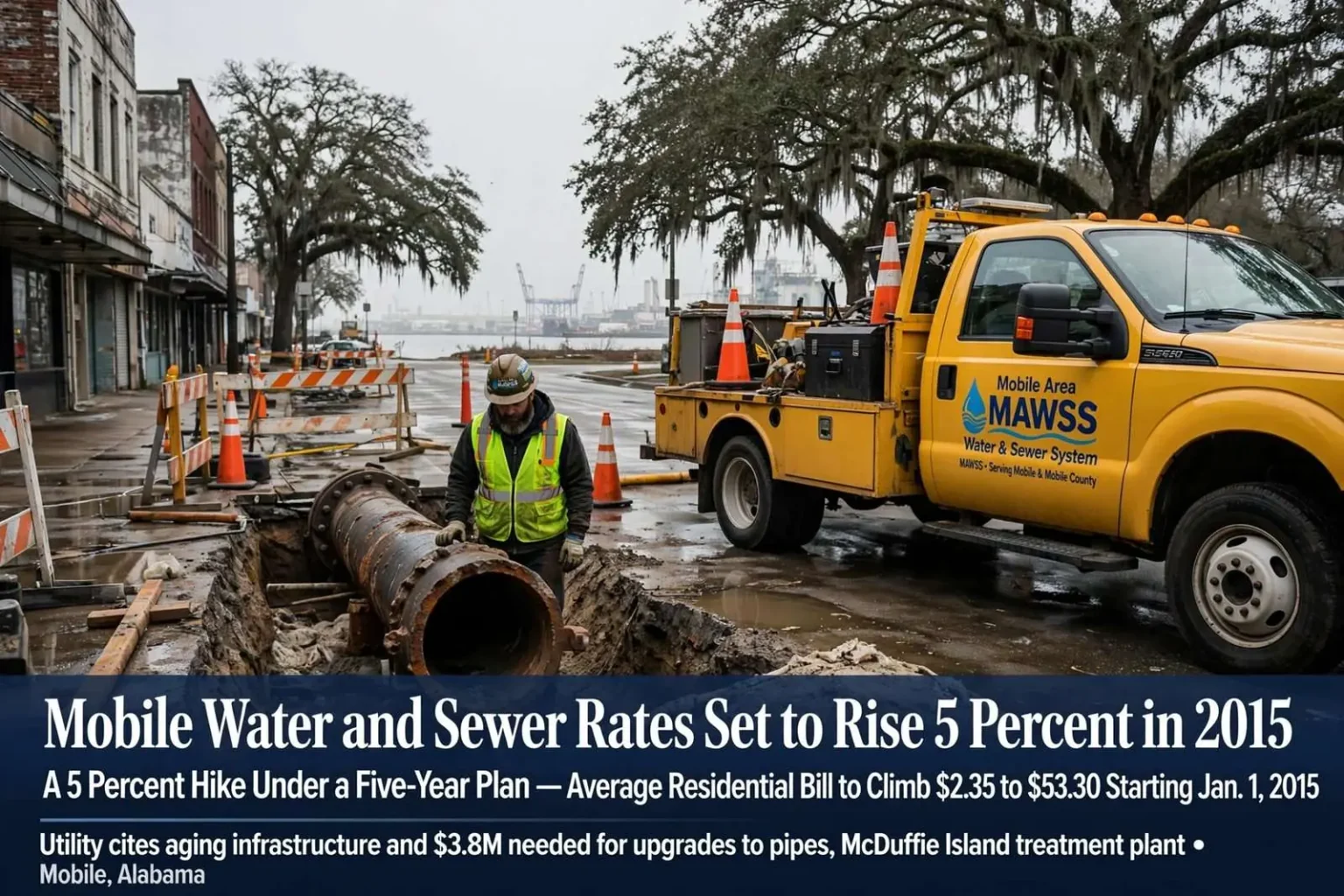
A 5 Percent Hike Under a Five-Year Plan
Water and sewer customers across Mobile and the surrounding area are facing another rate increase in the new year. The Mobile Area Water and Sewer System’s board of directors has approved a 2015 budget that includes a 5 percent hike in monthly bills, adding roughly $2.35 to the average residential customer’s payment starting January 1. The increase is part of a five-year plan the utility’s board first approved in 2011, calling for annual 5 percent rate hikes to help fund upgrades to aging pipes and treatment facilities across the system. For customers, the cumulative effect of the plan is becoming visible on bills that have risen every January since it took effect.
Under the new rates, a typical residential customer using about 5,000 gallons a month will see their bill climb from roughly $50.95 to $53.30. One more increase is scheduled for 2016, which would bring the average bill to about $55.80 a month. The numbers matter for households on fixed incomes, and they matter for the utility’s argument that steady, predictable increases are easier to absorb than the large emergency hikes that follow deferred maintenance. Utility officials have made the case each year that the alternative to gradual increases is a system that fails in far more expensive ways.
Utility officials say the additional revenue, expected to generate around $3.8 million in 2015 alone, is critical to addressing infrastructure that has aged well past its intended lifespan. Much of the system’s underground pipe network and treatment infrastructure was built decades ago and requires ongoing repair and replacement to keep pace with demand and avoid service failures. Water systems across the country face the same arithmetic, as pipes installed in the mid-20th century reach the end of their working lives at the same time. Every break that floods a Mobile street or interrupts service is, in the utility’s telling, an argument for the rate plan.
The utility’s service area extends beyond the city of Mobile itself, reaching into unincorporated parts of Mobile County as well as Spanish Fort, Prichard and Chickasaw. Residents and businesses throughout that footprint will see the increase reflected on their bills. The regional scope of the system means the rate decision touches suburban Baldwin County customers in Spanish Fort as well as residents of some of the older, poorer communities along Mobile Bay’s western shore. Customers in those areas have limited alternatives, since water service is a natural monopoly in practice, which is why the board’s budget deliberations draw attention from local officials.
Where the Money Goes
Some of the new revenue is earmarked for a treatment plant on McDuffie Island, where a $20 million bond issued earlier in the year is being repaid through the rate increases. McDuffie Island, the industrial parcel at the mouth of Mobile Bay that historically served as the site of the city’s sewage treatment operations, anchors a capital program the utility has been building out to meet both regulatory requirements and growth. Debt service on a bond of that size is a fixed obligation, and ratepayers see it directly in the monthly charge. The plant work is one of the most visible pieces of the upgrade campaign, but the bulk of the system’s needs lie underground in pipe that no customer ever sees.
Officials say the overall 2015 operating budget totals more than $57 million, with a growing share going toward outside contractors and consultants brought in to help manage capital projects and day-to-day operations. The reliance on outside firms has been a point of recurring discussion at board meetings, with members questioning whether the utility’s own workforce should be handling more of the work. Contract labor gives the system flexibility during a heavy construction period, but it comes at a premium compared with in-house staff, and it keeps expertise that leaves when the contract ends. The pattern has made the utility’s contracting practices a small but persistent theme in its oversight debates.
Utility leadership has said they hope to reduce reliance on outside contracting over time as staffing and internal processes are reevaluated. That effort will require rebuilding internal capacity that was slimmed down in earlier years, and it runs against the immediate pressure to keep capital projects moving on schedule. Board members have framed the balance as a question of long-term cost: paying contractors today versus developing a permanent workforce that can maintain the system once the current construction wave is finished. Neither answer is free, and the utility’s budget documents make clear that both are being funded simultaneously.
The Prichard Question, Kept Separate
The rate hikes are separate from ongoing conversations about the financially troubled Prichard Water system. Earlier in 2014, Mobile’s utility board considered absorbing that system but ultimately declined, citing concerns over tens of millions of dollars in existing contractual obligations tied to the Prichard system’s private operator. Prichard, the older industrial city northwest of Mobile, has watched its water utility struggle financially for years, and the prospect of MAWSS taking over the system had been floated as a way to stabilize service for Prichard’s residents. The board’s study concluded that the debts and obligations attached to the system, particularly the long-term contract with its private management, made an acquisition more expensive than it appeared.
Officials emphasized that decision has no bearing on the new rate structure approved for MAWSS customers. The distinction is important for ratepayers who feared their bills would effectively subsidize a neighboring system’s problems. Had the board accepted the Prichard system, customers across the MAWSS footprint would likely have shared the burden of its obligations; having declined, the utility’s budget remains devoted to its own infrastructure and obligations. The question of who ultimately fixes Prichard’s water finances remains open, and it will return to regional discussions regardless of what MAWSS does with its own rates.
What Customers Should Expect
Mobile Area Water and Sewer System operates under a board-appointed structure that insulates day-to-day management from City Hall, even though the utility’s rates and capital decisions ripple through every household budget in its service area. The system’s finances are funded almost entirely by rates rather than taxes, which is why its board treats the annual budget vote as the moment when infrastructure policy becomes customer cost. Board meetings are open to the public, and the budget discussion that produced the 2015 plan unfolded over multiple sessions as members weighed staff recommendations against complaints about affordability. The 5 percent figure that emerged was the same one the 2011 plan called for, a consistency that board members cited as evidence the utility was keeping its word.
Utility leaders say they will reassess the need for further increases once the current five-year plan concludes in 2016, weighing the pace of infrastructure repairs against the financial burden placed on ratepayers. The reassessment will arrive after two decades’ worth of deferred maintenance has been partially addressed, and its outcome depends on factors the utility cannot fully control, including regulatory mandates and the cost of materials. Board members have acknowledged that another five-year plan could follow, but they have said the 2016 review is the proper moment to decide whether the annual 5 percent cadence should continue, accelerate or end. Customers who have watched four consecutive January increases will be watching that review closely.
For households, the practical effect of the 2015 hike is modest in dollar terms but cumulative. The $2.35 monthly increase stacks on top of the increases already absorbed since 2011, and the scheduled 2016 rise would add more on top of that. Customers who are struggling with bills can contact the utility about payment arrangements and assistance programs, options that exist for exactly these circumstances. Large-volume commercial customers see the same percentage increase, which is one reason business groups follow the board’s budget process even though it rarely generates controversy.
The board’s approval of the budget also locks in the spending plan for a system that serves as basic infrastructure for more than 300,000 people across the region, from downtown Mobile’s high-rises to the subdivisions of western Mobile County. Water and sewer systems operate out of sight until they fail, and the utility’s leadership has made the case that the rate plan is what keeps failure rare. As of the first billing cycle of the new year, that argument will be reflected once again in what customers owe.
For now, customers throughout the greater Mobile area should expect to see the new rates reflected on bills beginning with the first billing cycle of the new year. Customers with questions about the new charges, meter readings or billing schedules can contact MAWSS directly through its customer service channels, and the utility publishes its rates and budget information for public review. The five-year plan has one year to run, the McDuffie Island bond has years of repayment ahead, and the pipes beneath the city’s streets have decades of deferred work to catch up on. January’s bills are, in the utility’s accounting, the price of all three.