Councilman Joel Daves Targets Road Conditions, Flooding for District 5 in 2015
Mobile Councilman Joel Daves says door-to-door polling shows road conditions and flooding are top concerns heading into 2015 for District 5.
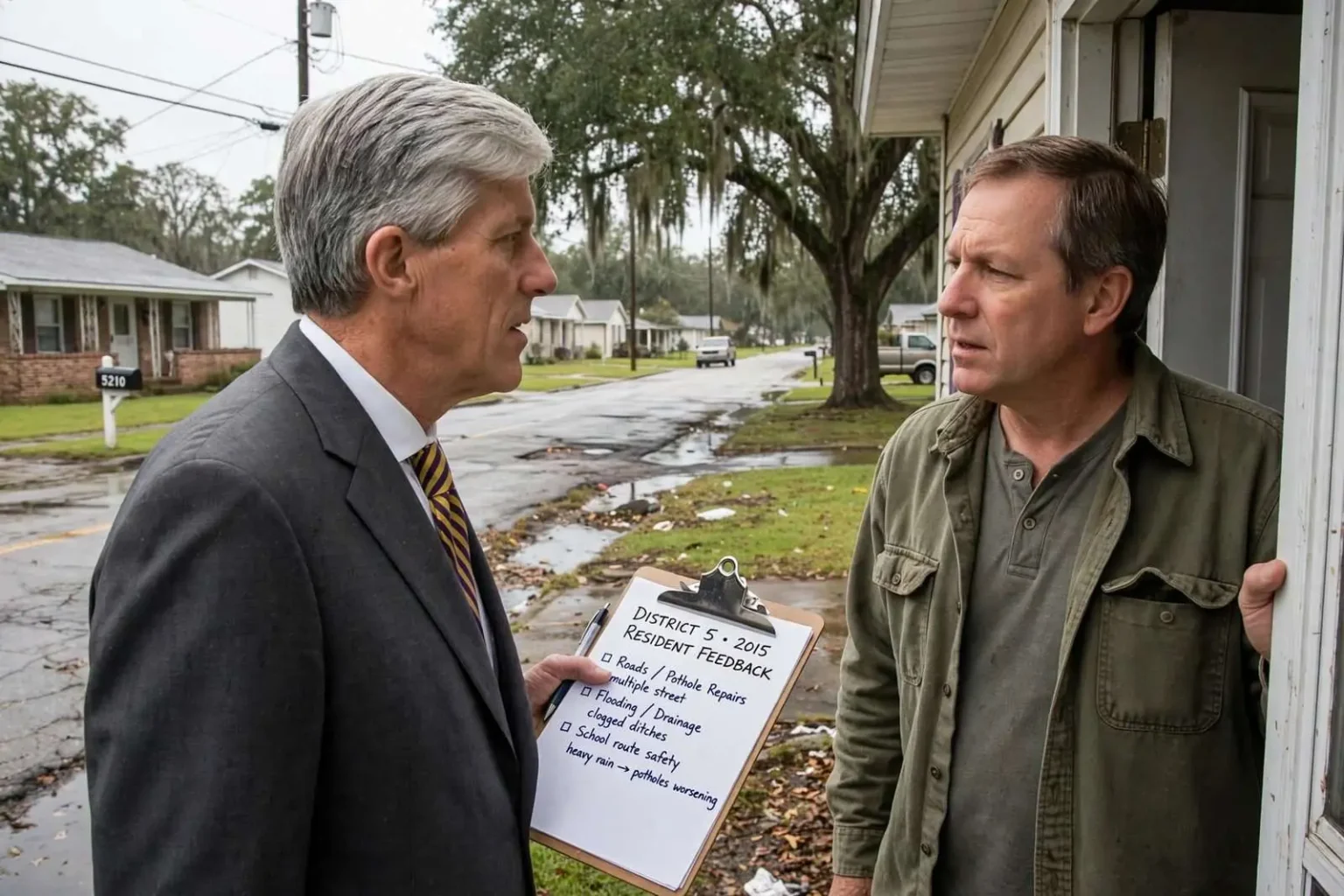
Door to Door, One Street at a Time
Mobile City Councilman Joel Daves says he has spent recent months going door-to-door across District 5 gathering resident feedback, and the results point clearly to two top concerns heading into 2015: deteriorating road conditions and persistent flooding problems. The two issues, residents told him, are not really separate — the same rains that turn a worn street into a patchwork of potholes also fill the ditches and drains that are supposed to carry the water away.
Daves said the direct outreach effort has been central to shaping his priorities for the coming year, giving him a clearer picture of which infrastructure issues residents want addressed first. Rather than relying solely on staff assessments or citywide data, he said hearing directly from constituents at their doors has surfaced specific trouble spots that might otherwise go unnoticed at City Hall.
The approach reflects a conviction about how district representation should work. Mobile’s council members each represent a defined geographic district, and Daves represents District 5 in west Mobile — a stretch of the city that grew rapidly in the second half of the twentieth century, with neighborhoods, schools and commercial corridors that matured together and are now aging together.
That aging shows up first on the pavement. Roads built for a different era of traffic carry decades of wear, and heavy Gulf Coast rainfall accelerates the damage, seeping into cracks, undermining the base layers and leaving potholes that grow from nuisance to hazard in a single wet season. Residents who flagged street conditions for Daves described a familiar cycle: patch, rain, repeat.
Mapping the Work Ahead
Building on that groundwork, Daves plans to hold districtwide meetings throughout 2015 to continue collecting resident input on infrastructure needs. The goal, he said, is to compile a prioritized list of capital improvement projects that can be tackled once $3 million in earmarked funding becomes available in 2016.
That timeline gives the district roughly a year to identify and rank the most pressing projects before construction dollars are actually on the table. The sequencing matters: a prioritized list built from public input, assembled before the money arrives, positions the district to move from funding to bids to work crews without losing a construction season to planning that could have been done in advance.
Road conditions have been a persistent concern in parts of District 5, with residents citing pothole-riddled streets and drainage systems that struggle to keep pace during heavy rain events common to the Mobile area. The city’s location in one of the wettest corners of the United States — Mobile regularly records among the highest annual rainfall totals of any American city — makes drainage an inseparable part of any road maintenance conversation.
Flooding complaints, in particular, tend to cluster around older neighborhoods where stormwater infrastructure has not kept up with development and changing rainfall patterns. Paving added over the decades sends runoff toward systems designed for a smaller, less built-out landscape, and intense bursts of rain can overwhelm pipes and ditches that would have handled a slower, steadier storm of the same total volume.
The consequences reach well beyond wet driveways. Standing water in streets can cut off access for emergency vehicles, undermine road beds from below and leave behind the very pothole damage residents report the following week. In that sense, every flooding complaint Daves collected was also, implicitly, a road complaint — and vice versa — which is why his planning treats the two as a single infrastructure question.
Daves’ remarks were part of a series of year-end interviews Mobile’s seven City Council members gave outlining priorities for their districts heading into the new year. The series offered residents across the city a district-by-district preview of infrastructure spending, public safety and community development priorities council members intend to pursue in the months ahead.
The year-end exercise carries real weight in Mobile’s form of government. With a mayor-administrator structure handling day-to-day operations, the council’s influence shows up most concretely in budget priorities and capital projects — the paving schedules, drainage upgrades and park improvements that residents experience directly. A district’s place in that queue depends heavily on how effectively its council member makes the case.
Mobile’s flooding history gives the district’s concerns a broader frame. The city sits where three watersheds converge on Mobile Bay, and neighborhoods across the city learned the stakes in a damaging flood episode in spring 2014 that swamped streets and homes and pushed stormwater capacity to the top of the municipal agenda. For older sections of the city, the episode was a reminder that drainage systems installed generations ago now face rainfall the original engineers never planned for.
Capital improvement planning is where those pressures get sorted. Cities typically rank projects by factors like the number of residents affected, safety implications, the condition of the underlying asset and the cost of deferral — and Mobile’s process benefits from a year of district-level input precisely because the residents who live on a flooding street know things a condition survey never captures, like which intersections pond first and where the ditches back up.
The $3 million earmarked for 2016 represents a meaningful but not unlimited sum in the world of infrastructure. Paving crews can resurface a substantial list of residential streets with that funding, but major drainage overhauls — new pipes, retention capacity, channel work — consume budgets quickly, which makes the prioritization exercise Daves is proposing the difference between visible progress and scattered repairs.
By emphasizing direct resident engagement now, Daves is positioning District 5 to enter the 2016 budget cycle with a documented, resident-backed case for its projects rather than a wish list assembled at the last minute. The door-to-door record, the districtwide meetings and the ranked project list together form a paper trail that strengthens the district’s hand when funding decisions are made at City Hall.
For residents of west Mobile, the practical message was straightforward: the year ahead is when their input becomes the blueprint. Street by street and ditch by ditch, the district’s 2016 construction calendar will be built from what people told their councilman at the door — and the neighborhoods that speak up loudest in 2015 will be the ones most likely to see crews in 2016.
The cost of waiting compounds in ways residents feel before they see. A residential street that could be resurfaced for a modest sum deteriorates, once the base fails, into a candidate for full reconstruction at several times the price. Drainage is the same story on a longer clock: a ditch that could be regraded for routine maintenance becomes, after enough washouts, a capital project. Municipal engineers across the Gulf Coast describe deferral as the most expensive maintenance strategy available.
Resident reporting also fills gaps that citywide inspections miss. A pothole on a school route, a stretch of road where standing water hides a sunken culvert, a corner that floods every time a certain creek backs up — those details live with the people who drive them daily, and canvassing campaigns like Daves’ harvest them at a scale that complaint hotlines rarely reach, because many residents never call but will talk when someone knocks.
The district’s growth pattern shapes its needs as well. West Mobile’s subdivisions, shopping centers and school campuses were built out over decades of steady expansion, which means the district contains streets of every vintage and condition, from recently rebuilt arterials to originals now pushing their fourth decade. Prioritizing within that mix requires exactly the block-level knowledge the door-to-door effort was designed to collect.
Council members in cities across Alabama have increasingly turned to similar listening campaigns as federal and state infrastructure money flows through competitive processes. A district with documented needs, ranked projects and demonstrated public support is better positioned to capture grants and cost-share programs than one that discovers its priorities only when an application deadline approaches — a reality that turns constituent meetings into practical groundwork.
The coming year’s districtwide meetings will also test a question every growing district faces: whether the loudest issues are truly the most urgent. Potholes generate complaints because they are felt daily; underground drainage problems can go unmentioned until they surface as a flooded living room. Daves’ task in 2015 is to weigh the visible against the latent, and the input gathered from residents will be his map for doing it.
Daves and his colleagues on the council will also have to balance district wishes against citywide equity. Every district in Mobile has its own list of worn streets and aging pipes, and the conversation over where limited paving and drainage dollars land is an annual ritual at City Hall. A district that arrives with clear documentation and broad resident backing has historically fared better in that competition than one relying on anecdotes alone — which is, in the end, the entire logic of spending a year listening before spending the money.