Federal spending bill funds Mobile’s Austal shipyard and Port of Mobile, Byrne says
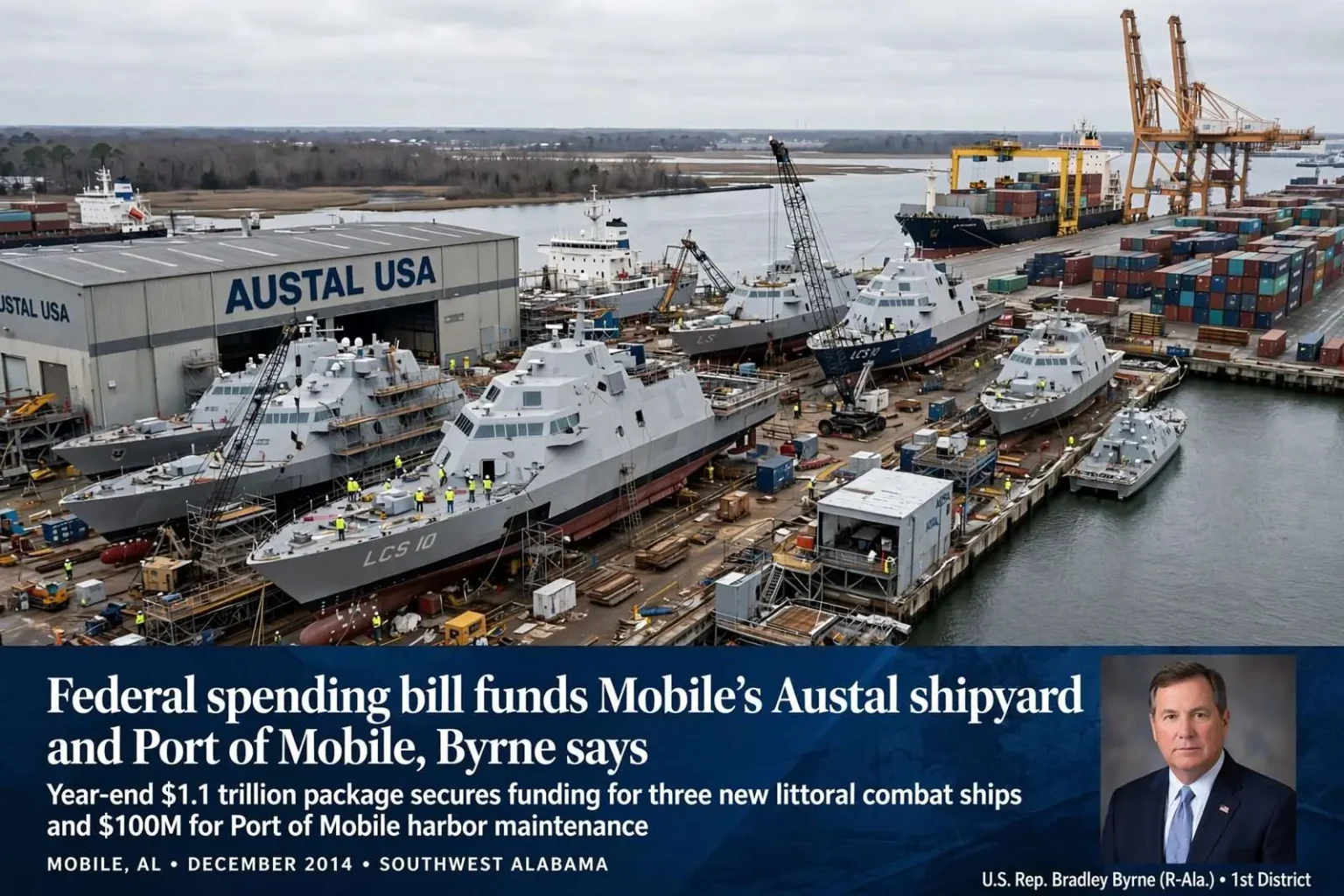
Rep. Bradley Byrne backed a federal spending bill funding three littoral combat ships at Mobile's Austal USA shipyard and $100 million for the Port of Mobile.
A sprawling federal spending package moving through Congress at the close of 2014 carried significant benefits for southwest Alabama, and the region’s congressman said he was ready to support it. U.S. Rep. Bradley Byrne, a Republican from Montrose, backed the roughly $1.1 trillion bill that would keep the federal government funded through the following September and avert a partial shutdown. House Republicans filed the measure after negotiations that produced compromises with Senate Democrats, who still held the chamber for a few more weeks before a new Republican majority took over in January.
The legislation arrived after several years of budget brinkmanship in Washington, when fights over stopgap funding measures, across-the-board cuts and debt ceilings repeatedly pushed federal agencies to the edge of shutdown. Members of both parties described the year-end package as an attempt to restore something closer to a regular budgeting process, combining annual appropriations into a single vehicle that could clear both chambers before funding lapsed. For Byrne, whose district stretches across all of Mobile County and much of Baldwin County, the decisive question was not procedural but practical: whether the bill protected the defense and transportation programs that anchor the coastal Alabama economy.
Byrne, a former member of the Alabama State Board of Education who took office in the U.S. House in 2014, had made military construction and shipbuilding priorities a recurring theme in his first year representing the 1st District. The year-end package gave him concrete results to point to, with multiple line items benefiting the Port City’s industrial base rather than distant projects with no local connection.
A boost for Mobile shipbuilding
The most consequential local provision involved shipbuilding. The bill included full funding for three new littoral combat ships built at Mobile’s Austal USA shipyard, along with $80 million for materials tied to a vessel scheduled for construction in 2016. It also carried money for another Austal-built ship, the Joint High Speed Vessel, a fast, shallow-draft transport the Navy uses to move troops, vehicles and cargo into ports too shallow or too congested for larger ships.
Full funding for all three ships meant the Navy could keep orders flowing to the Mobile yard without interruption, avoiding the kind of gaps in procurement that ripple through a shipbuilder’s supply chain. The $80 million in advance procurement money, meanwhile, allowed the Navy to buy long-lead materials for a future vessel, keeping work moving toward the 2016 construction start.
For a shipyard that anchors thousands of jobs in the Mobile area, the funding represented a major vote of confidence. “It has 100 percent of the money we need to continue to build the littoral combat ship and another Joint High Speed Vessel,” Byrne said in a phone interview from Washington.
Austal USA operates a large production complex along the Mobile River, just downstream from downtown, where it builds the aluminum-hulled Independence variant of the littoral combat ship. The vessel class was designed for operations close to shore, with modular mission packages that can be swapped out for surface warfare, mine countermeasures or anti-submarine work. Alongside the combat ships, the yard turns out the Spearhead-class Joint High Speed Vessel, an aluminum catamaran capable of carrying hundreds of tons of cargo at commercial airliner speed across open water. Together the two programs have made the yard one of the pillars of the Navy’s surface ship industrial base.
The steady stream of Navy work has made Austal one of the region’s largest industrial employers, and continued orders help sustain the broader maritime economy along the Gulf Coast. Shipbuilding jobs reach well beyond the yard’s gates: aluminum suppliers, electronics and systems integrators, pipe fitters, maritime painters and a network of small contractors across Mobile and Baldwin counties all depend on a steady pipeline of naval orders. When Congress funds ships in a single year rather than spacing them out, suppliers can hire with more confidence, and apprenticeship and training programs along the coast have more reason to expand.
Local economic development officials have long treated the shipyard as a cornerstone of the region’s effort to diversify beyond the port’s traditional cargo trade. The presence of a major defense contractor at Brookley and along the river helped recruit other aerospace and advanced manufacturing employers over the past decade, and steady Navy procurement is a key part of the pitch recruiters make when courting companies that supply the shipbuilding sector. Each ship order, in that sense, carries weight far beyond the hulls themselves.
Help for the Port of Mobile
Another provision of local interest increased funding for the Harbor Maintenance Trust Fund by $100 million, money the Army Corps of Engineers can put toward improvements at the Port of Mobile. The trust fund, financed by a federal tax on cargo, was created decades ago to pay for dredging and maintenance of the nation’s deep-draft harbors, but for years Congress appropriated only a portion of the money it collected, leaving ports to compete for a shrinking share of maintenance dollars.
A deeper, better-maintained shipping channel is a longstanding priority for port officials and the businesses that depend on it, making the additional dollars a welcome development for the area’s trade economy. The Port of Mobile handles everything from coal and forest products to containers moving through the modern terminal downriver, and cargo volumes have grown steadily as shippers take advantage of the port’s rail and highway connections. Every additional dollar for harbor maintenance helps the Army Corps keep the ship channel at its authorized depth, which determines how heavily loaded vessels can enter and leave the bay.
Port supporters in the Alabama congressional delegation have argued for years that Gulf ports deserve a larger share of harbor maintenance spending, given the volume of export cargo moving through the region. The additional funding in the year-end bill did not settle that debate, but it moved in the direction port officials had been seeking, and it signaled that Mobile’s channel needs remained on the radar of the lawmakers who write annual spending bills.
The money also matters to the thousands of jobs tied directly to cargo movement — longshoremen, trucking companies, rail operators, tug services and the warehouses spread across Mobile County. When channel maintenance falls behind, shippers face light-loading requirements that raise costs, and the port’s competitive position against other Gulf harbors suffers. Steady maintenance funding protects against that slide and supports the private terminal investment that has followed the port’s growth.
Beyond the local provisions, Byrne pointed to broader policy fights ahead. He said Republicans planned to push harder on spending discipline once they controlled both chambers, favoring a return to passing spending in separate bills rather than one massive package. Under regular order, appropriations subcommittees would craft individual bills for each department, allowing amendments and debate on specific programs instead of forcing lawmakers to accept or reject a single take-it-or-leave-it measure.
He also signaled that his party would renew efforts to roll back parts of the federal health care law and press other priorities after the new Senate was seated. With Republicans holding a larger margin in the House and taking control of the Senate in January, party leaders promised oversight hearings and legislative attempts to scale back the law’s requirements, though any changes would still face a presidential veto. Byrne said Alabama’s delegation would be part of that push while continuing to argue for fiscal restraint across the federal budget.
Still, for constituents in Mobile and Baldwin counties, the practical takeaway was the money flowing toward local shipbuilding and the port. Those investments, Byrne argued, would help protect existing jobs and support the industries that form the backbone of the southwest Alabama economy.
The congressman noted that the bill’s defense and transportation accounts are the portions of federal spending with the most direct local impact. Salaries at the shipyard, contracts for Gulf Coast suppliers, and Army Corps maintenance work on the bay all trace back to those line items, which is why he said he weighed the package largely on what it did for the district rather than on the process complaints he had about how it was assembled.
Byrne acknowledged that the compromise process was not the way he would prefer Congress to operate, but he argued that the alternative — another round of short-term extensions or a shutdown — would have cost the district more than it gained. Federal installations and contractors cannot plan hiring around funding that expires every few weeks, and a lapse would have hit precisely the defense accounts the Gulf Coast depends on.
For the communities along Mobile Bay, the measure means work continuing at the shipyard, dredges staying busy in the channel, and a congressman who said he intends to keep pressing for both when the new Congress convenes. The year-end compromise, he suggested, was not perfect, but it left southwest Alabama measurably better off than a shutdown would have.