Hagel’s Exit Raises New Questions for Mobile-Built Combat Ship Program
Hagel's resignation as Defense Secretary sparked cautious optimism among backers of Austal USA's littoral combat ship program in Mobile.
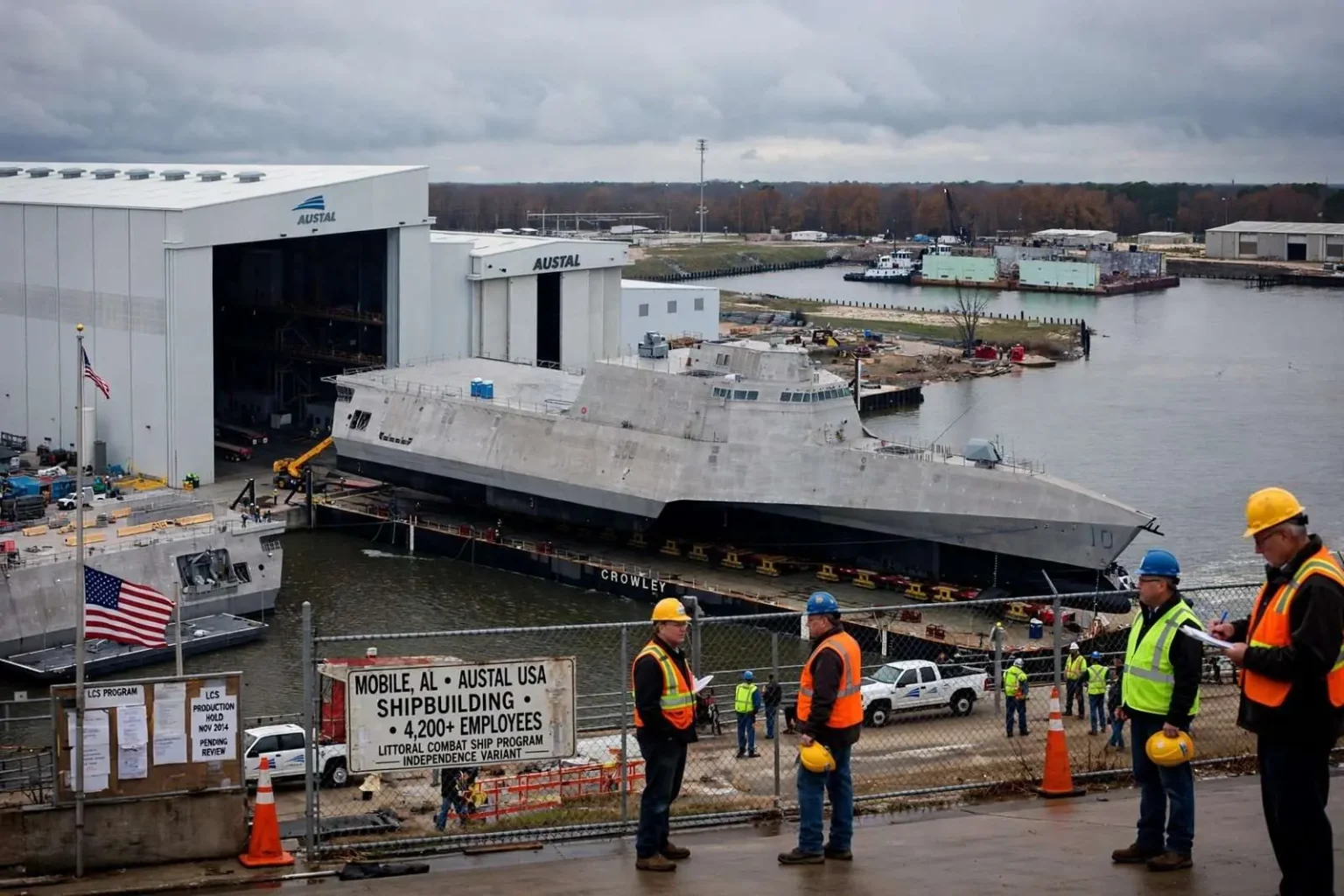
When U.S. Defense Secretary Chuck Hagel announced his resignation in late November 2014, the news rippled far beyond Washington, landing squarely on the docks of Mobile’s Austal USA shipyard. Hagel had spent much of his tenure raising pointed questions about the littoral combat ship program, a fast, shallow-draft vessel built for close-to-shore Navy missions. His departure gave supporters of the program, including U.S. Rep. Bradley Byrne of Fairhope, a reason for cautious optimism.
More than 4,200 workers build littoral combat ships and joint high-speed vessels at the Austal facility in Mobile, making the program one of the region’s largest employers tied to federal defense spending. Earlier in 2014, Hagel had ordered a halt to LCS production after 32 of a planned 52 hulls, forming a task force to study whether the ship’s combat capability needed a redesign. That decision left the future of the remaining 20 vessels, and the jobs connected to them, in limbo.
Byrne, who represents Mobile and much of coastal Alabama in Congress, said he hoped whoever succeeded Hagel at the Pentagon would back the program’s continuation. He argued the ship’s design could still be adapted to satisfy the Navy’s requirements, and he was critical of what he described as indecision from the White House on defense policy more broadly.
Adm. Jonathan Greenert, the Navy’s top uniformed officer, had indicated a decision on the fate of the remaining ships in the program was expected soon, adding urgency to a debate happening well outside the Beltway from the banks of Mobile Bay.
An Austal spokeswoman declined to comment on the personnel change atop the Defense Department.
What happened next
Austal’s Mobile shipyard builds the Independence variant of the littoral combat ship, an aluminum trimaran; the other version, the Freedom variant, is built by a Lockheed Martin-led team at Marinette Marine in Wisconsin.
In December 2014, Hagel accepted the Navy’s recommendation to base the remaining 20 ships on upgraded, more heavily armed versions of both existing LCS designs. Ashton Carter succeeded Hagel as defense secretary in February 2015.