
‘I Accept the Challenge’: Mobile Answers a Senator Who Said Alabama Builds Nothing
A Washington senator told NPR she had never seen anyone in Alabama build anything. Mobile's mayor, a county commissioner and a candidate for governor lined up to correct her, and to defend the tanker bid.
It took one sentence on public radio to unite Alabama’s feuding politicians, and the sentence belonged to a senator from Washington state. Sen. Patty Murray, defending Boeing’s position in the $40 billion competition to build the Air Force’s next aerial refueling tanker, told a nationally broadcast radio program: “I have stood on the line in Everett, Washington, where we have thousands of workers who go to work every day to build these planes. I would challenge anybody to tell me that they’ve stood on a line in Alabama and seen anybody building anything.”
The response from Alabama was immediate, bipartisan and, in places, gleeful. Democrats and Republicans, officeholders and candidates, elbowed one another aside for the chance to be Murray’s most prominent critic. Insult a man’s mother, kick his dog, or question his work ethic — the last of these had just been done to an entire state.
The mayor writes to her doctor
Mobile Mayor Sam Jones bypassed the senator altogether. He addressed his letter to Murray’s “personal physician.”
“Would you please check on your patient?” Jones wrote. “Her recent remarks indicating that she has never seen anybody in Alabama building anything makes me believe that she may be off her medications.”
Beneath the needling was a serious argument. Jones pointed out that Northrop Grumman and its suppliers already employed more than 400 people in Washington state with an annual economic impact of over $500 million, and that a dual award would add some 2,700 more jobs there. He listed Washington suppliers supporting the Northrop tanker: ELDEC in Lynnwood, Honeywell in Redmond, Kaiser Aluminum in Spokane Valley, Accra Manufacturing in Bothell, Exotic Metals Forming in Kent.
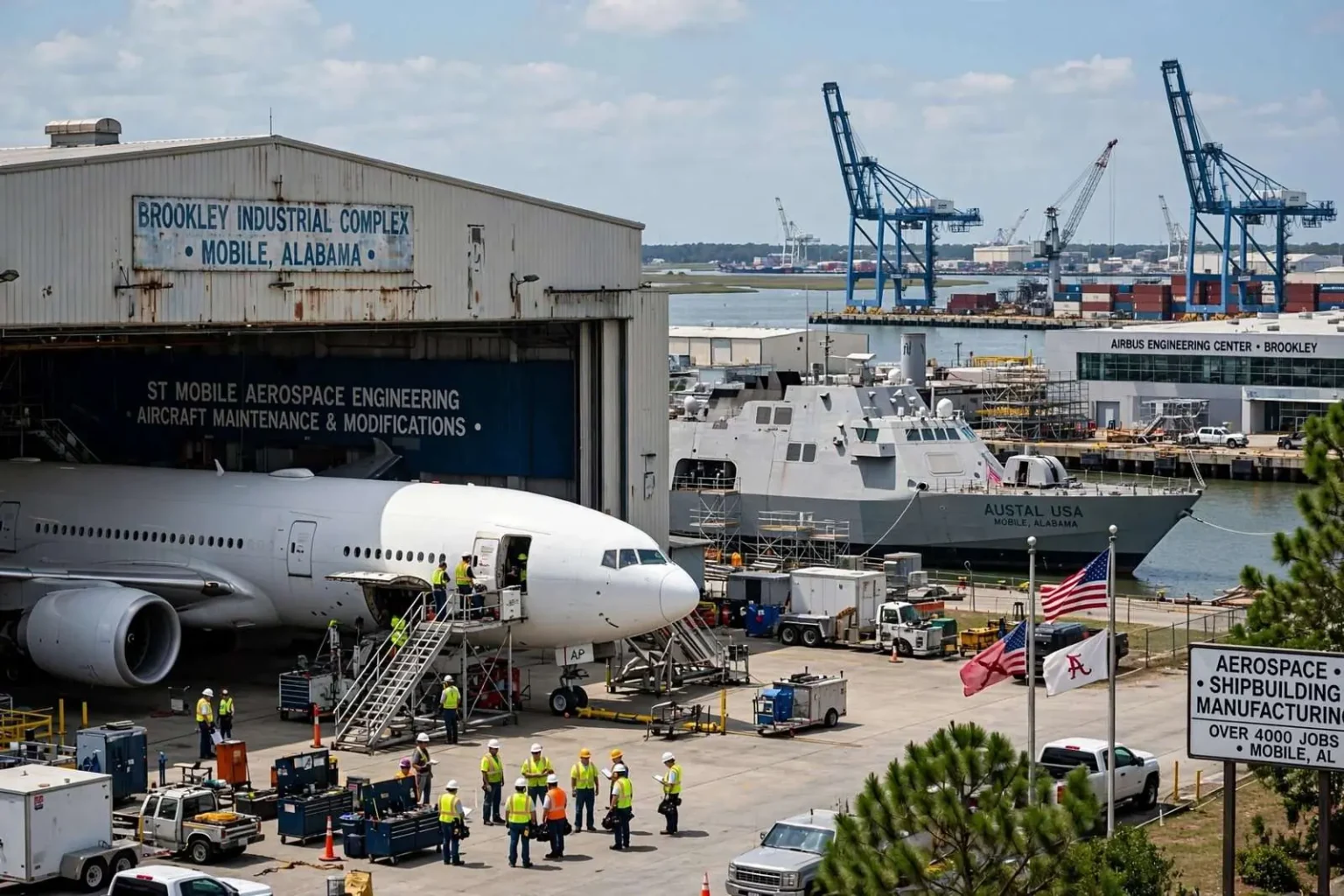
Then he issued an invitation: come to Mobile, tour the plants, walk the deck of the littoral combat ship USS Independence built here by Austal, and visit the aerospace facilities at Brookley Field.
The county commissioner accepts the challenge
Mobile County Commissioner Stephen Nodine took Murray’s dare literally.
“I accept the challenge,” he wrote. “In Mobile, Ala., I’ve stood on a line and seen thousands of technicians keeping what Boeing builds in the air.”
He was talking about ST Mobile Aerospace Engineering at the Brookley Industrial Complex — the city’s largest private employer — where crews performed scheduled maintenance and major modifications on wide-body and narrow-body aircraft, servicing six models of Boeing commercial airliners from the 727 to the 777.
“Maybe the last time you flew to Washington you were on a United Airlines jet repaired in Mobile,” Nodine wrote. Much of the FedEx fleet, he added, had been worked on in Mobile too.
He also pointed to Airbus’s engineering center at Brookley, where scientists were designing next-generation aircraft, and to Airbus Military North America’s new 30,000-square-foot repair and overhaul center near Mobile Regional Airport, which supported the Coast Guard’s C-212 and CN-235 tactical transports.
“Throughout the tanker competition, Boeing supporters such as you and others in Washington state have portrayed Alabamians as simpletons incapable of producing such an aircraft,” Nodine wrote. “This is stereotyping at its worst.”
A candidate offers to pay her way
Bradley Byrne, the Baldwin County Republican running for governor, offered to personally pay Murray’s way to Alabama. He invited her to Huntsville to watch Boeing’s own Alabama workers on the Ground-based Midcourse Defense program, which he said supported nearly 5,600 jobs; to the ThyssenKrupp steel plant north of Mobile, which was about to make Alabama the second-largest steel-producing state in the nation; and to Austal USA, whose aluminum modular process he called the most effective shipbuilding method in the world.
He could not resist the obvious counterpunch. Mercedes-Benz was moving C-Class production from Germany to Alabama, Byrne noted — while Boeing was moving a second 787 line out of Washington state to South Carolina.
“Simply because you haven’t stood on a line and seen Alabamians building world-class products using cutting-edge technology,” he wrote, “that’s no reason to imply that it isn’t happening.”
Sessions goes to the floor
U.S. Sen. Jeff Sessions, professing “great admiration” for his colleague, noted that “the people of Alabama get a little bit offended when people suggest they are not able to produce anything of world-class quality,” and delivered the longest rejoinder of all from the Senate floor.
Underneath the theater lay real money: an aircraft assembly line at Brookley, thousands of jobs, and a decade of industrial development that Mobile had been chasing since the airfield closed.
The tanker contract — for 179 aircraft intended to replace the Air Force’s aging fleet of KC-135 refuelers — was widely understood to be the largest prize Mobile had ever competed for, and the Northrop/EADS bid proposed assembling the planes at a new plant at Brookley, the site of the air base the Pentagon had closed in 1969. Winning it would have converted Mobile’s half-century of aerospace repair and engineering work into full-scale manufacturing, the kind of employment few American cities of comparable size ever get the chance to bid on.
That is what made Murray’s challenge sting so precisely. Mobile’s aerospace credentials were not aspirational; they were operational, built by the same kinds of production and maintenance lines she described in Everett. The workers at ST Mobile had made their living keeping Boeing aircraft flying for years, and the Airbus engineering center had put Mobile into the rare company of cities where commercial aircraft are actually designed, not just serviced.
For Jones, the letter to the “personal physician” did double duty as civic marketing. The mayor’s public correspondence catalogued the Northrop work already flowing to Washington state — jobs and dollars that would grow, not shrink, if the Mobile bid won — undercutting the argument that Alabama’s gain was Washington’s loss. Cities caught up in defense competition fights usually trade such statistics through consultants and lobbyists; Mobile’s edition came wrapped in a punchline, which is why it got read.
The episode also illustrated the unusual politics of the moment. Byrne, a former state senator running statewide, spoke as confidently about Huntsville missile defense and ThyssenKrupp steel as any Washington officeholder, and Sessions — one of the Senate’s most reliable Boeing critics on the tanker — could frame the fight as defense of Alabama’s honor while remaining, by his own account, Murray’s admirer. The competition made strange coalitions across party lines, but it made no distinctions at all between Alabama Democrats and Republicans when the state’s workers were questioned.
Whatever the procurement process ultimately produced, the week’s exchange left one fact on the record for anyone following the contract: if a senator from Everett wanted to know whether anything was being built in Alabama, Mobile’s mayor, its county commissioner, its congressional-era namesake and its senator were all, in their different registers, willing to show her the line.
Mobile’s stake in the answer was easy to state in numbers of its own. A Brookley assembly line would have meant thousands of direct jobs, a supplier wave across the Gulf Coast, and the conversion of a site that had sat partly idle since the base closure into one of the South’s major aerospace campuses. Local leaders had spent years positioning for exactly that outcome — recruiting the Airbus engineering center, expanding ST Mobile’s hangars, and marketing the old airfield’s runways, rail access and port connections as a ready-made industrial address.
Byrne’s itinerary for the senator captured how broad Alabama’s manufacturing base had grown by then. The Ground-based Midcourse Defense work in Huntsville made the state a player in missile defense hardware as well as aerospace, ThyssenKrupp’s mill in Calvert was positioned to reshape the national steel map, and Austal’s modular aluminum construction had already delivered a frontline Navy warship from Mobile’s riverfront. His Mercedes point carried the sharper edge: a German automaker had chosen Alabama for its most important sedan line while the state’s rival bidder in the tanker fight was exporting one of its own production lines out of state.
Nodine’s argument leaned on the maintenance side of the ledger, and it was the factually inconvenient one for the senator. If thousands of Alabama technicians had already been overhauling Boeing airliners — six models, from the 727 through the 777 — and much of the FedEx fleet besides, then the claim that no one in Alabama had ever seen anything being built or kept flying collapsed under its own weight. The irony of Washington-bound travelers possibly riding in a jet repaired in Mobile made the point in a single sentence.
Sessions’ floor speech, the longest of the responses, reflected the significance of the moment for the state’s congressional delegation. Alabama’s senators had spent the competition pressing the case that the refueling fleet was aging, that the Air Force needed the aircraft, and that a domestic industrial base capable of building them should include more than one state. The speech gave the argument its formal record while the mayor’s letter and the commissioner’s challenge supplied the widely shared version around the state.
What united the responses — mayor, commissioner, candidate, senator — was less the theater than the underlying anxiety that a $40 billion contract could be decided by impressions. Mobile was asking to be judged as an industrial city, on its record of aircraft work and shipbuilding, rather than by caricature. That is why the sentence on the radio mattered: it reduced a procurement debate to a question of respect, and Alabama’s politicians, whatever else divided them, agreed on the answer to that one.


