County Turns to New Bond Counsel for $70 Million ThyssenKrupp Incentive Issue
Mobile County tapped Matt McDonald and Brian Cash of Miller Hamilton to handle a $70 million bond issue tied to incentives for the $3.7 billion ThyssenKrupp steel plant in north Mobile County.
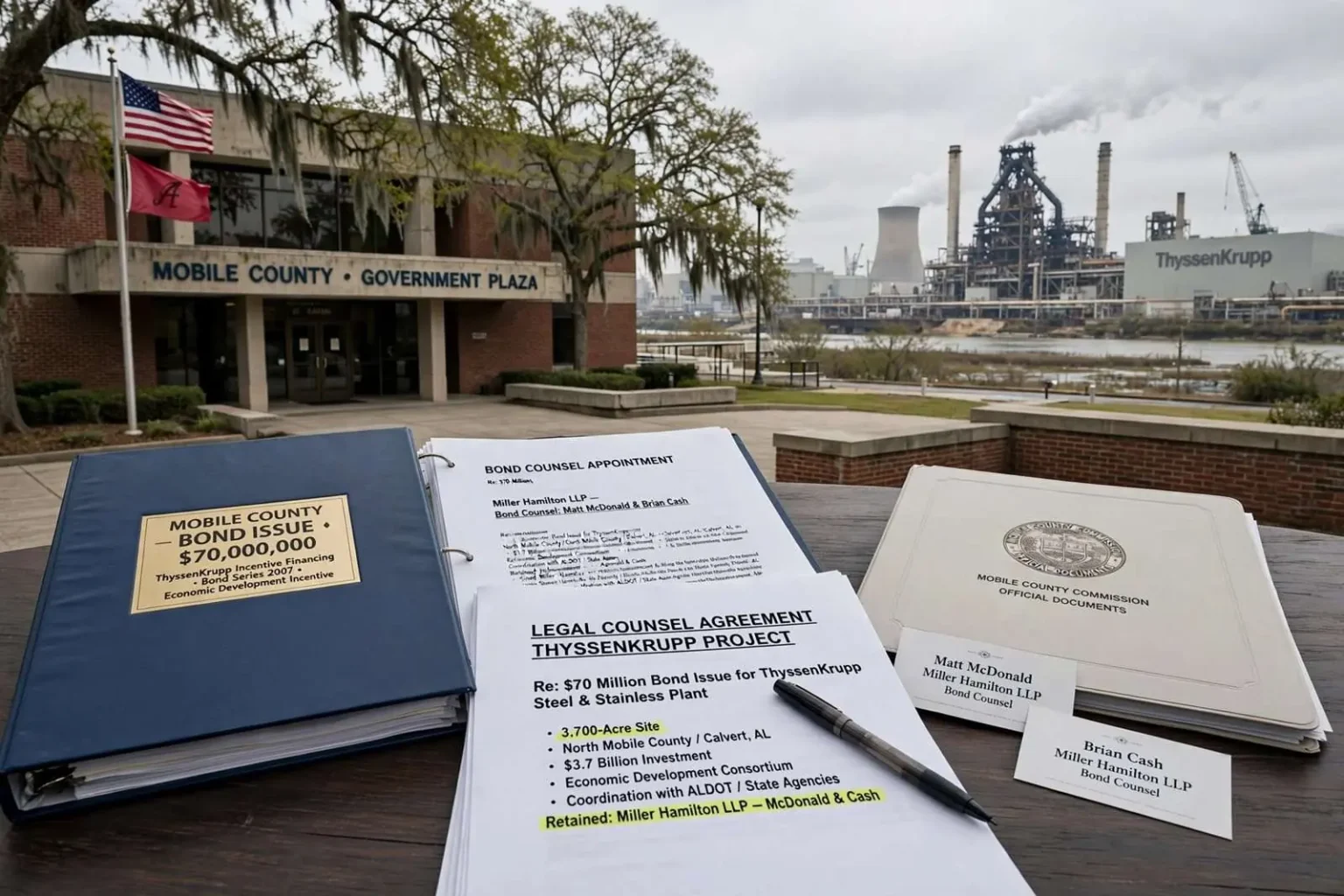
Mobile County selected attorneys Matt McDonald and Brian Cash of the Miller Hamilton law firm to handle the legal work on a $70 million county bond issue tied to the incentive package that landed the $3.7 billion ThyssenKrupp steel and stainless plant in north Mobile County. The choice marked a departure from recent practice: on recent issues, the county’s bond counsel had been Preston Bolt of Hand Arendall.
County Commission President Stephen Nodine said the decision carried no hidden meaning and did not signal a break with the county’s longtime counsel. “We’ve always been satisfied with Preston and we’ll be using Preston again in the future, I’m certain,” Nodine said. “In fact, I don’t think you can count him out totally on this deal.”
Nodine credited McDonald with much of the groundwork that made the deal possible. “Matt and Mark (Erwin) put in a lot of hard work in putting together the (economic development) consortium,” he said. “They did a lot of negotiating with ALDOT.” The consortium — the web of state, county and local agencies whose commitments made up Alabama’s incentive offer — required months of coordination among governments whose pieces had to fit together precisely for the state’s bid to be credible.
Bolt, he noted, had been handling the county’s work on the competition to build aerial refueling tankers — the EADS and Northrop Grumman bid that Mobile civic leaders hoped would bring an assembly line to Brookley Field. “We’re allowing Matt and Brian to work this and plan on using Hand Arendall in the future,” Nodine said. “There is a lot of good counsel out there. We believe in spreading the work as much as we can so the county benefits from all qualified counsel.”
A departure, but a familiar kind of one
The rotation of assignments says something about how Alabama counties manage their legal work. Bond counsel relationships tend to run for years — a firm that knows a county’s outstanding debt, its indentures and its financing history can move quickly on the next issue — and switching firms midstream requires the incoming counsel to get up to speed on weeks of deadlines. By framing the change as spreading work rather than replacing a firm, the commission preserved its relationship with Hand Arendall while giving the lawyers who built the ThyssenKrupp deal the chance to finish it.
There was also a practical logic in pairing assignments with capacity. With the ThyssenKrupp incentives, the tanker competition and a growing capital program all in motion, Mobile County had enough legal work in front of it to keep more than one firm busy. Neither firm could absorb every obligation the county was taking on at once.
The largest industrial prize in county history
The bond issue was one piece of the public commitment behind the largest single industrial investment ever made in Alabama. ThyssenKrupp, the German steel and technology conglomerate, announced in May 2007 that it would build a carbon and stainless steel processing complex on roughly 3,700 acres along the Tombigbee River in north Mobile County, near Calvert. The site offered river navigation, rail lines, proximity to the Gulf Coast industrial corridor and room to build on a scale few American sites could match.
Alabama beat out Louisiana for the project with an incentive package assembled from state, county and local sources — money for site preparation, road and rail access, worker training and infrastructure. The competition had been national in scale and closely watched, with the two Gulf Coast states offering rival packages for a plant that would immediately rank among the largest construction projects in the region’s history. The county’s share required borrowing, and $70 million in bonds was the instrument.
The plant was projected to employ roughly 2,700 people directly at full operation, with thousands more jobs expected among suppliers and contractors, and it reshaped economic expectations across a swath of north Mobile and Washington counties that had seen little industrial investment in decades. For a rural stretch of the county long defined by timber, paper mills and small farms, the announcement marked the largest single economic event in living memory.
Who does the county’s legal work on a bond issue is a question few residents ever consider, but it is not trivial. Bond counsel writes the legal opinions that allow a government to borrow, certifies that the debt is validly issued and, in the case of tax-exempt bonds, that interest paid to investors is exempt from federal taxation. Those opinions are the documents the entire transaction rests on: investors and underwriters rely on them, and a defect in the legal work can follow a bond issue for its whole life.
The role demands a particular mix of skills. Bond counsel must know federal tax law as it applies to municipal debt, state constitutional and statutory limits on borrowing, and the procedural machinery of county government — commissions, industrial development boards, public hearings and elections where required. The work happens under compressed deadlines once a deal is signed, because construction schedules and incentive commitments do not wait for financing paperwork to be finished at leisure.
The firms that do the work earn fees scaled to the size of the issue, and the assignments tend to go to a small number of established practitioners. In a market the size of Mobile County, a $70 million issue is a significant piece of business, and the decision about who receives it carries both professional and civic weight. Spreading the work, as Nodine described it, served two purposes at once: it broadened the county’s bench of qualified counsel and it distributed the fees.
The financing behind the deal
The county’s $70 million share sat within a much larger public commitment. Alabama’s overall incentive offer to ThyssenKrupp was among the largest the state had ever assembled, drawing on state economic development funds, site preparation work, rail and road improvements and training programs. County governments participate because large projects deliver benefits close to home — property tax growth, construction spending, and the suppliers and service businesses that follow a plant — and because the state’s bid is stronger when local governments visibly share the cost.
Bond issues of this kind are typically repaid over decades, often from dedicated revenue sources rather than the general fund, which spreads the cost across the generations of taxpayers who will benefit from the investment. The structures used for economic development incentives have become standard practice across Alabama, and Mobile County’s experience with earlier industrial financings gave it a working template for the ThyssenKrupp issue.
The tanker deal that shares the docket
The other major project on the county’s legal calendar — the Northrop Grumman and EADS bid to build aerial refueling tankers at Brookley Field — helped explain why the assignment moved. The tanker competition, in which Mobile was competing against rival sites for an assembly line that could employ thousands, involved its own web of incentives, land transfers and infrastructure commitments. Bolt’s role on that project kept Hand Arendall deeply engaged with the county’s most consequential economic work even as Miller Hamilton took the ThyssenKrupp financing.
Civic leaders in Mobile had spent years positioning Brookley — the former Air Force base that closed in the 1960s and reopened as an industrial airport — as a home for aerospace manufacturing, and the tanker bid represented the largest potential prize yet. A win would have paired the region’s biggest construction project, the steel mill, with its biggest manufacturing recruitment, and the county’s legal community was effectively working both campaigns at once.
For Mobile County, the assignment of counsel was a small administrative decision inside an extraordinary season: a $3.7 billion steel mill rising on the Tombigbee, a tanker competition approaching decision, and a commission managing more economic development work than it had ever handled. Choosing McDonald and Cash for the bonds and keeping Bolt on the tankers was, in the commission’s telling, simply a way of matching lawyers to the deals they knew best — and making sure that all of the county’s qualified counsel got a chance to contribute.
The selection also reflected a wider pattern in how Alabama’s public-finance bar is organized. The state’s bond work concentrates in a handful of firms with offices in Birmingham, Mobile and Huntsville, many of them descended from practices that financed schools, hospitals and county capital programs for generations. Judges, commissions and boards tend to know these lawyers personally, and reputations travel fast — which is why a commission president can speak about “a lot of good counsel out there” with real knowledge of the field.
ThyssenKrupp’s decision to build in Alabama placed the state among the leading destinations for heavy industry along the Gulf Coast, a corridor that runs from Houston’s petrochemical complex to the shipyards and aerospace plants of the central Gulf. Counties along that corridor have competed for decades using incentives, sites and infrastructure, and Mobile County’s $70 million issue put it squarely in the mainstream of that competition. The bonds turned a county’s promise into money a project could actually use — and made the county a full partner in the largest industrial deal in its history.