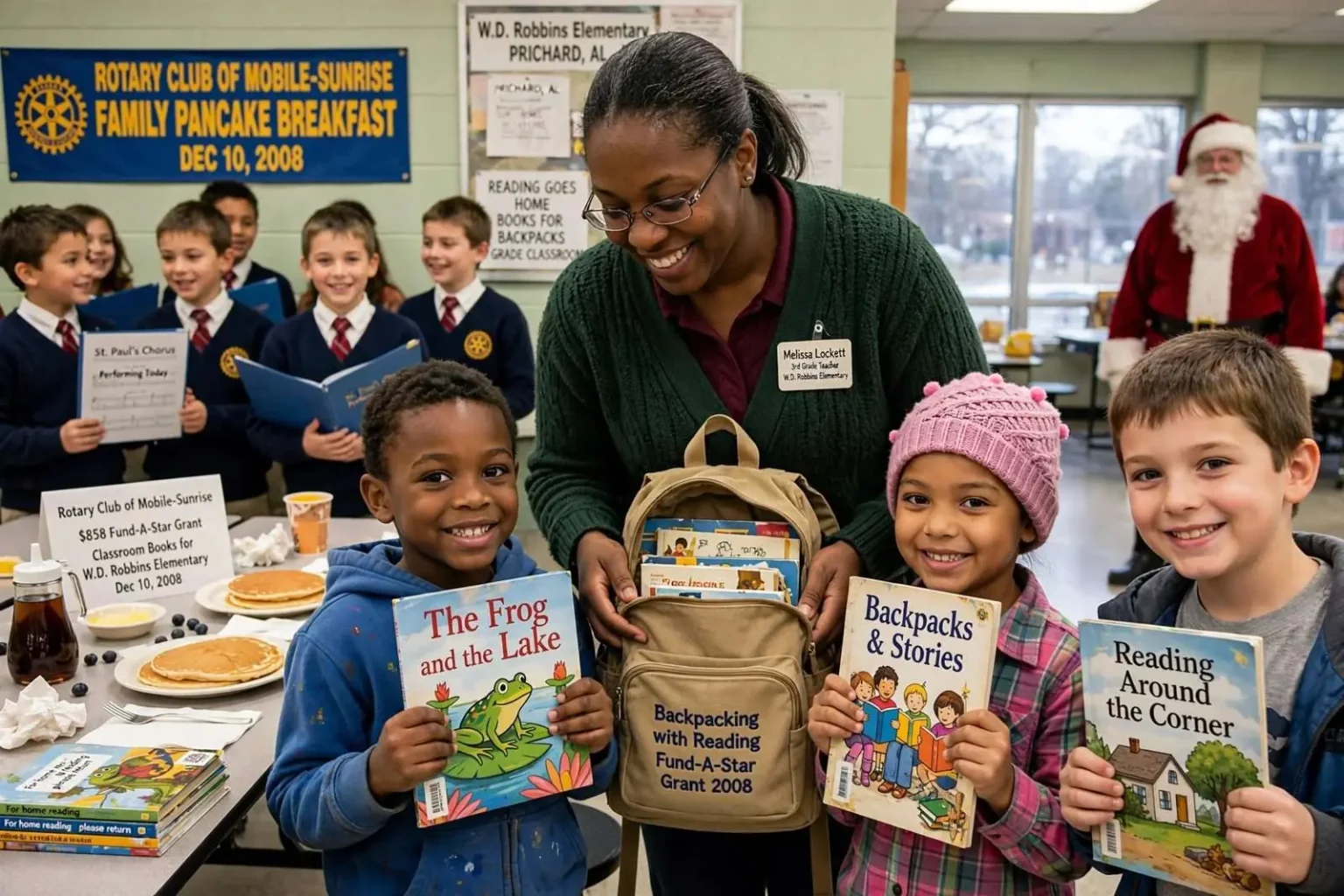
The Rotary Club of Mobile-Sunrise set aside its usual program on Dec. 10, 2008, for one of the club’s oldest and best-attended traditions: the family pancake breakfast, with music supplied by the St. Paul’s Chorus. Members were told to expect a surprise visitor as well, a hint that fooled no one in the second week of December.
The breakfast is the kind of meeting that gives a service club its character — children at the tables, a chorus from one of Mobile’s schools supplying the music, and the club’s usual business agenda set aside for a morning. The visitor in the red suit arrived as expected, and the photographs from that morning show what every December pancake breakfast looks like: syrup, Santa and a room fuller than usual.
But the item in the club’s bulletin that will read best a decade or two on had nothing to do with pancakes. It concerned $858 and a third-grade classroom in Prichard.
Backpacking with Reading
Sunrise Rotary, together with Rotarians Gigi Armbrecht and Jim Frost, sponsored a Fund-A-Star grant of $858 for Melissa Lockett, a third-grade teacher at W.D. Robbins Elementary School in Prichard. The money paid for a project she called Backpacking with Reading.
The idea behind the project is as simple as its name. Books that live in a classroom stay at school; books that go home in a child’s backpack travel into the places where reading habits are actually formed — kitchen tables, bedrooms, waiting rooms, the half hour before bed. Lockett’s grant purchased a set of books designed to make that round trip, week after week, for children whose homes might otherwise hold few.
Photographs circulated to members showed Lockett standing behind her class as the children held up the books the grant had bought. The picture is the standard artifact of a small grant well spent, and it is worth reading closely: eight-year-olds, holding books that did not exist in their classroom two weeks earlier, in a school district that had no budget line to buy them.
The sum is small enough to disappear into a rounding error in a school system budget. In a single classroom, it is not small at all. Fund-A-Star and similar teacher-grant programs exist precisely because the distance between a good idea and the money to execute it is often only a few hundred dollars — and because that distance can be, in practice, impassable.
The grants work by inverting the usual funding path. Instead of a proposal climbing through the district office hierarchy, a teacher writes a specific request for a specific amount, and a club, a business or an individual sponsors it directly. The turnaround is measured in weeks, not fiscal years, and the accountability is built in: the sponsor sees the photographs, meets the teacher, and knows exactly what $858 bought.
A teacher in Prichard in 2008 asking for books to send home in children’s backpacks was asking for something that no line item in a strained municipal school budget was likely to cover. Instructional budgets, when they exist at all, go first to mandated materials — textbooks, testing, compliance — and classroom libraries and take-home programs sit permanently at the bottom of the list, above nothing.
Prichard, immediately northwest of Mobile, had by then spent years struggling with a declining tax base, and its schools carried the consequences. The city’s financial troubles — which would culminate in its nationally noted pension crisis and its decision to stop mailing pension checks altogether — left little room in the municipal ledger for anything beyond survival, and the school system felt that squeeze in every classroom budget.
That context is what makes the arithmetic of an $858 grant worth recording: it bought books for children in a city where books were not a given.
A club’s December ledger
The rest of the bulletin was the ordinary business of a service club in the last weeks of a hard year.
A few slots remained for Salvation Army Christmas kettle bell-ringing on Saturday, Dec. 13, at the Sam’s Club on Airport Boulevard. Members were directed to see club staff or John Thompson to sign up. Kettle duty is the least glamorous work a Rotary club does — two-hour shifts beside a red kettle, ringing a bell in the wind outside a warehouse store — and it is also among the most productive, since the Airport Boulevard location draws holiday shoppers in numbers the Salvation Army could never assemble on its own.
The district still needed volunteers for a Group Study Exchange trip to Peru, scheduled April 15 to May 15, 2009. A Spanish-speaking Rotarian team leader and non-Rotarian team members were being sought, with GSE chair Robin Roberts and Mickey Parish taking names.
Group Study Exchange was one of Rotary International’s signature programs: a month-long cultural and vocational exchange in which young professionals lived and worked alongside their counterparts in another country, hosted by local Rotary clubs along the way. For a young professional on the Gulf Coast, a GSE month in Peru was an experience that no local salary could buy — the kind of trip that surfaces, decades later, in the biographies of judges, doctors and civic leaders.
Suggestions for district governor for 2011-2012 had to be submitted as a formal resolution to past district governor Richard Bollinger no later than Dec. 22.
The deadline matters to the record because it shows how far ahead Rotary plans its leadership. The district governor who would take office in July 2011 — two and a half years after this bulletin was printed — was being identified in December 2008, by a process that required formal resolutions rather than a show of hands. Service clubs run on calendars like this one.
David Randel of the Mobile Bay Convention and Visitors Bureau was booked for Dec. 17, the club’s last meeting of the year. There would be no meetings on Dec. 24 or Dec. 31.
Randel’s slot on the final meeting of the year was quietly apt. The Convention and Visitors Bureau’s job is to fill hotel rooms and restaurants by bringing outside attention to Mobile — conventions, tournaments, festivals — and the club’s own work, from the pancake breakfast to the $858 grant, is a smaller-scale version of the same proposition: that the city’s quality of life is built by people who show up and organize.
The point of the pancakes
Service clubs are easy to caricature — the breakfast, the bell, the badge, the attendance percentage read aloud like a batting average. What the caricature misses is the mechanism underneath. A few dozen people meet weekly for years, and the accumulated familiarity turns into money moved quickly and without ceremony to places that need it: a kettle outside a warehouse store, a scholarship, a set of readers for eight-year-olds three miles up the road in Prichard.
The mechanism depends on the meetings. Rotary’s founders built the organization around weekly attendance precisely so that the trust required to move money informally could accumulate — so that when a member stood up and said a teacher in Prichard needed $858, the room did not need a background check or a committee cycle to say yes. Sunrise Rotary’s December 2008 bulletin, read that way, is a single node in a supply chain that runs from a weekly breakfast to a child’s backpack.
It also depends on the sponsors. Armbrecht and Frost did not simply sign the sponsorship line; their names attached to the grant meant two more people who would look at Robbins Elementary differently afterward, and tell the story in their own circles. Small grants multiply in ways that are hard to trace and impossible to fake — each one converts a donor into a witness.
The 2008 context deserves one final note. December 2008 was the worst month of the worst economic year since the 1930s. Retirement accounts had lost a third of their value, local businesses were closing, and every charitable organization in the country was bracing for a fall in giving. A Rotary club that, in that month, chose to fund an $858 book program for a Prichard classroom was making a small bet against the recession — a declaration that the club’s work would continue at full speed regardless of the headlines.
On the morning of Dec. 10, 2008, the club ate pancakes, listened to a chorus, greeted a visitor in a red suit, and had already sent the books.
That is the whole story, and it is enough. The books went home in backpacks, week after week, through the spring of 2009. The kettle rang on Airport Boulevard on Dec. 13. And somewhere in the club’s records, between the bell-ringing sign-up sheet and the district governor’s deadline, sits the receipt for $858 that bought a third-grade class in Prichard its own library — portable, circulating, and read.