The candidates in waiting
A senator’s indecision is never a private matter. At least three prospective candidates had been circling District 34, and Myers’ answer affected each of them differently.
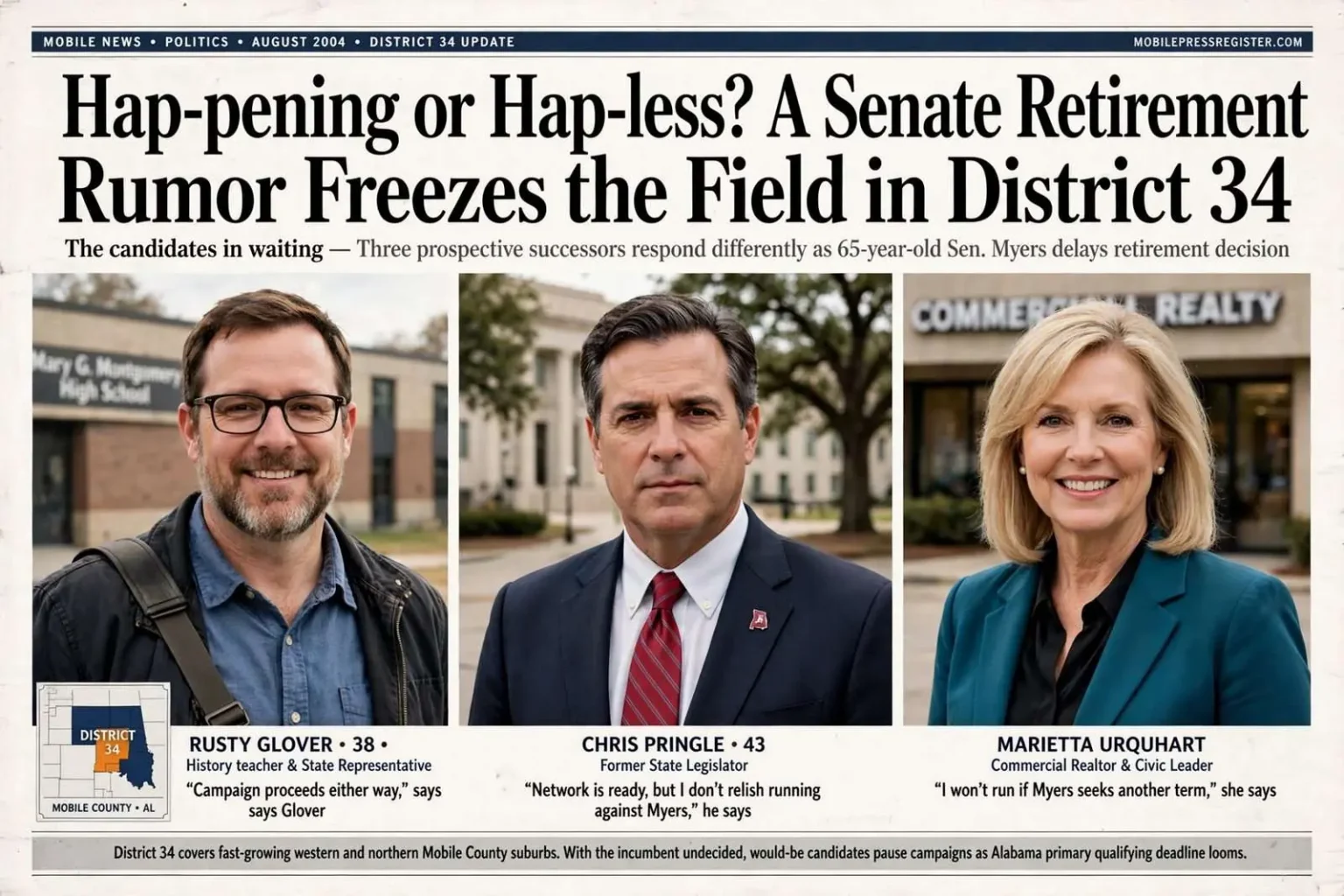
Rusty Glover, then a state representative and a 38-year-old history teacher at Mary G. Montgomery High School, said his campaign for the seat would proceed regardless of what Myers decided. He was running either way.
Chris Pringle, 43, a former state legislator, said he did not relish running against Myers — but that his supporters were lined up to such a degree that his candidacy was likely anyway. Pringle had left the Legislature in 2002 to run for Congress, and his old District 101 House seat was won by Jamie Ison, who defeated Bess Rich for it.
Marietta Urquhart, a Mobile commercial realtor and a leader in a string of community-building projects over the years, took the opposite approach: she said flatly she would not run if Myers sought another term.
Three prospective candidates, three different answers to the same question — a fair illustration of how an incumbent’s mere hesitation can freeze, scatter or accelerate an entire field.
Why the waiting game mattered
Qualifying for an Alabama primary is a scheduled, deadline-driven process, and an undecided incumbent freezes everything around it. Potential challengers must raise money, build organizations and commit their own careers to a race that may never happen. A holding statement like Myers’ — “if I had to make a decision today” — keeps every option open without committing to any of them.
Glover’s answer was the most decisive. A classroom teacher running for the Senate signals a campaign built on a distinct personal profile rather than on an incumbent’s weakness, and running “either way” meant he had already made the calculations about time, money and messaging that the others were deferring.
Pringle’s position was the most complicated. He had given up his House seat in 2002 to challenge for the Republican congressional nomination to succeed the retiring Sonny Callahan, an expensive and bruising contest that ended without a nomination. Losing that race left him without an office but with a network of supporters who had invested in him, and their readiness to back another run made his calculus different from that of a fresh entrant.
Urquhart’s deference reflected the etiquette of Alabama politics as much as strategy. Challenging a respected incumbent of your own party is costly in relationships, and she stated plainly that she would not pay that price if Myers stayed.
The pattern of the on-again, off-again incumbent
Myers had reportedly been on the fence four years earlier as well before deciding to run again — a pattern that gave his latest statement a familiar ring. Legislative veterans in Alabama often oscillate in exactly this way, announcing tentative retirements in off years only to qualify when the deadline nears, because the work of the Senate — and the leverage its seniority provides — is difficult to walk away from.
For District 34’s voters, the practical effect was uncertainty at both ends of the ballot: no one knew until qualifying whether the incumbent would be on it, and the challengers’ own plans could not firm up until he did.
What qualifying means on the ground
Qualifying in Alabama runs on a fixed calendar: candidates file with the state party during a window set months before the primary, and everything — fundraising, organizing, endorsements — keys off that date. For an open seat the window opens a scramble; for an occupied one it starts a countdown. Myers’ phrase — “it’s a long way off though” — was a pointer straight at that calendar, and everyone in the district read it the same way.
State senators in Alabama serve four-year terms in a 35-member chamber and carry two kinds of work. There is the statewide business — the education budget, the General Fund, and confirmation of the governor’s major appointments — and there is the local business, because many matters affecting a county can pass only with the consent of its own legislative delegation. A senator from Mobile County spends much of the session brokering exactly that kind of bill.
For a district covering fast-growing suburbs, the practical agenda is roads, school construction and growth management — the issues that arrive faster in a boom area than any state agency can answer them. Whoever succeeded Myers would inherit precisely that workload.
The age and backgrounds of the three would-be successors were part of the story in their own right. Alabama’s Legislature has long been stocked with classroom teachers, small-business owners and local officials, and District 34’s field reflected the pattern: a 38-year-old teacher-legislator, a 43-year-old former lawmaker rebuilding after a congressional run, and a commercial realtor whose community projects had made her name well beyond her industry.
Rumors of a veteran’s retirement ripple quickly through a district, and each cycle of them sets off the same chain reaction: donors hold back, consultants idle, and local party figures poll their lists. That is what Myers’ non-answer suspended — and what his partial answer, delivered with a hedge, thawed only slightly.
Around the district
Other notes from Mobile and Baldwin politics that August:
A school board president’s lament
Mobile County School Board President Lonnie Parsons, responding to a poll showing largely negative public views of the board, offered a candid assessment: “I think there are some people who aren’t educated enough to know what’s going on with the school board. A lot of them don’t understand the workings of the school board.”
The remark was a striking thing for a board president to say about his own constituents, and it captured the frustration of officials whose fiscal decisions — staffing, transportation, construction — are routinely misunderstood by the public they serve. The proposed Mobile County Public School System budget for fiscal 2004-05 stood at $516 million for roughly 65,000 students — about $7,938 per pupil.
The system is among the largest in Alabama, spanning dozens of schools across the city and county, and its annual budget process — hearings, work sessions and a final board vote — is one of the largest single spending exercises in southwest Alabama government.
Baldwin County’s boom, in numbers
Figures from the Baldwin County Economic Development Alliance, confirmed by its director Lance LaCour, documented an extraordinary run of growth between 2000 and 2003. The share of Baldwin households earning more than $150,000 quintupled, from 0.9 percent to 4.5 percent. Median household income jumped from $25,712 to $42,840; average household income rose to $57,616 from $32,239; per capita income nearly doubled to $23,099 from $12,275.
In 2000, about 18 percent of Baldwin households earned $50,000 or more. By 2003, more than 42 percent did.
The county’s population rose from 140,415 in 2000 to 153,991 in 2003, with a projection of 177,069 by 2008.
The numbers described a county being transformed in real time. Coastal migration from Mobile and beyond, an expanding Eastern Shore real estate market, and retirement and resort development around Fairhope, Gulf Shores and Orange Beach were pulling income and people across the bay at a pace the county had never recorded.
A congressional hire
U.S. Rep. Jo Bonner hired Pringle at $2,000 a month to help his re-election campaign against Democratic nominee Judy Belk, the former Mobile school board member.
The arrangement was notable because both Pringle and Belk had run against Bonner in 2002 — Belk in the general election, Pringle in the hotly contested Republican primary to succeed retiring Rep. H.L. “Sonny” Callahan. Hiring a former primary rival onto the campaign payroll was both a reconciliation and an insurance policy, folding a well-known Mobile name into the incumbent’s operation while keeping him off the 2004 ballot.
Windom stays put, for now
Former Lt. Gov. Steve Windom said talk that he was relocating to Montgomery was premature. He had leased a house there but had not sold his home on Fowl River.
“We probably will eventually be permanently in Montgomery,” he said. “We don’t have any immediate plans to sell our house. … Our mothers and families are still in Mobile.”
Windom lost the 2002 Republican gubernatorial primary to Bob Riley and had since built a thriving lobbying practice.
The leasing-but-not-selling arrangement told its own story: Montgomery practice, Mobile roots. A former statewide officer building a lobbying business in the capital needed a presence there, but Windom’s family, his property and his political identity remained tied to the coast.
The Baldwin numbers also explain why Mobile County politicians watched the county across the bay so closely. Baldwin’s growth was shifting the two-county region’s center of gravity: new residents, new tax base and new commuters whose daily drive across Mobile Bay tied the counties’ politics together. Legislative priorities that once split cleanly along county lines increasingly had to be negotiated as one coastal agenda — highways, bridges, schools and environmental questions that crossed the water in both directions.
The income figures, in particular, marked Baldwin as something more than a bedroom county. A jump of that size in less than four years pointed to an economy adding high-earning households — professionals, retirees and business owners moving in — rather than merely accumulating population. For state legislators, that meant a constituency whose expectations for schools, roads and services were rising as quickly as its numbers.
Windom’s situation, meanwhile, illustrated the standard post-office career path in Alabama politics. A former statewide officer with name recognition and relationships across the Statehouse builds a lobbying practice in Montgomery, where clients pay for exactly the access he spent a career accumulating. The leased house and the unsold home on Fowl River kept his options open in both capitals — and kept his name alive in Mobile political conversation regardless of where he slept.
Why District 34 mattered
Alabama Senate District 34 sat in the fast-growing western and northern reaches of Mobile County — territory whose voters had been steadily reshaping local politics through the 1990s and 2000s. A seat there was worth waiting for.
Senate districts in Alabama elect one member each to a 35-member chamber, and Mobile County’s districts had for decades reflected the county’s shifting population, with growth in the western suburbs steadily redrawing the political map. Whoever held District 34 held a vote on the budgets, local legislation and statewide priorities that shaped the coast.
In 2004, three politicians were doing exactly that — waiting — and one 65-year-old senator was in no hurry to tell them how long the wait would be.