Sessions Takes the Senate Floor to Defend Alabama Workers and the Mobile Tanker Bid
U.S. Sen. Jeff Sessions used a Senate floor speech to answer a colleague's slight against Alabama workers and to argue that the Pentagon had rewritten the aerial tanker bid rules against the aircraft that would be built at Brookley.
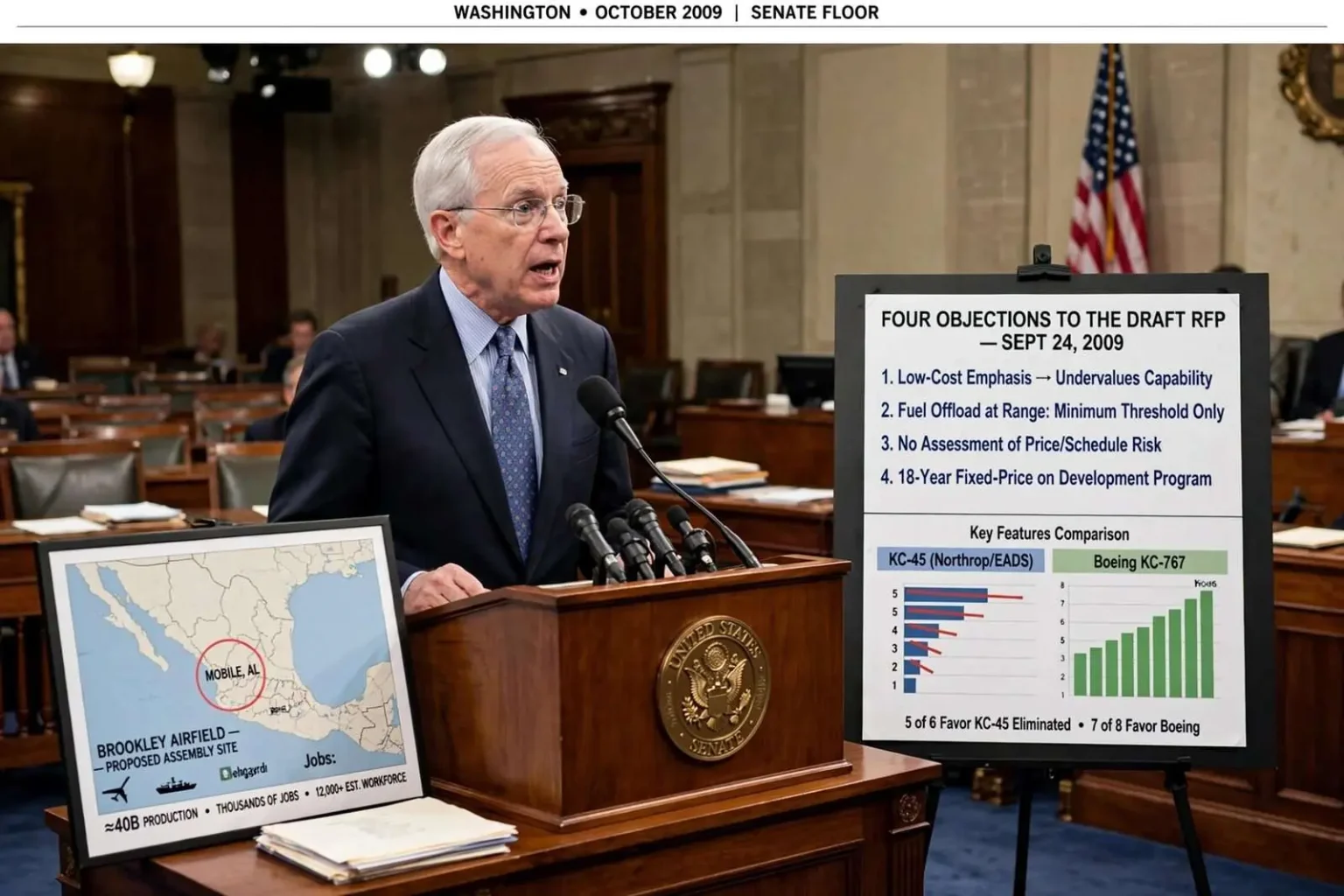
WASHINGTON — U.S. Sen. Jeff Sessions took the Senate floor this week to answer, at length and with charts, a colleague who had suggested that Alabamians do not build anything — and to press a far more consequential charge: that the Pentagon had rewritten the rules of the largest procurement competition since World War II in a way that favored one bidder over the other. The contract at stake was the Air Force’s KC-X aerial refueling tanker, a program worth roughly $40 billion. If Northrop Grumman and EADS won it, the aircraft would be assembled in Mobile, at the old Brookley airfield on the western shore of Mobile Bay. If Boeing won, the work would go to Everett, Washington.
Few procurement fights have ever landed with this much force on a single city. A $40 billion production line meant assembly buildings, tooling, suppliers, and thousands of jobs that would be spent somewhere in America for decades. For Mobile, which had watched the Brookley field close as an active base a generation earlier and had spent years courting aerospace work to replace it, the tanker was the prize that could remake the city’s industrial map. Sessions understood that better than almost anyone in the chamber, and his speech was built to show that the contest’s rules — not just its rhetoric — had changed.
Answering the Slight
Sessions began with the remark that had inflamed Alabama for a week. Sen. Patty Murray of Washington had told National Public Radio: “I have stood on the line in Everett, Washington, where we have thousands of workers who go to work every day to build these planes. I would challenge anybody to tell me that they stood on a line in Alabama and seen anybody build anything.”
Sessions, who said he held Murray in “great admiration,” observed that “the people of Alabama get a little bit offended when people suggest they are not able to produce anything of world-class quality.” He reminded the chamber that the Saturn V rocket that carried men to the moon was developed in Alabama; that Mercedes, Honda, Hyundai and Toyota all build automobiles in the state; and that in Mobile workers had just built a trimaran warship capable of 40 knots — a reference to the littoral combat ship then coming out of the Austal USA yard on the Mobile River.
Brookley itself, he said, was ready. The field had closed as a military installation four decades earlier, but the runway, the deep-water access, the rail and the interstate were all still there, and an aerospace engineering center had already been built on the site. The old airfield sat on a peninsula jutting into Mobile Bay, with rail service and barge access few competing sites could match, and city and county officials had spent years assembling the land and permits that a manufacturer of this scale would require. Workers at Austal had shown that a Gulf Coast yard could deliver to exacting military specifications, and the state’s auto plants had proven the same at automotive scale. The runway at Brookley, unused for airlift for decades, remained one of the longest such assets on the northern Gulf coast.
Four Objections to the Draft RFP
The bulk of the speech was a methodical attack on the Defense Department’s draft request for proposals, released Sept. 24, 2009. Sessions organized his complaints into four themes: the evaluation method rewarded lowest cost rather than best value; that approach built in a bias toward a smaller, less capable aircraft; the government had declined to assess price and schedule risk; and the contract mechanism — an 18-year firm fixed-price arrangement — was wrong for what was, in practice, a development program.
His central claim was arithmetic. Of the six key features that had favored the Northrop/EADS KC-45 in the previous competition, he said, five had been eliminated or made non-mandatory in the new draft. Meanwhile eight features of the Boeing aircraft were upgraded, with seven of the eight ending up in Boeing’s favor.
“The very sad conclusion I have had to reach,” Sessions said, “is that this closely watched competition was altered with a purpose, and that purpose was to favor one bidder over another.”
He was particularly exercised that fuel offload at range — in his words, the very reason a tanker exists — would no longer earn a bidder additional credit beyond a minimum threshold equal to that of the 50-year-old KC-135 the new plane was meant to replace. Under the draft rules, he noted, if one aircraft cost 1.1 percent more than the other, its extra capability would not even be weighed. To tanker crews and air force planners, that was the heart of the matter: a refueling aircraft is judged by how much fuel it can hand off, how far from home, and whether it can do both while protecting itself. A scoring method that stopped counting capability past a minimum threshold, Sessions argued, was scoring something other than the mission.
The firm fixed-price structure drew equal scrutiny. An 18-year fixed-price contract on an aircraft still in development shifts the risk of engineering surprises from the government to the contractor — which sounds disciplined until the contractor, facing losses it cannot reprice away, cuts corners or walks. Sessions told his colleagues that development programs almost never unfold exactly as drawn, and that pretending otherwise in the contract language was not fiscal prudence but an invitation to failure.
The History Behind the Fight
Sessions reminded his colleagues that the tanker program had already produced a scandal: Boeing and Defense Department employees were prosecuted, and some imprisoned, over an earlier attempt to lease tankers on a sole-source basis. That episode, uncovered in the early 2000s, had cost officials their careers and forced the competition to be reopened — a history that made every subsequent procedural choice subject to unforgiving scrutiny.
After the 2008 award to Northrop/EADS, Boeing filed 111 complaints; the Government Accountability Office sustained eight of them. The Pentagon, Sessions argued, had responded not by fixing those eight flaws but by rewriting the competition wholesale. He also noted that the Air Force had released Northrop Grumman’s pricing data to Boeing after the last competition and had declined to release Boeing’s data to Northrop — an asymmetry he called a taint on the price competition.
The GAO’s sustained complaints had covered matters ranging from how capability requirements were weighted to how cost estimates were treated, and the Air Force had promised a revised, cleaner contest. What emerged instead, in Sessions’ telling, was a document tilted the other way — enough so that the senator’s charts, laid out on the floor, traced the movement of each requirement from the old draft to the new one and asked the chamber to draw its own conclusion.
What It Meant in Mobile
For Mobile, the stakes were measured in thousands of jobs and a generation of industrial development at Brookley. The city had spent years courting the aerospace industry, and the tanker was the anchor tenant that would justify everything else — the suppliers, the engineering graduates kept in the state, the second and third phases of industrial investment that follow a production line once it is running. Local leaders had repositioned the Brookley complex as an industrial aerospace park precisely for a moment like this, and no one in the room where those plans were drawn had mistaken the tanker bid for an ordinary recruitment target.
The statewide argument carried its own weight. An assembly plant drawing on the state’s existing automotive and shipbuilding workforces — workforces assembled over two decades of foreign auto plants and, in Mobile’s case, a growing shipyard — offered the Air Force a labor pool with proven experience in large-scale advanced manufacturing. That was the case Alabama’s delegation made quietly in meetings and, on this day, loudly on the Senate floor.
Session members from Washington state pressed back with equal force, and the exchange made plain how little of the fight was really about tankers and how much was about which state’s economic future the contract would underwrite. For Alabama, though, the arithmetic of the argument was the point: a procurement worth $40 billion should be decided by what the aircraft can do and what it costs over its life, not by which congressional delegation shouts loudest. The charts on the floor were meant to show that on its own terms, the rewritten contest no longer did that.
Sessions closed by telling the Senate the matter was important enough that he would return to it. He was right about that. The tanker fight would consume Alabama’s congressional delegation for another year, outlasting the draft RFP’s flaws and the chairman who oversaw them, and ending — after a re-fought competition — with the aircraft, and the assembly line, coming to Mobile after all. The floor speech became one of the fixed points in that long argument: the day Alabama’s junior senator documented, line by line, how a competition meant to be open had been steered, and made the chamber listen.