Young Democrats to Host Mobile Mayoral Candidate Forum
The Young Democrats of Mobile scheduled a public forum for the city's four mayoral candidates at the Boilermakers union hall on Government Street, with moderated questions and audience Q&A.
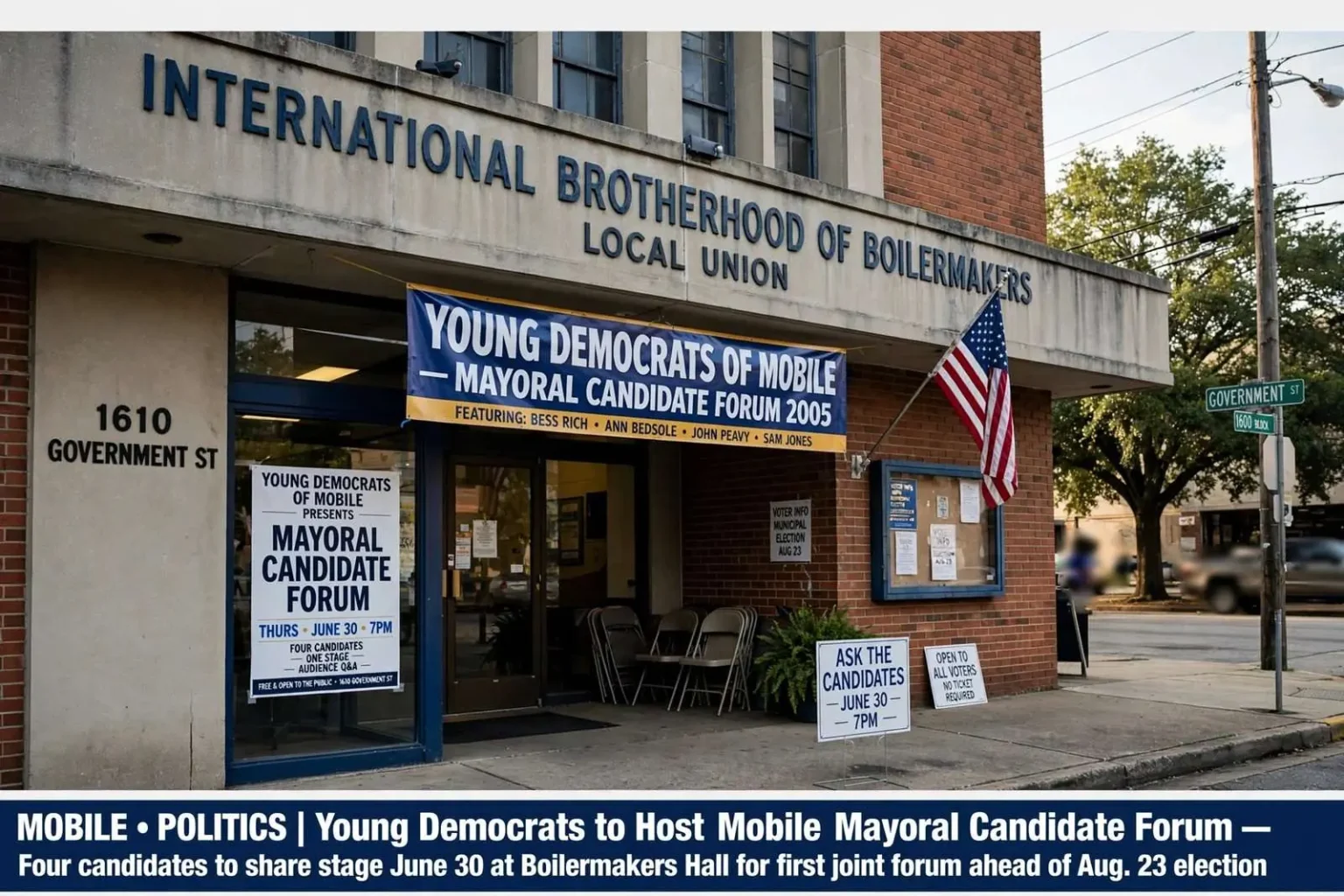
The four candidates seeking to become Mobile’s next mayor were invited to share a stage on Government Street, as the Young Democrats of Mobile announced plans to sponsor a public mayoral forum ahead of the city’s municipal elections. The forum was set for 7 p.m. Thursday, June 30, in the hall of the International Brotherhood of Boilermakers local union at 1610 Government Street. The event was free and open to the public.
The announcement landed at a moment when voters had few chances to see the candidates side by side. With an open seat and a crowded field, most early campaign activity consisted of fundraisers, yard signs and one-on-one introductions — formats in which a candidate controls the message and the room. A shared stage, moderated by someone else and open to anyone who walked in, was different, and the Young Democrats positioned it as the first substantive test of the summer.
An hour of questions, then the audience
Organizers laid out a structure designed to give voters more than a string of stump speeches. The program called for each candidate to deliver opening remarks, followed by an hour of moderated questions. The final thirty minutes were reserved for a direct question-and-answer exchange between the candidates and members of the audience. Closing remarks would end the evening.
That second half — the open exchange with the room — was the part that made such forums unpredictable, and the part that drew crowds. In a citywide race with no incumbent, an unscripted question from a resident of Toulminville or west Mobile could put a candidate on record in a way that no controlled campaign event ever would. Moderators can trim a question; a neighbor who has waited through a season of flooded streets cannot be trimmed, and everyone in the hall knows it. Political professionals in Mobile have long treated the audience segment of a candidate forum as the closest thing local politics offers to an honesty test.
The structure also imposed its own discipline on the candidates. An hour of moderated questions rewards command of specifics, while the open exchange rewards temperament. Voters watching a candidate answer a hostile question learn as much from the tone as from the content, and in a four-way race, temperament can be the tiebreaker.
For the Young Democrats of Mobile, the forum was also a statement of purpose. The organization, part of a national network of party youth groups, has historically used candidate forums and voter registration drives to carve out a role in a city whose municipal elections give party organizations no formal place on the ballot. Hosting the field in June — two months before Election Day — put the group at the center of the conversation at the exact point when most voters were still deciding whether to pay attention.
The field
Four candidates had emerged by the time the forum was announced: Bess Rich, a former Mobile City Council member who had run for mayor once before; Ann Bedsole, a former state senator with a long record in Montgomery and in Mobile civic life; John Peavy, a sitting Mobile City Council member representing District 7; and Sam Jones, a veteran Mobile County commissioner. Each entered with a distinct base. Rich carried name recognition from her years on the council and a record of challenging the establishment; Bedsole brought the longest resume in state government and a network built over decades of civic work; Peavy offered sitting-city-hall experience and a constituency in the district he represented; Jones carried the profile of a countywide officeholder who had dealt with roads, drainage and budgets that dwarfed anything the city council touches.
All four were competing to succeed Mayor Mike Dow, who had decided against seeking a fifth term after sixteen years in office. Mobile’s municipal elections are formally nonpartisan, and the ballot carried no party labels — a detail that made a forum hosted by a Democratic organization something other than a partisan endorsement event. Three of the four candidates had run for other offices as Republicans; Jones had spent his county commission career as a Democrat. In practice, the labels mattered less than the networks behind them, and the Young Democrats’ invitation to all four reflected that reality: in a nonpartisan city race, the party’s role is to convene, not to crown.
Why a union hall
The choice of venue was itself a piece of Mobile political geography. The Boilermakers hall sat on Government Street, the spine that runs from downtown out through midtown, and organized labor — particularly the trades tied to the shipyards, the port and the industrial plants along the river — had long been a durable force in local elections. Holding the forum there put the candidates in front of an audience with direct stakes in the city’s industrial economy and in the wages that flowed from it.
For a candidate for mayor of a port city, that audience was not optional. Mobile’s economy runs on the water: the State Docks, the shipbuilding and repair yards up the Mobile River, the chemical and paper plants that line the waterways and the trucking and rail lines that feed them. The trades that build and maintain that infrastructure answer roll calls in every municipal election, and candidates who dismiss union halls as one more stop on the circuit do so at their peril. A union hall crowd asks different questions than a chamber of commerce luncheon — about apprenticeships, about prevailing wages on city projects, about what happens to jobs when a plant closes — and the answers given at 1610 Government Street would be repeated in break rooms the next morning.
Government Street itself carried symbolic weight. It connects the seat of county government and the downtown business district to midtown neighborhoods that have watched decades of reinvestment concentrate closer to the water. A forum held along that corridor, in a working hall rather than a downtown ballroom, signaled that the campaign was expected to travel the whole length of the street — and of the city.
What was at stake
The 2005 campaign was the first genuinely open contest for the mayor’s office in a generation. Dow’s long tenure had reshaped downtown, brought a convention center and a cruise terminal to the waterfront, and made industrial recruitment the centerpiece of the city’s economic strategy. His departure opened an argument about what should come next: whether the city should keep pressing on big projects and business recruitment, or turn its attention and its budget toward drainage, streets, police and fire service in the neighborhoods.
That argument was already visible across the city by June. Residents in flood-prone neighborhoods could measure the last sixteen years in the water that backed up into their streets during heavy rains; downtown boosters could measure them in the cranes on the skyline and the ships at the cruise terminal. Every candidate in the field would spend the summer trying to claim both inheritances — the growth and the grievance — without conceding either one to an opponent.
Candidate forums in that summer served as the main public venue for that argument. With the general election set for Aug. 23 and a runoff expected on Sept. 13 if no candidate cleared fifty percent, each appearance carried weight in a race that was widely expected to be decided by turnout and by which candidate could assemble a coalition across a city divided by geography, race and income.
The arithmetic of a four-way race shaped everything. With no incumbent and four credible candidates, the most likely path to the mayor’s office ran through a runoff, which meant the summer’s real contest was not to win the Aug. 23 vote outright but to survive it — to consolidate enough of a base to advance, then expand. A strong showing at a June forum would not decide anything by itself. What it could do is establish which candidates belonged on the same stage in September.
Organizers asked that anyone wanting further information call 643-1717. The forum was scheduled to run roughly two hours, with the doors at the Boilermakers hall open to any resident of the city who wanted to come and listen — no ticket, no reservation, no campaign contribution required. In a municipal race, that accessibility is the point: the electorate in an Aug. 23 city election is assembled one forum, one church meeting and one neighborhood association at a time, months before most voters think about a ballot.
The host organization had its own reasons for keeping the event open and unfiltered. Young Democrat chapters across Alabama have historically measured their influence not by endorsements but by access — by being the group that reliably draws all the candidates to one room and keeps the questioning honest. A closed or staged event would have undercut that franchise entirely. An open hall, with union members and neighborhood residents in the chairs, gave the June 30 forum its value both to the party organization and to the candidates, each of whom could claim a credible appearance before a cross-section of the city.
For voters, the practical takeaway was simple: four candidates, one roof, and thirty minutes in which anyone in the hall could ask anything. Residents weighing whether to attend had only to consider what the summer’s campaign had lacked so far — a direct, unscripted look at how the four contenders handled pressure — and what the June 30 forum promised to supply.
A durable habit on the Gulf Coast
Forums of this kind — free, open, held in a union hall or a church fellowship room rather than a hotel ballroom — remain one of the more durable features of municipal politics along the central Gulf Coast. From Prichard to Daphne, from Mobile’s midtown to Gulf Shores, the format survives because the stakes are personal and the scale is human: a city hall election is close enough to daily life that a candidate’s answer about garbage collection or drainage is worth an evening in a folding chair.
Two decades on, the pattern holds: in a city election with no incumbent and no party label to guide voters, the candidates go where the people are and answer questions face to face. Party organizations host because they must, to matter; unions host because their members’ wages ride on city contracts and port jobs; neighborhood associations host because they have learned that the time to pin down a future mayor is before the election, not after it. The June 30 forum at the Boilermakers hall fit squarely in that tradition — a modest room on a long street, four candidates who wanted to lead the city, and an audience free to ask them why.
What the forum would not do is settle the race. With the Aug. 23 general election still weeks away and a Sept. 13 runoff looming if no candidate won a majority, the evening was a first test, not a verdict. But first tests matter in a field of four, where the difference between a runoff appearance and an early exit can be measured in the handful of voters who watched a candidate answer a hard question well — and remembered it six weeks later at the polls.