Lt. Gov. Ivey Tours Austal USA Shipyard in Mobile, Touts Job Growth
Lt. Gov. Kay Ivey toured Mobile's Austal USA shipyard, highlighting Navy shipbuilding work and thousands of local jobs.
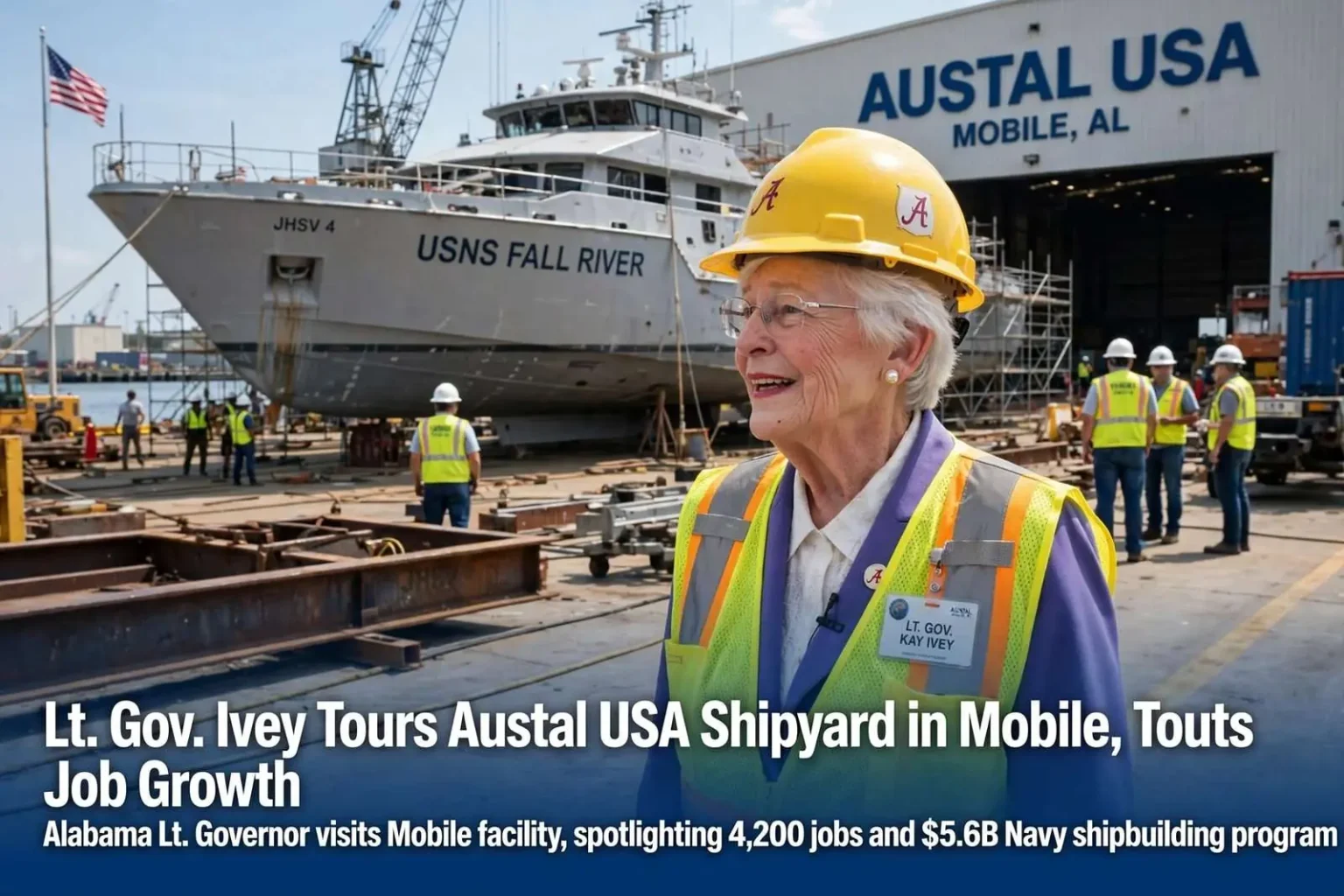
Alabama Lieutenant Governor Kay Ivey visited the Austal USA shipyard in Mobile this week, using the stop to spotlight the shipbuilder’s role as one of the region’s largest employers and to argue that the state’s job picture is improving.
Austal USA’s Mobile facility employs roughly 4,200 workers and is currently building 10 joint high speed transportation vessels and 12 littoral combat ships for the U.S. Navy, part of a shipbuilding program worth more than $5.6 billion. All of the vessels under the current contracts are scheduled for completion by the end of 2019, making the yard one of the busiest industrial sites on the Gulf Coast.
During her tour, Ivey walked the shipyard’s assembly line and was shown the USNS Fall River, a twin-hull catamaran transport vessel built for the Navy. The ship, which will carry a crew of 22, is scheduled to depart for Japan within the week.
Ivey praised the shipyard’s workforce, describing the employees as skilled and hardworking. “It’s obviously hardworking, well-trained folks with all types of job skills,” she said, adding that the ships being built at the yard “speak well for our national defense.”
The visit came as Ivey, a Republican seeking re-election against Democratic challenger James Fields in the November election, pointed to statewide unemployment figures as evidence of economic improvement. She noted that Alabama’s unemployment rate stood at 9.3 percent when she took office in January 2011 and had fallen to 6.9 percent by August, a decline she attributed in part to job growth at facilities like Austal USA.
Alabama’s rate at the time remained above the national unemployment rate of 5.9 percent, and only a handful of states, including Oregon, California, Michigan, Tennessee, Nevada, Rhode Island, Mississippi and Georgia, reported higher unemployment than Alabama. North Dakota had the nation’s lowest rate at 2.8 percent.
Fields, campaigning against Ivey, pushed back on the rosier framing, saying young Alabamians were still leaving the state in search of work elsewhere because local job opportunities remained limited.
A separate economic outlook survey from PNC Financial Services Group, released around the same time, found only about one in 10 small businesses nationally planned to add full-time employees over the following six months, and characterized Alabama’s near-term sales and profit outlook as “cautious” compared with the spring 2014 forecast.
Despite that broader caution, Ivey pointed to continued private investment in the state as a sign of momentum, saying that hundreds of large and small firms had already invested to create jobs in Alabama and that more announcements were expected.
About Austal USA
Austal USA is the American arm of Australian shipbuilder Austal, which is based in Henderson, Western Australia. The joint high speed vessels built in Mobile, including the USNS Fall River, were later redesignated by the Navy as Expeditionary Fast Transports. The yard’s littoral combat ships are the aluminum-trimaran Independence variant.