Gateway to the Gardens: Stimulus Money Could Reshape the Springhill Avenue Corridor
Federal stimulus dollars are set to resurface Springhill Avenue from I-65 to Municipal Park. A councilwoman wants to add median landscaping and turn the stretch into a proper entrance to Mobile's cultural core.
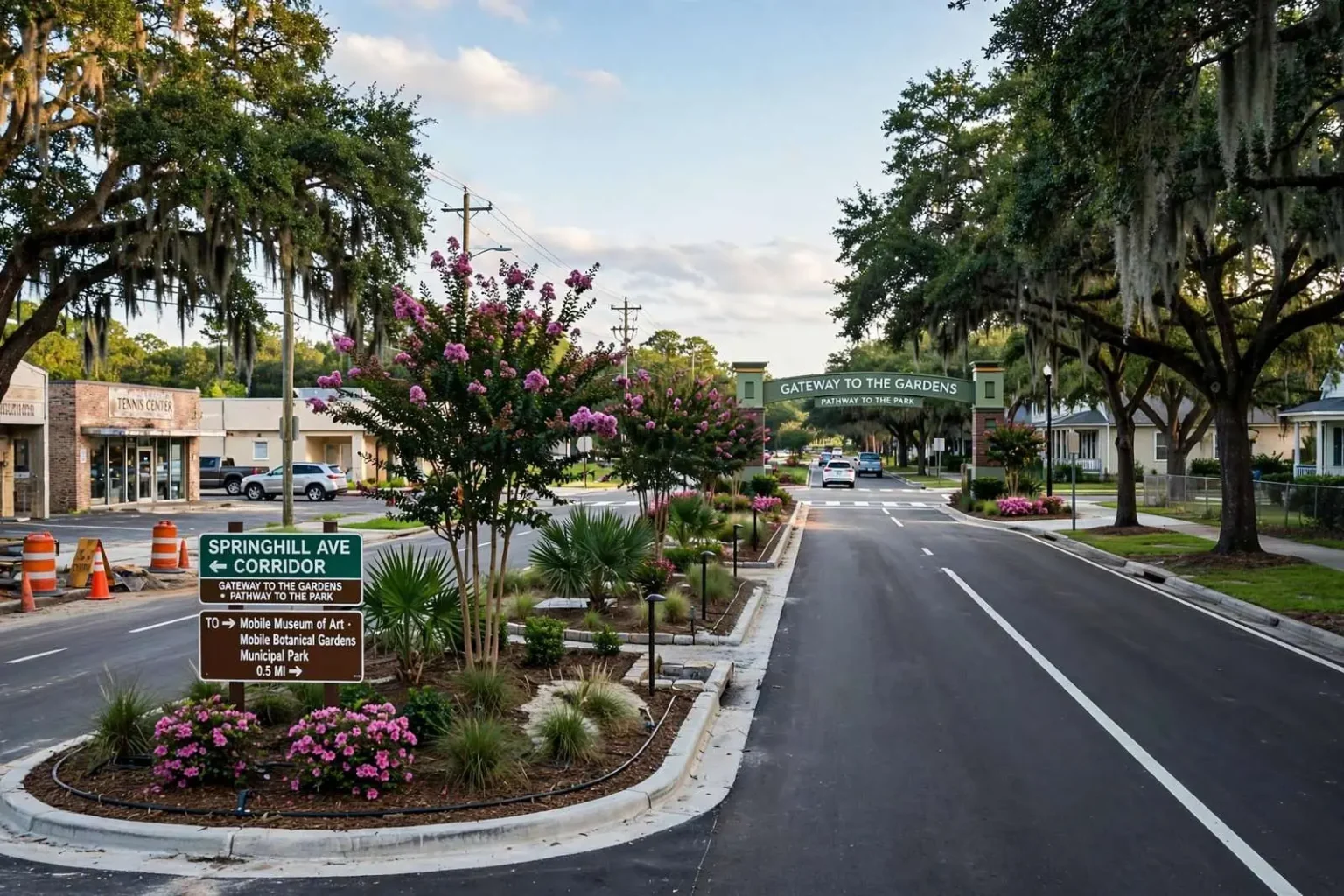
Gateway to the Gardens. Pathway to the Park. Tennis Way. Golf Drive. Boulevard of the Arts. None of those names has been adopted, and perhaps none ever will be. But the fact that people in Mobile are trying them out says something about what is being contemplated for a two-mile stretch of Springhill Avenue — and about how a routine paving project has turned into a conversation about what kind of entrance this city deserves.
The brainstorming names have a common thread: each one describes what actually sits along the corridor rather than what a marketing consultant might wish were there. Springhill Avenue’s eastern end brushes against one of the densest concentrations of public cultural and recreational facilities in Mobile, and the people floating names are essentially asking whether the street should acknowledge that fact — in signage, in landscaping, in the way the road itself is built — or continue functioning as an anonymous connector between the interstate and the neighborhoods east of it.
Naming campaigns like this one have a practical purpose beyond branding. A named, branded corridor can compete for grants more effectively, appear on maps and wayfinding systems, and give residents a shorthand for advocating improvements. Cities across the country have converted ordinary arterial streets into branded gateways — signed, landscaped, and marketed as destinations — and the exercise usually begins exactly the way this one has: with a list of candidate names that force the community to decide what the corridor is actually for.
Pavement First
The concrete proposal is unglamorous: resurface Springhill Avenue from Interstate 65 east to Municipal Park, using money from the federal stimulus package passed earlier this year. Road resurfacing is the workhorse category of stimulus spending — shovel-ready by definition, quick to bid, quick to finish, and easy to justify. Cities across the country have used the American Recovery and Reinvestment Act to catch up on deferred paving they could not otherwise afford, and the federal law’s designers understood that reality: the fastest way to move money into local economies was through projects that already had engineering plans, right-of-way and public support in place.
Mobile is no exception. The city’s street maintenance backlog has grown through lean budget years, and a federally funded repaving of a major east-west artery is money the city does not have to find in its own general fund. Springhill Avenue carries heavy daily traffic between I-65 and the neighborhoods and institutions east of the interstate, and its pavement has aged past the point where patching suffices; a full resurfacing resets the road’s condition for a decade or more and eliminates the jolting ride that residents have endured along worn sections. The project’s cost, absorbed by federal money, frees local paving dollars for residential streets that would otherwise wait years.
The federal program’s rules shaped which projects qualified. Money flowed fastest to jurisdictions that could put crews on the ground within months, which meant resurfacing, signal work, sidewalk repair and bridge rehabilitation dominated allocations nationwide. Mobile’s transportation requests were prepared against that standard, and a two-mile resurfacing of a heavily traveled arterial fit the profile exactly — benefits measured in safety and ride quality, jobs counted in construction employment, and completion within a single construction season.
The Idea Underneath the Asphalt
What has attracted attention is the possibility of doing more than laying asphalt. City Councilwoman Gina Gregory said she would look into additional funding to incorporate median beautification into the project — landscaping the center strip so the corridor reads as an entrance rather than a thoroughfare. Median landscaping on a repaving project costs a fraction of what it costs when attempted independently, because the crews, traffic control and closures are already mobilized; the incremental expense is mostly plant material, irrigation and design. That sequencing logic is what makes the moment significant: the corridor will be torn up once, and everything the city wants to add to it is cheapest to add now.
The argument is one of geography. A visitor coming off Interstate 65 and heading east on Springhill Avenue is, without knowing it, driving straight into Mobile’s concentration of public amenities. Within a short radius sit the Mobile Museum of Art, the Playhouse in the Park, the Mobile Botanical Gardens, the Azalea City Golf Course, the municipal tennis center and the youth ballfields of Municipal Park. It is, in effect, the city’s cultural and recreational front door. It simply does not look like one.
That mismatch between what the corridor contains and what it communicates is the heart of the proposal. Drivers on Springhill Avenue pass commercial strips, older apartment complexes and scattered signage, with no indication that a turn to the south leads into Langan Park and the museum, or that the gardens and the golf course sit within a few minutes’ drive. Visitors who arrive for one destination routinely miss the others, and residents who live along the corridor describe a street that feels like a boundary between places rather than a route connecting them. A landscaped median, directional signage and a consistent visual identity would not change the traffic counts — they would change what the corridor says about the city it serves.
Why Medians Matter
Median landscaping is the sort of civic investment that is easy to mock and hard to argue against on the merits. The mockers note that mowing season never ends, that irrigation systems fail, that crepe myrtles and seasonal plantings demand budgets year after year. But the record from cities that have invested in landscaped medians is consistent: they calm traffic by visually narrowing the roadway, they raise adjacent property values, they give commercial corridors a cohesion that scattered development otherwise lacks, and they signal to residents and visitors that the city maintains standards. The cost argument, measured against the corridor’s daily traffic volume and the presence of major public institutions, is modest.
The maintenance question has a practical answer in the corridor’s own geography. Plantings along a gateway route can be designed for low water use and seasonal color from species that thrive on the Gulf Coast — the same palette the Botanical Gardens showcases a few minutes away. Adopt-a-median partnerships with civic groups and garden clubs, which several Southern cities have formalized, distribute maintenance labor and create local ownership of the corridor’s appearance. What matters in the design stage is choosing a planting scheme the city can actually sustain, because a neglected median communicates failure more loudly than an unimproved one.
The Amenities Behind the Gateway
Each of the destinations the proposed names point toward draws a distinct audience, and together they give the corridor a visitor base that most arterial streets never see. The Mobile Museum of Art, set in Langan Park, anchors the cluster with rotating exhibitions, a permanent collection spanning centuries, and programming that brings school groups through year-round. The Playhouse in the Park, adjacent to the museum grounds, stages community theater seasons that fill its auditorium on weekend nights. The Mobile Botanical Gardens, with its nationally noted collection of azaleas and its year-round plant sales, draws gardeners from across the central Gulf Coast.
The Azalea City Golf Course serves the city’s daily golfers and junior programs, while the municipal tennis center hosts leagues and tournaments that bring out-of-town players — players who eat downtown, stay in local hotels and otherwise never think about Springhill Avenue. Municipal Park’s ballfields carry thousands of youth-league families each season, arriving in waves on weeknight evenings and weekend mornings. The pattern that emerges is a corridor that already functions as a destination district, but performs that role invisibly, with each institution pulling its own traffic and none of them benefiting from the others’ presence on any sign, map or streetscape.
Coordinated wayfinding would compound those audiences. Cities that have signed their cultural clusters report measurable cross-visitation — museum-goers discovering the gardens, tennis players returning for gallery openings — because directional signage converts the incidental into the intentional. The gateway concept would formalize that: visitors exiting I-65 would know within the first mile that they had entered a district of public attractions, with consistent signage directing them to each.
Funding the Vision
Gregory’s search for additional funding reflects the practical arithmetic of the project. The stimulus allocation covers the roadway work; medians, signage and streetscape elements would need separate sources — federal enhancement grants, state transportation alternatives funding, or municipal capital budget lines. Enhancement-style grants, which fund exactly the category of beautification and wayfinding work contemplated here, have historically favored projects that connect to larger transportation investments, and a resurfaced gateway corridor would present a strong application. The sequencing also matters for the city’s budget: if beautification is deferred and attempted later as a standalone project, the city would pay full mobilization costs and endure a second construction disruption on the same street.
The councilwoman’s district includes the corridor, and her involvement signals that the project has an advocate inside the city’s budgeting process. Council districts in Mobile control significant discretionary capital spending, and the willingness to chase external funding rather than simply accepting the pavement-only scope is what separates corridors that become landmarks from corridors that become smoother versions of what they were.
Residents along Springhill Avenue have their own stake in the outcome. A corridor that reads as a destination district changes the economics of the commercial properties lining it: visibility improves, vacancies become more attractive to tenants who want gateway exposure, and the residential streets that feed the corridor benefit from a slower, calmer arterial fronting them. Neighborhood associations in the area have historically engaged on paving and drainage issues; a beautification plan gives them a new agenda item with visible, near-term results.
From Names to a Plan
Whether any of the proposed names survives the process is almost beside the point. The exercise of trying them out — Gateway to the Gardens, Pathway to the Park, Tennis Way, Golf Drive, Boulevard of the Arts — has already done its work by forcing a definition of the corridor’s identity. Whichever name or none is adopted, the underlying question will be answered by what gets built: medians planted or not, signage installed or not, and the street treated as an entrance or left as an arterial.
The resurfacing project itself will proceed on its own timeline regardless, delivering the tangible benefits federal money was designed to produce: a smoother, safer two-mile artery, construction-season employment, and a decade of deferred maintenance erased from the city’s backlog. The beautification question rides alongside it, and its resolution will depend on whether grant applications succeed and whether the council, once the bids and budgets are in front of it, chooses to spend the incremental dollars while the corridor is open.
What the conversation demonstrates is how a city’s self-image gets renegotiated through projects this size. Mobile has spent years marketing its historic districts, its waterfront and its festival economy; the Springhill Avenue discussion extends that effort inland, to the corridor where thousands of daily drivers enter the city without knowing they have arrived anywhere in particular. The names being tried out are the first step in deciding whether that entrance will finally say what it has long contained — that two miles east of Interstate 65, a driver is passing the front door of Mobile’s public life.