
Jo Bonner Ruled Out a Run for Governor, Choosing Appropriations Over Montgomery
U.S. Rep. Jo Bonner announced in February 2009 that he would not seek the Republican nomination for governor in 2010, ending months of speculation and clearing the field for other contenders.
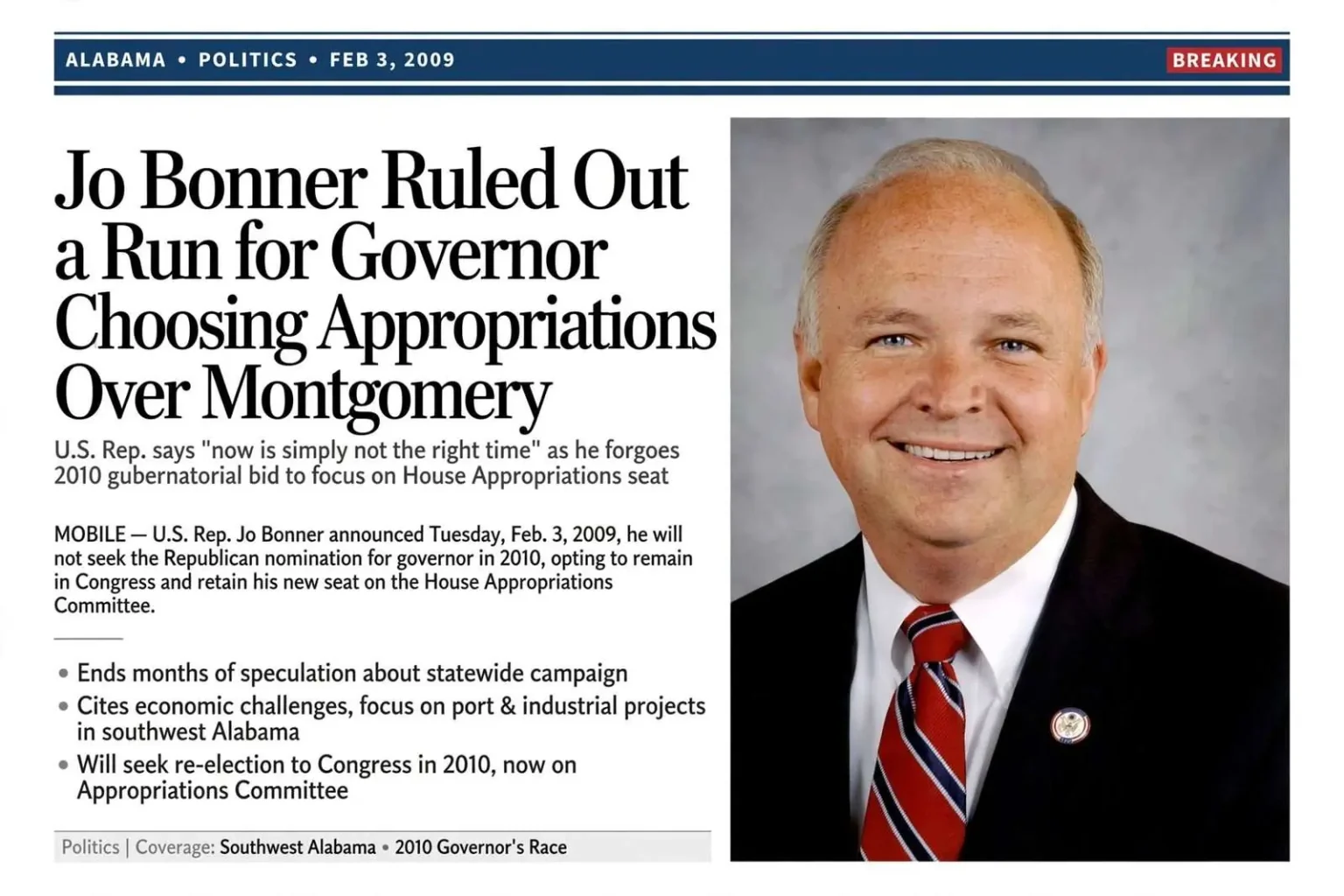
U.S. Rep. Jo Bonner announced on Tuesday, Feb. 3, 2009, that he would not be a candidate for the Republican nomination for governor of Alabama in 2010, ending months of speculation about the political plans of southwest Alabama’s congressman. The decision, delivered in a reasoned written statement rather than at a press event, kept one of the state’s most respected Republican officeholders out of a race that was already attracting a crowded and unpredictable field.
‘Now Is Simply Not the Right Time’
“Over the past several months, countless people from all corners of our state have encouraged me to run for governor next year,” Bonner said in a statement, calling the encouragement and the offers of financial support both flattering and humbling. “But after a lot of serious thought and consideration, as well as many heartfelt prayers, [my wife] Janée and I have concluded that now is simply not the right time to launch a statewide campaign,” he said. Bonner said he could best serve south Alabama, and the state, by continuing to represent Alabama’s First District, and that he intended to seek re-election to Congress in 2010.
The announcement landed in Mobile’s political world with a mixture of relief and disappointment. Party donors and business leaders who had quietly encouraged Bonner to make the jump lost their strongest homegrown option for the state’s top office, while constituents who valued his accessibility and his growing influence in Washington gained certainty that their congressman would stay put.
The Calculation Behind the Decision
Two considerations ran through the congressman’s statement. The first was the economy. “Our country is facing some serious economic challenges, we are still fighting on two battlefields in the ‘war on terror,’ and southwest Alabama has not been immune from either of these two facts,” he said. Bonner argued that the region had won historic economic development commitments during the six years he had worked alongside Gov. Bob Riley, and that seeing those projects through required his full attention. “I believe I can best focus my attention on fulfilling the promise of some of these projects if I am not dividing my time between being a full-time congressman and traveling through all 67 counties as a candidate for governor,” he said.
The reference to economic development commitments was not abstract. By early 2009, southwest Alabama was in the middle of the most consequential industrial transformation in its modern history, with the Airbus assembly line at Brookley, the ThyssenKrupp steel mill under construction in north Mobile County, and major expansions along the port and shipbuilding corridors all representing jobs and capital that had been promised but not yet delivered. Those projects had come together through years of coordination between the governor’s office, the congressional delegation and local economic developers, and Bonner’s argument was essentially a promise to finish what had been started rather than trade a seat of influence for a longer shot at a different one.
The second consideration was seniority. Bonner had recently claimed a seat on the House Appropriations Committee, the panel that writes federal spending bills — an assignment that, given his relative youth and the district’s history of long congressional tenures, pointed toward considerable influence over time. Giving that up for a statewide race that he might lose was a steep price. Appropriations seats are among the scarcest commodities in Congress, and for a district whose previous representatives had built decades-long careers, the committee assignment represented exactly the kind of clout that south Alabama had learned to value: the ability to shepherd federal spending toward port projects, military installations and research programs across the region.
The congressman also cited the burden a statewide campaign would place on his family. The Bonners had two children, a 13-year-old daughter, Lee, and a son, Robins, who was nearly 11. Bonner noted that he was leaving the following day with a small congressional delegation traveling abroad on national security matters, and said he looked forward to thanking service members in person.
A Nod to Riley
Bonner closed with an endorsement not of a candidate but of a record. “It is absolutely vital to Alabama’s future that we elect someone next year who will build on the successful foundation that has been laid by Gov. Bob Riley,” he said, calling Riley the best governor in the state’s history and expressing hope that Republicans would rally behind whoever could best continue his agenda. The remarks positioned Bonner as a guardian of the Riley legacy without committing him to any of the contenders who would eventually compete for it — a careful stance that let him stay above the fray while the primary took shape.
The Field He Left Behind
Bonner’s withdrawal reshaped an unsettled race. Greenville businessman Tim James, a Republican and the son of former Gov. Fob James, was the only announced candidate at that point. Other Republicans said to be weighing a bid included state Treasurer Kay Ivey, two-year college chancellor Bradley Byrne and Troy University president Jack Hawkins. Each brought a different base: Ivey the treasurer’s office and years of statewide name recognition, Byrne the reformist energy of the two-year college system he had been hired to clean up, and Hawkins a network of alumni and supporters spread across Troy’s campuses.
On the Democratic side, attention was concentrated on U.S. Rep. Artur Davis of Birmingham, who had all but formally announced; Lt. Gov. Jim Folsom Jr.; and state Agriculture Commissioner Ron Sparks. The contrast between the parties’ benches was stark — Democrats offering a youthful, nationally connected congressman against two established statewide officeholders, Republicans sorting through a field of ambitious but unproven candidates in search of a frontrunner.
The 2010 race would ultimately be won by Robert Bentley, a Tuscaloosa dermatologist and state representative who was not yet part of the conversation in early 2009. Bentley’s rise from the back of the field to the governor’s office became one of the more improbable stories in modern Alabama politics, and it retroactively made Bonner’s decision look fateful: the race he declined was won by a man almost no one was discussing when he declined it.
The timing of the announcement also mattered. February 2009 was the depths of the national recession, and Washington was consumed with the economic stimulus debate that would send recovery dollars streaming through federal agencies — many of them funded through the very Appropriations Committee Bonner had just joined. A governor’s race would have pulled him into a yearlong campaign across the state precisely when the region’s delegation was positioning itself to steer recovery spending toward Gulf Coast priorities. The statement’s emphasis on “fulfilling the promise” of existing commitments reflected that context directly: the big projects were won but not yet built, and the money to support them was moving through Congress at that moment.
For the politicians who did run, Bonner’s exit changed the arithmetic of the Republican primary immediately. Candidates who might have deferred to a well-funded sitting congressman with a Mobile base now had room to build coalitions of their own, and the eventual field grew crowded enough that the nomination was effectively decided by plurality rather than majority. That dynamic — a wide-open race producing a surprise winner — became the defining feature of the 2010 cycle in Alabama, and it traced directly back to the winter day when the state’s most obvious frontrunner took himself out.
Bonner, for his part, was re-elected to Congress and stayed in the House until 2013, when he resigned to take a post with the University of Alabama System. Alabama’s First District, which he represented from 2003, covers Mobile and Baldwin counties and much of the surrounding region. His four terms in the seat continued a pattern of longevity that has defined the district for generations, where representatives tend to accumulate the seniority that transforms a coastal district into a player in federal spending decisions.
Within the district itself, the re-election announcement was greeted as routine but welcome. Bonner had built his reputation on constituent service and on the unglamorous work of showing up — chamber of commerce breakfasts in Foley, port briefings in Mobile, ribbon-cuttings across Baldwin County — and voters had returned him with increasing margins in each cycle. The decision to seek another term in 2010 meant those rhythms would continue uninterrupted, and that the relationships behind the region’s federal projects, from harbor deepening to military construction, would remain in familiar hands.
In the longer arc, the Feb. 3 announcement reads as the moment Bonner chose Washington over Montgomery — a choice his subsequent career vindicated in one sense, with the university system post and continued influence, even as the governor’s office he passed on remained open to others. For voters in southwest Alabama, the practical effect was continuity: the congressman who had helped land the region’s biggest economic projects would be back the following year, asking for one more term to see them through.


