
Ethics Complaint Filed Against Peavy; Councilman Sues Accuser
Jim Zeigler filed his ethics complaint against Mobile mayoral candidate John Peavy in Montgomery, and Peavy responded with a lawsuit alleging defamation, outrageous conduct and abuse of process.
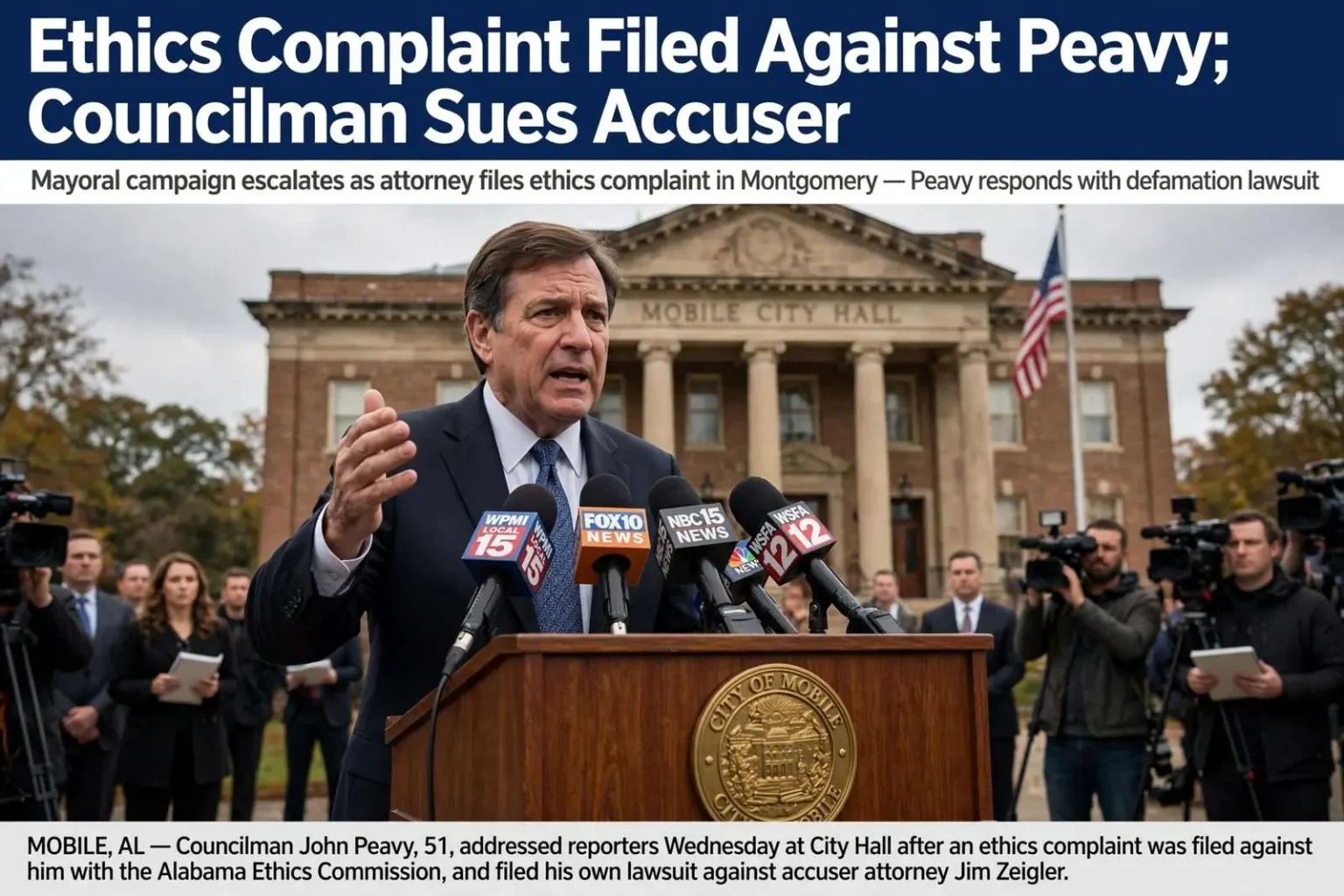
The ethics fight at the center of Mobile’s mayoral campaign escalated sharply as attorney Jim Zeigler filed his complaint against City Councilman John Peavy with the Alabama Ethics Commission in Montgomery — and Peavy answered not only with a denial but with a lawsuit of his own.
Zeigler filed the complaint at 2:30 p.m. Wednesday at the commission’s Montgomery office, alleging that Peavy, 51, had committed “multiple violations of state ethics laws.”
“He and his business, Peavy Construction Company, intentionally sought and performed work on a city project on which John Peavy participated as council member,” Zeigler charged.
Peavy Goes to Court
Peavy called the complaint baseless and addressed it at length at a City Hall press conference Wednesday afternoon.
“The complaint is without merit,” he said. “Some of the things in it are clearly fallacious from what I’ve been told is in it. I think it will be dismissed easily just by looking at the documentation. It’s ridiculous really. But this is what politics is about, I guess. It’s starting to kick up, so we must be doing something right.”
He also went on the legal offensive. Peavy was reported to have filed suit against Zeigler seeking damages on three counts: defamation, outrageous conduct and abuse of process.
The case was reported to have been assigned to Mobile County Circuit Presiding Judge Bob Kendall, who according to an attorney involved had scheduled a telephone conference among the lawyers for the following Tuesday afternoon. Peavy’s legal team was believed to be preparing to seek a temporary restraining order against Zeigler.
The ethics charge at the center
The substance of the complaint sits at the heart of Alabama’s ethics code: the prohibition on a public official using his office for the benefit of his own business interests. Alabama’s law, among the strictest in the country, bars officials from voting on or participating in decisions in which they, family members or their businesses hold a substantial financial interest. A councilman whose construction company sought or performed work on a city project he helped decide would, if the allegations held, fit squarely inside that prohibition.
The Ethics Commission’s process, though, is built for deliberation rather than headlines. Complaints filed in Montgomery are reviewed by the commission’s staff, which investigates before any finding reaches the full commission; the panel can dismiss a complaint, issue an advisory opinion, or refer findings to a district attorney for prosecution. That pipeline takes months — well beyond the timetable of a city election — which is why complaints of this kind function primarily as political events, with the legal process trailing the campaign calendar.
Zeigler, a Mobile attorney who built a public reputation on consumer and government-accountability cases, understood that dynamic as well as anyone in the state. His complaints over the years had made him a familiar figure in campaigns, and the Wednesday filing at the commission’s Montgomery office was staged to do what such filings do: put the allegation on the public record in a form that reporters can verify and opponents can cite, regardless of how the commission ultimately rules.
Peavy’s response recognized the same arithmetic. A press conference at City Hall the same afternoon, followed within hours by a defamation suit, converted a defensive posture into an aggressive one — and the choice of claims mattered. Defamation addresses the public statements; “outrageous conduct,” Alabama’s version of the intentional-infliction tort, frames the behavior as beyond the bounds of decency; abuse of process alleges that the Ethics Commission complaint itself was filed for an improper purpose. Together, the three counts portray not a candidate who misspoke but an opponent weaponizing the ethics apparatus.
Zeigler: ‘He Is Overreacting’
Zeigler seized on the lawsuit as evidence of poor judgment, arguing that Peavy had converted a narrow complaint into the defining issue of his own campaign.
“I think he is overreacting, especially if he believes he has a strong defense to the complaint,” Zeigler said. “He is going to make this into the biggest issue in the campaign.”
The observation had tactical substance. A candidate facing an ethics complaint has two paths: absorb it quietly and argue the facts, or escalate and risk making the allegation the campaign’s center of gravity. By suing, Peavy guaranteed continued coverage of the dispute, gave Zeigler a second platform, and attached the words “defamation” and “ethics commission” to his own candidacy for the remainder of the race — even if every legal proceeding eventually went his way.
The threatened temporary restraining order added another layer. Seeking to silence an opponent’s statements during a campaign collides with generations of First Amendment doctrine; American courts are overwhelmingly hostile to pre-election injunctions against campaign speech, even false statements, preferring that such disputes be resolved after the votes are counted. The move signaled resolve to supporters, but it also invited the argument that a councilman running for mayor wanted a judge to stop a critic from talking.
Judge Kendall’s assignment of the case put one of Mobile County’s senior jurists at the center of a campaign story within days of the filing. A presiding judge’s initial scheduling conference would set the pace for what could otherwise become a long-running distraction, and the telephone conference set for the following Tuesday suggested both sides wanted the procedural questions — including the restraining order — addressed quickly.
Ethics complaints as campaign weapons
The episode belongs to a recognizable genre of Alabama politics, where the Ethics Commission has long served as an arena for campaign combat alongside its intended role of policing official misconduct. Complaints filed in the heat of a race — timed for news cycles, amplified by press conferences, answered with counter-lawsuits — have become a standard escalation ladder. The commission itself takes no position on timing; it processes what it receives, and its confidentiality rules prevent officials from defending themselves through the investigation even as the complaint circulates publicly.
That asymmetry is what gives ethics complaints their campaign potency. An accusation can be reported because it exists; the response can be reported because it is made; and the underlying facts may not surface for months, after the election has passed. Candidates therefore respond not with silence but with aggression — denials, documentation, and lawsuits designed to shift the story from “councilman accused” to “councilman fights back.”
Whether the tactic works depends on the candidate and the community. In a city that has seen its share of government-corruption cases, an ethics allegation against a construction-company councilman carries a certain surface plausibility that requires more than a denial to dispel. Peavy’s press conference — “It’s starting to kick up, so we must be doing something right” — was calculated to project a fighter’s confidence to a mayoral electorate that expects its politicians to be tested.
The filing also clarified the shape of the mayor’s race. Zeigler’s role as complainant — lawyer, activist, and perennial government watchdog — gave the ethics story a protagonist with standing and history, while Peavy’s construction business gave the allegation a concrete subject. What began as paperwork in Montgomery became, within a day, a lawsuit in Mobile County Circuit Court with a presiding judge, a telephone conference on the calendar and a possible restraining order in motion: the full machinery of two legal systems, criminal-adjacent and civil, pointed at a city election.
The lawsuit’s outcome would matter well beyond this campaign. Alabama’s courts have generally protected the filing of good-faith ethics complaints from retaliatory litigation, on the theory that accountability mechanisms die the first time an accuser faces damages for making them. A successful defamation suit against an ethics complainant would send a signal that ripples through every future race: that complaints carry a price tag. Zeigler’s certainty that Peavy was “overreacting” reflected that understanding — the lawsuit was not just a defense, in his telling, but a precedent.
For Mobile voters, the dispute compressed the mayoral campaign’s central questions into a single storyline. Does a councilman’s private business intersect with his public votes? Who polices the police? Can a watchdog’s complaint be distinguished from an attack? Those questions have outlasted every candidate who has run for the office, and the Peavy-Zeigler fight gave each of them a concrete, documentable form: a complaint timestamped 2:30 p.m. Wednesday in Montgomery, a press conference in City Hall the same afternoon, three counts filed in circuit court, and a judge’s conference set for Tuesday.
The speed of the escalation was itself the news. Within a single business day, the story moved from allegation to denial to litigation, leaving no interval in which the dispute could have been quietly resolved or de-escalated. That pace is the product of a campaign calendar — every day of silence is a day the opponent’s framing hardens — and it ensured that the ethics fight would be the first thing many voters learned about the mayor’s race at all.
Both men emerged from the week with something they wanted. Peavy possessed a defense narrative — a fighter answering a baseless charge — and a vehicle, the lawsuit, for contesting the accusation on his own terms. Zeigler held the public record: a filed complaint, a charged quotation, and an opponent now obligated to address the ethics question every day of the campaign. The Ethics Commission would eventually do what the commission does, on its own timetable; the defamation suit would run its course through Judge Kendall’s courtroom; and the campaign, as both men understood, would be fought on the ground they had staked out in that single week.
However the proceedings ended, the sequence became a case study in how Alabama’s campaign ethics machinery is used — complaint as weapon, lawsuit as shield, and an electorate left to weigh the allegations long before any tribunal weighs them first.


