Mobile Firefighters Union Endorses Bess Rich for Mayor
The Mobile firefighters' union backed Bess Rich for mayor ahead of the Aug. 23 city election, the second endorsement from an organized city employee group for the former councilwoman's campaign.
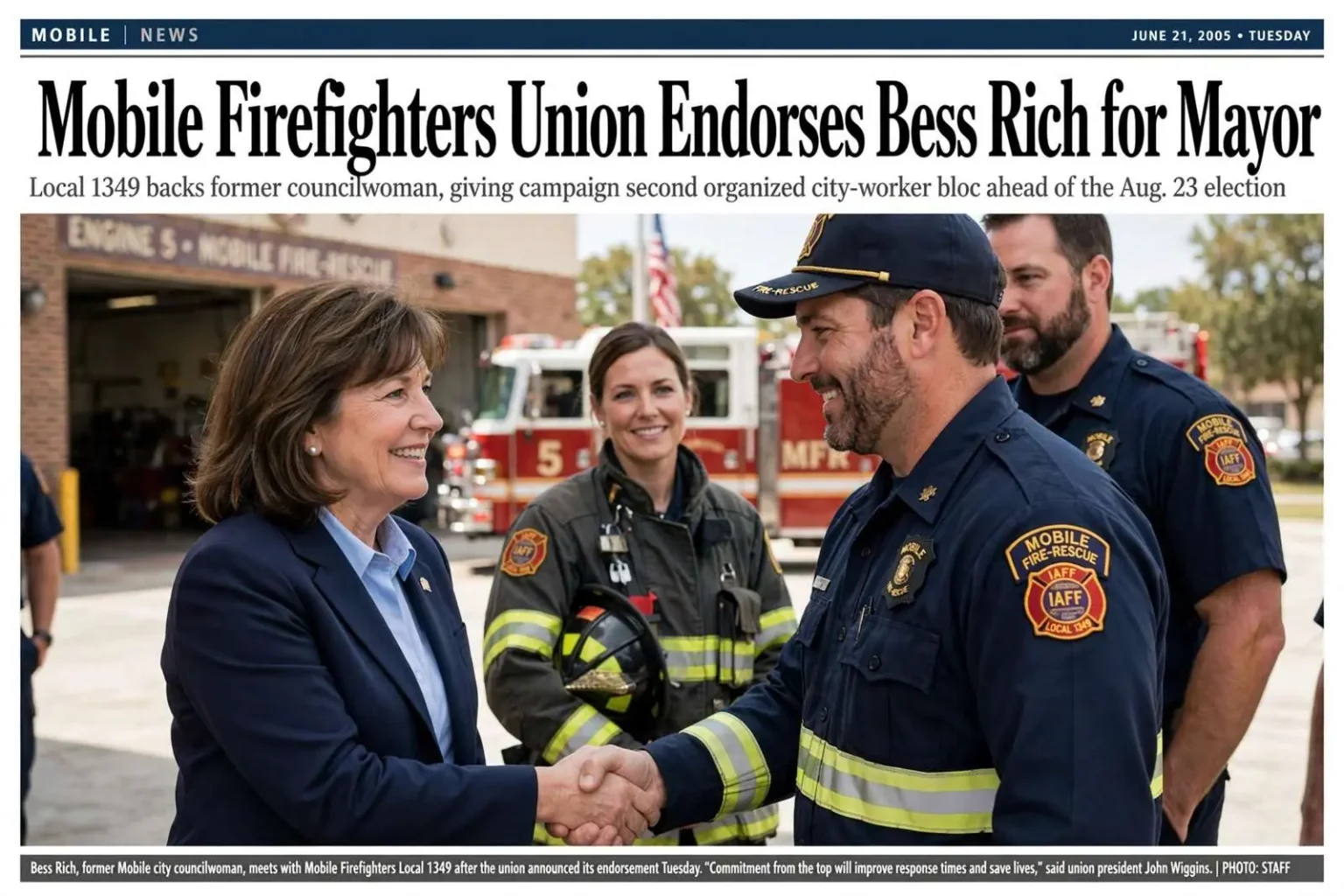
Mobile’s firefighters lined up behind Bess Rich in the city’s mayoral race, announcing an endorsement that surprised almost no one at City Hall but that gave the former councilwoman a second organized bloc of municipal employees in her corner ahead of the Aug. 23 election.
The Mobile Firefighters / International Association of Fire Fighters Local 1349 made the endorsement public on a Tuesday, roughly two months before voters went to the polls to choose a successor to Mayor Mike Dow.
Second city-worker endorsement in a month
The firefighters’ nod followed the backing Rich had picked up the previous month from the United City Workers Coalition, another group representing municipal employees. Her campaign attributed the accumulating support among city workers to what it called her “core services” platform — an argument that City Hall should concentrate on the basics of police, fire, drainage and street maintenance before pursuing more ambitious projects.
That framing was the central fault line of the 2005 campaign. Dow, who was not seeking a fifth term, had spent sixteen years remaking downtown Mobile and courting industrial recruitment, and the candidates competing to replace him spent much of the summer arguing over whether neighborhoods had been shortchanged in the process.
The fault line ran through every debate of the summer, and the candidates’ positioning followed the city’s own geography. Downtown’s revival — the waterfront convention center, the restored historic blocks, the corporate towers on the skyline — was Dow’s legacy, and it had given Mobile a national reputation and a convention business. But in the outlying council districts, residents pointed at crumbling streets, chronic drainage flooding after summer storms, and fire stations whose apparatus aged past replacement schedules. The “core services” message gave voters in those neighborhoods a name for the imbalance, and every candidate serious about the runoff margins adopted some version of it.
For Rich, the unions’ arrival had a double meaning. It supplied the campaign’s most credible validation of the core-services argument — the employees who actually deliver police, fire and sanitation were telling voters the candidate would fund their work — and it supplied organizational muscle no advertising buy could match: members who would walk precincts, display signs and vouch for her in conversations across every corner of the city.
What the union said
“Bess has never wavered in her commitment to the firefighters and paramedics in this community,” said John Wiggins, president of the firefighters association. “With commitment from the top, we can improve our response times and possibly save more lives.”
Response times were not an abstraction in the endorsement. Mobile’s fire department also carried the city’s emergency medical response load, and station staffing and equipment replacement had been recurring budget arguments in council chambers for years.
The dual role is what made the fire budget such a persistent flashpoint. In a city where the fire department answers the overwhelming share of medical calls, engine and rescue staffing is in effect the city’s ambulance system, and shorting it shows up directly in the interval between a 911 call and help arriving. Rich had sat on the council through the budget fights that set staffing levels and apparatus replacement schedules, and Wiggins’ phrase — “commitment from the top” — named the union’s actual grievance: that funding decisions made in the mayor’s office, not the council floor, had left the department defending its staffing year after year.
Rich, who had sought the mayor’s office once before, noted that the same union had been with her the first time.
“Once again, I’m honored to accept the endorsement of these fine men and women who risk their lives to make us safer,” she said. “They supported me in my bid for mayor in 2001 and they support me now. All I can say is I will do my absolute best to support them in every way I can when I’m mayor. This in turn will better serve all the citizens of Mobile.”
The continuity was a strategic asset. A union that had endorsed her unsuccessful 2001 campaign against Dow was not betting on a newcomer; it was renewing a four-year-old relationship, which suggested its judgment was based on her record rather than on the 2005 field’s arithmetic. That history also armed her campaign’s answer to the inevitable charge that city-worker endorsements amounted to a bargain with city labor: the relationship predated the race.
LeAnn Tacon, a fire captain and vice president of the association, cast the endorsement in terms of Rich’s familiarity with the mechanics of municipal government.
“Bess understands the day-to-day operation of city government,” Tacon said. “As mayor, she will champion the role of public safety by empowering all Mobile to improve our quality of life. The citizens of Mobile will be the ultimate winners when Bess is elected.”
Tacon’s framing was aimed past the campaign, at the ordinary voter deciding whether a former councilwoman’s experience counted as a credential. The fire service’s case for Rich rested on exactly that: four years of watching budgets assembled, seeing which proposals survive, knowing where the money for staffing and apparatus actually comes from. In a race where her rivals included two sitting or former officeholders with their own government résumés, the union’s insistence that she uniquely understood “day-to-day operation” was a claim about competence rather than gratitude.
The field
Rich was one of four significant candidates in a nonpartisan municipal election that had drawn unusual attention across South Alabama. The others were Mobile County Commissioner Sam Jones, City Councilman John Peavy and former state Sen. Ann Bedsole. With four credible contenders and a majority required to win outright, most observers expected the Aug. 23 vote to produce a runoff, scheduled for Sept. 13.
The four-way field gave the race its structure. Jones, the county commissioner, carried name recognition from countywide service and the strongest fund-raising coalition, as his disclosures would later show. Peavy brought a council district’s organization and long service on the body that had fought the budget battles. Bedsole, the former state senator, carried decades of civic standing and a network built across a career in Mobile politics. Rich’s core-services coalition was her counterweight to all three. With no candidate able to claim a natural majority of a citywide electorate, the smart money in the summer of 2005 was on a September runoff between whichever two candidates consolidated their bases first.
The value of a uniformed endorsement
Public-safety endorsements have long carried a particular weight in Mobile municipal politics. They arrive with volunteers, with yard signs in firefighters’ own front yards across every council district, and with an implicit argument that the people who answer the calls trust one candidate over the others to fund the department properly.
That geography matters more than most observers credit. A firefighters’ local draws its members from stations distributed across the entire city, so its endorsement places visible, uniformed-adjacent support in every council district simultaneously — something no other endorsement in a municipal race can do. When a voter sees a neighbor who fights fires for the city standing behind a candidate, the implicit recommendation is difficult for a television spot to match.
They are also, as the endorsement itself hinted, transactional in the ordinary democratic sense: a union that puts its name behind a candidate expects the next administration to remember it at budget time. The firefighters’ message — commitment from the top, better response times, lives saved — was a clear statement of what Local 1349 wanted from the next occupant of the mayor’s office on Government Street.
Transaction is not a scandal in this context; it is how the bargaining between municipal departments and city halls has always worked. Departments that cannot endorse politically have only their budgets to negotiate with, year after year, and administrations that take public-safety support without consequence teach the next union not to bother. What made the 2005 endorsement newsworthy was its clarity: Local 1349 named its price — staffing, equipment and a mayor who treated response times as a measure of city government’s success — and told the city exactly what a vote for Rich would buy.
The announcement’s timing also served the calendar. Coming roughly two months before the Aug. 23 election, it landed while the four-way field was still sorting itself out and before any runoff pairing was set — the window when a bloc of committed volunteers and yard signs does the most to move a candidate from the second tier of discussion into the top two. Rich’s task for the rest of the summer was to convert the uniformed validation into votes across districts where no fire station flies her banner, and her core-services message gave her the script for doing it.
Election date: Tuesday, Aug. 23, 2005
Runoff, if needed: Tuesday, Sept. 13, 2005
Seat at stake: Mayor of Mobile, open after Mike Dow declined a fifth term
For a campaign built on the promise of restoring basic services, the backing of the people who deliver one of the most basic services of all was the kind of validation money could not buy.