
Attorney Says He Will File Ethics Complaint Against Councilman Peavy
Mobile attorney Jim Zeigler said he would file an ethics complaint accusing mayoral candidate John Peavy of using his City Council seat to benefit his construction company on an Azalea Road repair job.
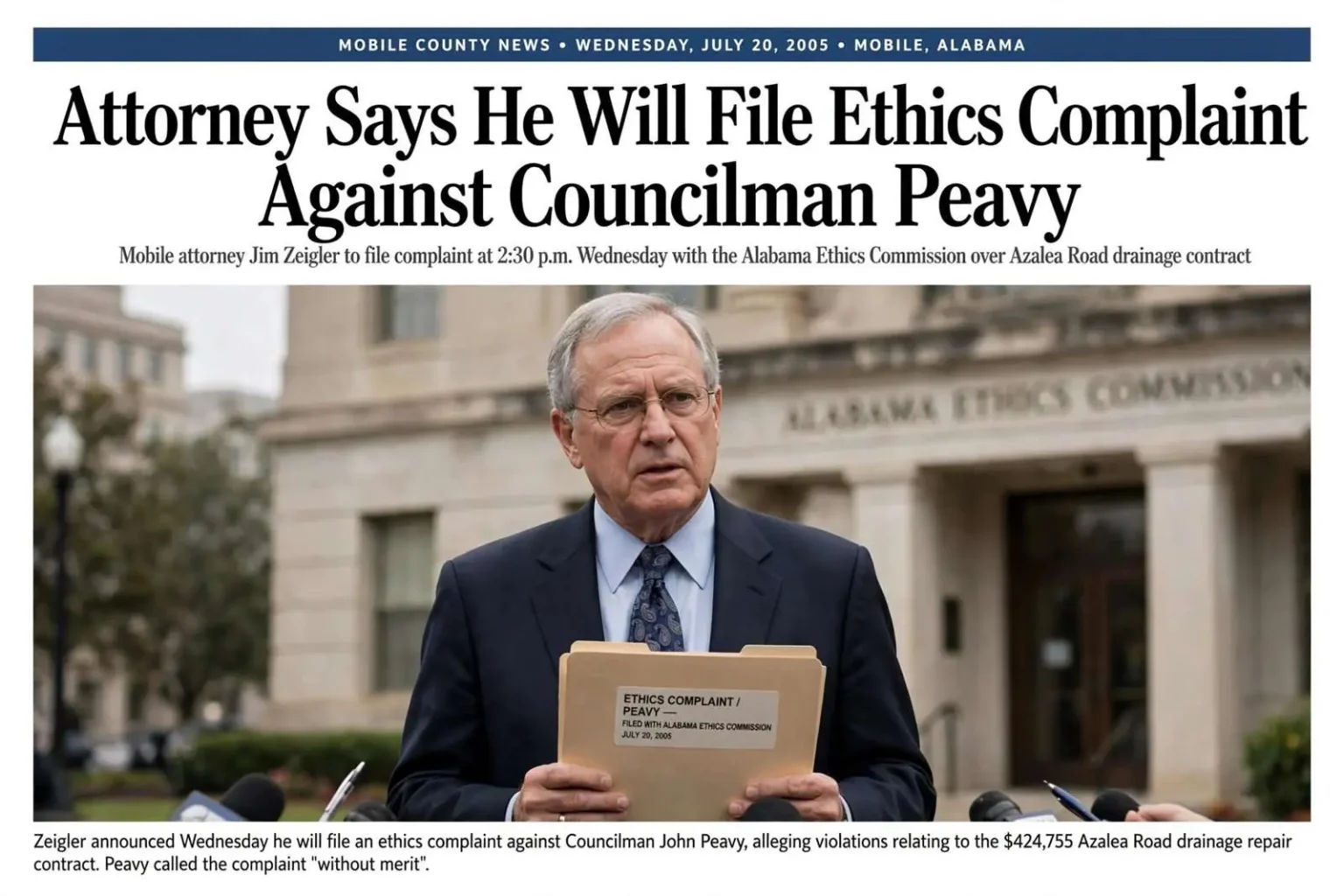
Mobile attorney Jim Zeigler announced that he would file a complaint with the Alabama Ethics Commission against City Councilman John Peavy, alleging that the mayoral candidate and his construction company improperly sought and performed work on a city project that Peavy voted on as a council member.
Zeigler said he would present the complaint at 2:30 p.m. Wednesday at the commission’s office in Montgomery. He alleged that Peavy had committed “multiple violations of state ethics laws.”
“He and his business, Peavy Construction Company, intentionally sought and performed work on a city project on which John Peavy participated as council member,” Zeigler charged in the complaint.
The announcement converted a long-simmering question about a city drainage contract into a formal legal proceeding, with the potential to shape both the councilman’s standing and his mayoral campaign in the weeks before election day.
Peavy: ‘The complaint is without merit’
Peavy rejected the allegations outright and said he would answer them in full at a press conference at City Hall that afternoon.
“The complaint is without merit,” Peavy said. “Some of the things in it are clearly fallacious from what I’ve been told. I think it will be dismissed easily just by looking at the documentation. It’s ridiculous really. But this is what politics is about, I guess. It’s starting to kick up, so we must be doing something right.”
The response framed the complaint as the product of a competitive campaign rather than a genuine legal grievance — a reading that would be tested by whether the Ethics Commission found the documentation persuasive. Peavy, a two-term councilman and the District 7 representative, had built his mayoral bid in part on his record of constituent service in west Mobile, and the complaint attacked precisely the area where he claimed expertise: how city construction work actually gets done.
The Azalea Road contract
At the center of the complaint was an emergency drainage repair on Azalea Road. According to the allegations laid out by Zeigler:
Heavy rains in the spring of 2005 damaged the Bolton Branch drainage canal on Azalea Road, and erosion made the roadway unstable, forcing its closure. The road, a major east-west corridor in west Mobile connecting the airport area to the growing residential districts along University Boulevard, could not simply be patched: the canal’s failing banks had to be rebuilt before traffic could safely return.
On April 5, 2005, the Mobile City Council approved a $424,755 emergency contract with Construction Labor Services, or CLS, to make the repair. Emergency contracts allow the city to bypass the normal competitive bidding timeline when public infrastructure fails and roadways must be restored quickly — which is also why such contracts draw scrutiny: fewer eyes review the work, and the dollars move faster.
CLS subcontracted 62 percent of the work — $266,306.25 — to Grady Dortch & Sons. Peavy and his company, the complaint alleged, helped Dortch prepare the bid for that subcontract, and Peavy recommended Dortch to CLS.
Zeigler argued that the arrangement violated the city’s standard construction contract, which requires a general contractor to perform at least half of the work with its own organization. The contract language he cited reads: “The contractor shall not sublet the contract or any portion thereof without written permission from the City Engineer. If consent is given, the contractor will be permitted to sublet a portion of the work, but shall perform with his own organization work amounting to not less than fifty percent of the total contract price.”
The complaint went further, asserting that Peavy Construction was in practical terms the real subcontractor. It quoted an inspector, Tim Dixon, as saying Dortch was used as a front. It alleged that Peavy employees worked on the site and were paid by Dortch, that Peavy heavy equipment was used on the job, and that Ken Peavy — the councilman’s brother and business partner — was regularly at the site shooting grades, directing work and consulting with Dortch.
Each of those allegations mattered separately, but together they aimed at a single conclusion: that the money the city paid CLS for a public works repair found its way, through a subcontracting arrangement, into work performed by the councilman’s own company — the precise scenario the ethics statutes were written to prevent.
Finally, the complaint pointed to the council’s own minutes, which show Peavy voting “aye” on the resolution awarding the emergency contract, and then participating in the unanimous approval of those minutes at subsequent meetings. Under the ethics law, the vote itself is the clearest possible evidence of participation, and the approval of the minutes compounded it by putting the councilman’s name on the record of his own vote.
The law cited
Zeigler grounded the complaint in Section 36-25-5 of the Code of Alabama, which bars a public official from using his office to obtain personal gain for himself, a family member, or “any business with which the person is associated,” unless specifically authorized by law. That provision is the general-purpose ethics rule of state law: it does not require proof of a corrupt deal, only that an official’s public office and private interest converged.
He also cited Section 36-25-99(c), which prohibits a member of a county or municipal board from voting on a matter in which he or a family member has a financial interest, and Section 41-16-6 and following, which bars officers of municipal governing bodies from holding a beneficial interest in public contracts. Together the three provisions cover the conduct from every angle — the gain, the vote, and the contract itself.
He asked the commission to open a preliminary inquiry, find reasonable cause for an investigation, hold a hearing, determine whether probable cause existed that the ethics law had been violated, and forward the case to Alabama Attorney General Troy King for prosecution.
The Ethics Commission’s process moved slowly by design. A preliminary inquiry screens complaints for merit; a full investigation follows only if the commission finds reasonable cause; and even a probable-cause finding leads to referral to the attorney general rather than an immediate penalty. For a candidate in a hard-fought race, the timeline meant the accusation would define the debate while the process ran its course in the background.
The complainant
Zeigler was no newcomer to Alabama politics. An ally of ousted state Supreme Court Chief Justice Roy Moore, he had been politically active for more than thirty years and was a former member of the Alabama Public Service Commission. He would go on to a long career as a self-described taxpayer advocate, building a public profile on challenges to government spending and ethics in office.
His approach to the Peavy complaint fit that profile: the filing was public, meticulously documented, and grounded in the specific text of the statutes — a style that treated an ethics complaint not only as a legal instrument but as a piece of political communication aimed at the voters as much as at the commission.
The timing
The complaint landed in the middle of a hard-fought mayoral campaign. Peavy, who represented District 7 on the council, was running for mayor in the Aug. 23 municipal election against former state Sen. Ann Bedsole, former City Councilwoman Bess Rich and Mobile County Commissioner Sam Jones. All four were seeking to succeed Mayor Mike Dow, who had chosen not to seek re-election after sixteen years in office.
The field itself told the story of the race: two seasoned women with long records in state and city government, a county commissioner with a built-in political network, and the incumbent councilman whose district anchored west Mobile’s growth. Ethics complaints filed against candidates during a campaign occupy an uncomfortable place in public life: the accusation is immediate and public, while any resolution — dismissal or otherwise — typically arrives long after the votes are counted.
For Peavy’s rivals, the complaint offered a way to raise questions about judgment without having to assert anything themselves; reporters would ask the questions, and the candidates would merely decline to defend him. For Peavy, the afternoon press conference at City Hall was the countermeasure — answer everything at once, in front of the cameras, and label the document what he said it was: politics.
Peavy’s own framing acknowledged as much. Politics, he said, was starting to kick up.
Whatever the commission eventually determined, the episode became a fixture of the campaign’s final weeks — a debate about whether a councilman’s construction business and the council’s emergency contracts could share a city, and about the ethics law’s reach into the day-to-day business of a growing municipality. The Azalea Road repair itself went forward, the canal banks rebuilt and the road reopened, while the argument over who really performed the work and who profited from it moved from the job site to Montgomery, where the complaint would be weighed on its documents rather than its headlines.


