Mobile Lawyer, Dauphin Island Fix at Center of Spill Response
As the BP oil spill fouled the Gulf, Mobile native Rick Kuykendall emerged as a leading claims attorney while BP agreed to fund a $15 million closing of Katrina Cut to shield Dauphin Island.
Two months after the Deepwater Horizon rig exploded off the Louisiana coast, the widening BP oil spill had thrust South Alabama into the center of a national disaster, and put a Mobile native at the center of the legal fight over who would pay for it. The coastline that drew tourists, shrimpers and fishermen for generations was suddenly a shoreline under threat, with oil on the water and fear moving faster than the crude itself.
‘I never expected it in my back yard’
Attorney Rick Kuykendall, a Mobile native, topped a national news network’s list of “Friday’s most intriguing people” for his work organizing claims on behalf of those harmed by the spill. The 55-year-old lawyer said he was working with attorneys from Louisiana, Alabama, Texas, Pennsylvania, Mississippi and Florida to press cases against BP, assembling a legal coalition that spanned the entire Gulf.
“I have prepared my entire professional life for this,” Kuykendall told the network. “But I never expected it to happen in my back yard.” He said his cases since 1995 had produced verdicts and settlements totaling more than $2 billion, a record built on complex litigation that made him, by the summer of the spill, one of the most experienced claim attorneys working the disaster.
The April 20 explosion aboard the Deepwater Horizon killed 11 workers and touched off what would become the largest offshore oil spill in the nation’s history. The rig, drilling a well in deep water more than a mile beneath the surface, burned and sank, and the uncapped well beneath it began releasing crude that flowed for months while engineers tried one containment strategy after another.
As crude drifted toward the Alabama coast, shrimpers, charter captains, hoteliers and property owners along Mobile Bay and the barrier islands faced mounting losses, and the machinery of litigation and damage claims began to spin up alongside the cleanup. Summer was approaching, the season on which Gulf Coast tourism businesses stake their entire year, and the images on television were the worst possible advertisement for a coastline that lived and died by its water.
A Coastline Bracing for Loss
Alabama’s shoreline economy is built on a chain of connected industries. Charter fishing boats in Orange Beach and Dauphin Island take anglers offshore for snapper and grouper; shrimp boats work the bays and the passes; restaurants along the waterfront sell what the boats bring in; and the condominiums and rental houses that line the beaches fill each summer with families whose spending supports payroll across the coastal counties. A spill that keeps tourists away and closes fishing grounds strikes every link of that chain at once.
The losses were also uneven and hard to measure in real time. A shrimper who cannot set his nets faces a clean calculation of days and catch; a condominium owner watching bookings evaporate faces a season of cancellations that may or may not recover; a seafood restaurant confronts both supply problems and a customer base worried about what is on the plate. Claim attorneys like Kuykendall were organizing precisely because the harm was broad, varied and difficult for any individual victim to quantify alone against a company the size of BP.
For South Alabama, the spill also carried a bitter historical echo. The region had rebuilt from Hurricane Ivan in 2004 and Hurricane Katrina in 2005, and coastal residents had become practiced at the paperwork of disaster — insurance claims, federal assistance, the slow arithmetic of recovery. Oil was a different kind of catastrophe, one without a wind date, whose damage arrived gradually and could not be photographed from a helicopter the way a flattened house could.
A $15 Million Barrier for Dauphin Island
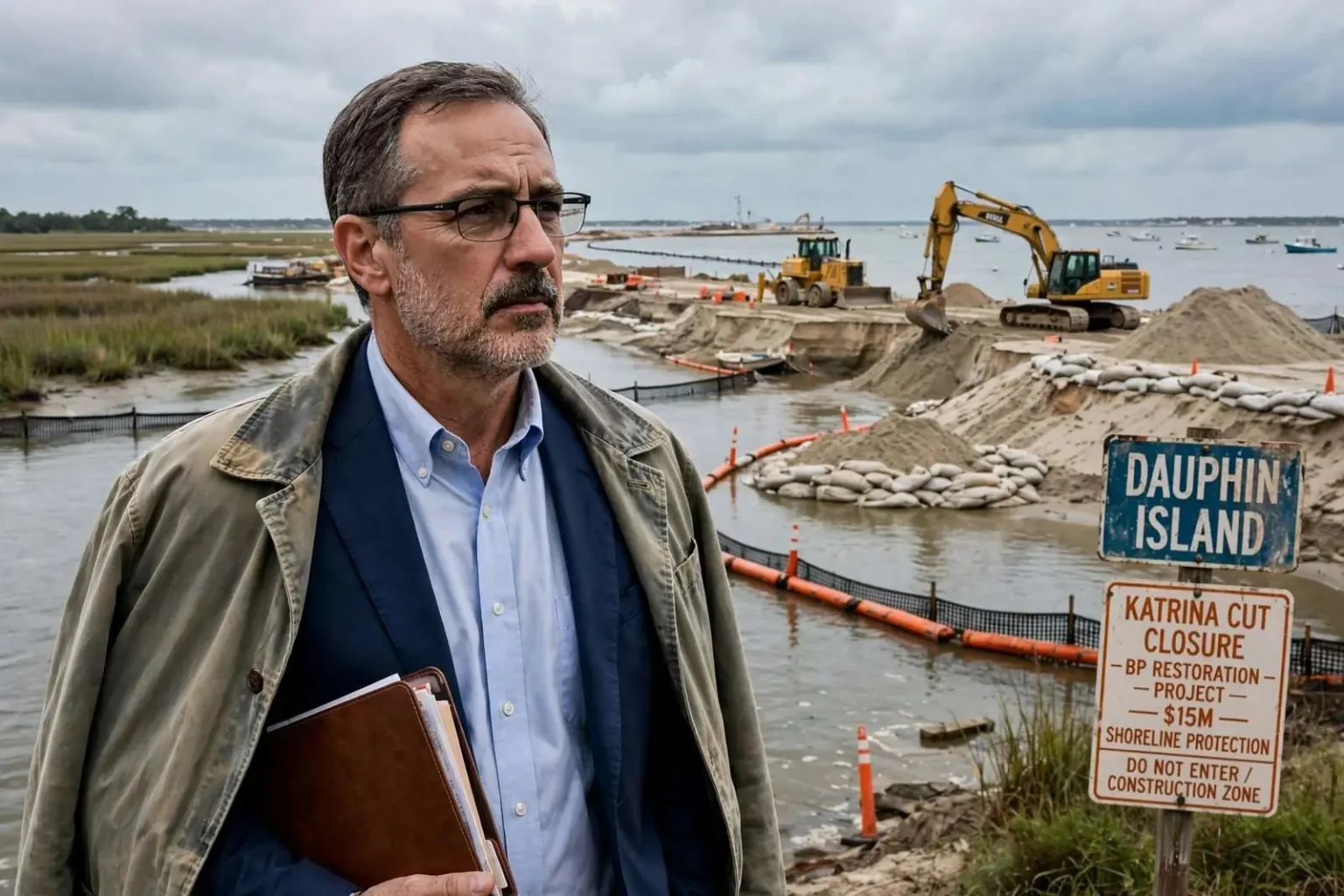
Closer to home, BP agreed to fund a roughly $15 million project to close Katrina Cut and help restore Dauphin Island to a more natural state. The agreement put money behind one of the most visible defensive projects on the Alabama coast during the spill, and it gave the town’s residents something concrete amid the uncertainty.
Katrina Cut was the breach that Hurricane Katrina tore across the thinly populated west end of Dauphin Island in 2005, effectively slicing the barrier island and leaving an open channel where beach and dune had been. The cut, hundreds of feet wide at its worst, became a permanent feature of the island’s geography, visible in every aerial photograph of the Alabama coast and a constant reminder of what a major hurricane does to a barrier island.
With oil approaching, officials saw the gap as a vulnerability, an opening through which crude could reach the sensitive marshes and waters behind the island. Sealing it was intended to give the island, and the Mississippi Sound beyond it, an added line of defense. Barrier islands are the Gulf’s first shield; they absorb wave energy and block what drifts in from open water, and a breach in the shield is a door left open to whatever the sea sends toward the mainland.
The engineering of closing a hurricane breach is substantial. Building a barrier across an open channel requires moving enormous volumes of sand, shaping it against the currents that will test it, and anchoring the new land in a way that survives the same storms that opened the gap in the first place. The $15 million BP funding addressed an urgent question, but it was also a restoration project in its own right, rebuilding a piece of the island that residents had wanted closed since Katrina took it.
For Dauphin Island residents, the project represented both protection and principle: the town had spent years arguing that the barrier island’s natural functions — shielding the mainland, buffering the Sound, hosting the wildlife that makes the place what it is — were worth defending with real money, and the spill forced the issue onto a fast track. The cut that had divided the island for half a decade would be closed while the crude was still offshore.
The Legal Machinery Grinds On
The litigation that attorneys like Kuykendall organized would stretch on for years after the summer of 2010, becoming one of the largest civil cases in American history. Claims processes, class actions and multi-district litigation in federal court absorbed thousands of lawsuits from businesses and individuals across the Gulf states, and the legal professionals who had spent decades in complex litigation found themselves managing cases for clients ranging from a single shrimp boat to entire resort communities.
Experience mattered in that environment. Attorneys who had handled mass claims, product liability and environmental litigation understood the rhythm of the process: documenting losses, preserving records, and building the evidentiary record that would eventually determine compensation. For the fishermen and hoteliers of coastal Alabama, the difference between a well-prepared claim and a poorly documented one could amount to the difference between recovery and nothing.
The human dimension drove the urgency. Two months into the spill, with no clear end to the well’s flow in sight, every week of delay carried real cost to businesses living on thin margins. The eventual resolution of the legal fight would come long after the oil stopped flowing, but the people of the coast needed help while the crisis was still unfolding, which is why the claims-organizing work drew national attention even while the litigation itself was just beginning.
South Alabama’s Long Recovery
The spill’s effect on the Gulf Coast extended well past the summer of the explosion. Tourism marketing campaigns fought the perception damage for years, seafood industries worked to test and certify their catch, and communities from Bayou La Batre to Orange Beach measured recovery not in months but in seasons. The spill became a defining event for a generation of coastal residents who had already weathered two major hurricanes in the preceding six years.
Katrina Cut itself remains part of that story. The restoration work funded during the spill changed the island’s shape and, residents hoped, its odds in the next storm. Dauphin Island’s west end had been rebuilt, breached and rebuilt again over the decades, and each project added to the argument that barrier islands are infrastructure as much as scenery, worth maintaining because of everything they protect behind them.
For the lawyers, the work of 2010 became a chapter in careers built on holding large institutions accountable. Kuykendall’s path from Mobile native to national list of intriguing people ran through decades of complex cases, and the spill concentrated that experience into a fight whose outcomes would be felt in every coastal town from Texas to Florida. His quote about preparing his entire professional life captured the sentiment of many Gulf Coast attorneys who watched the disaster unfold over water they had grown up on.
The events of that summer are now part of the region’s history, studied by everyone from emergency managers to historians of the Gulf. The April 20 explosion, the months of uncapped flow, the $15 million cut closure at Dauphin Island and the massive legal mobilization that followed are pieces of a single story about a coastline tested and the people who pushed back, on the water, in the courts and on the sand.