New $16.2 Million Glen Arbor Apartments Open Doors to Mobile Seniors and Families
The $16.2 million Glen Arbor apartment community opened in Mobile with 112 units for seniors and families, part of a broader city push to expand affordable housing.
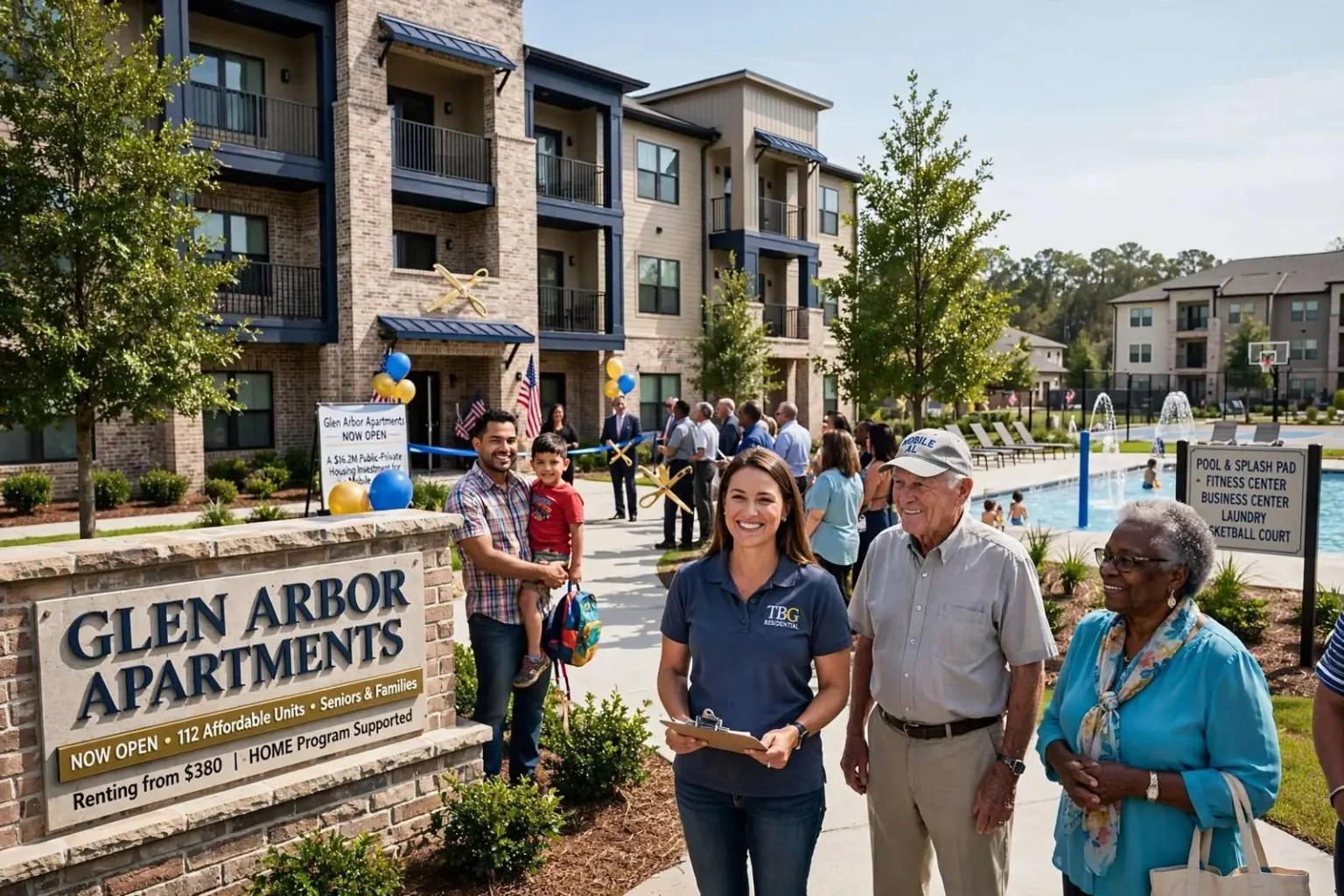
MOBILE, Alabama – A new $16.2 million apartment community, Glen Arbor, opened its doors on Friday to seniors and families in Mobile, adding 112 newly built rental units to the city’s affordable housing stock. The opening marks one of the larger single additions to the city’s supply of income-restricted housing in recent years, and it arrives as demand for affordable rentals continues to outpace what the private market alone has produced.
The development is part of a broader push by city officials to expand quality, income-restricted housing options for low- and moderate-income residents. Rather than concentrating solely on rehabilitation of aging properties, the city has paired new construction with restoration projects across the city, an approach intended to add units while addressing the blighted properties that can drag down surrounding neighborhoods. Glen Arbor represents the construction side of that strategy at scale.
Residents at Glen Arbor will have access to a swimming pool, a toddler splash area, a fitness center, a business center, an on-site laundry facility and a basketball court. The amenity package is designed to serve the development’s mixed population of seniors and working families, with the splash area and basketball court aimed at households with children and the business center offering space for residents who need a place to work or search for jobs online.
Rent begins at $380 a month for a one-bedroom unit, $445 for two bedrooms and $502 for three bedrooms. To qualify, a family of four must have an income at or below $44,100. Those figures place the units well below market-rate rents for comparable new construction, and the income limits tie eligibility to area median income standards used in federal housing programs, ensuring the units serve the households they were financed to reach.
A public-private financing package
The project was financed through a mix of public and private sources. The City of Mobile contributed $1,125,000 through the federally funded HOME Investment Partnerships Program, while the Alabama Housing Finance Authority supplied the remainder of the funding needed to complete construction. Layered financing of this kind is the standard architecture for affordable development, because rents restricted to affordable levels cannot support the debt service of a project built at market cost without public subsidy filling the gap.
Mobile Mayor Sandy Stimpson credited the developer for helping the city meet a pressing need. “I want to thank the developer TBG Residential and the Alabama Housing Finance Authority for investing in the City of Mobile,” Stimpson said. “We share a responsibility and a commitment to ensure our low-to-moderate income families has access to quality, affordable housing. We will continue to build new living spaces and restore old ones, because every citizen deserves a home.”
The mayor’s remarks framed the opening as part of a continuing effort rather than a one-time achievement, and the city’s pipeline of projects bears that out. Beyond Glen Arbor’s 112 units, Mobile’s affordable housing agenda includes work underway in several neighborhoods at once, each pairing public funding with private development capacity.
Glen Arbor is one piece of a larger affordable housing effort underway across Mobile. The city is also restoring five blighted shotgun houses along West Prichard Avenue in a public-private partnership with developer Lyn McDonald, which will create five additional single-family rental units for low-to-moderate income families once complete. The shotgun house, a narrow single-story design that runs room to room from front to back, is a signature housing type of Mobile’s older neighborhoods, and restoring surviving examples preserves both affordable units and the historic character of the streets where they stand.
In the Campground neighborhood, the city is building a new three-bedroom, two-bath home on a lot that once housed a drug den for roughly 40 years, again using HOME Program funding. Officials say the project reflects an effort to convert blighted or long-vacant sites into productive housing stock rather than leaving them empty. The Campground, one of Mobile’s historic communities, has seen how a single problem property can affect an entire block, and replacing a decades-long nuisance with a new family home is intended to signal the city’s approach: acquire, clear and rebuild where blight has taken hold.
Taken together, the projects illustrate the range of tools the city is using – large new apartment communities, small-scale restoration partnerships, and infill construction on problem lots. Each addresses a different slice of the housing need: families seeking new multi-bedroom units, seniors looking for accessible accommodations, and neighborhoods where vacant properties have undermined stability.
How the HOME program works
The HOME Investment Partnerships Program, administered by the U.S. Department of Housing and Urban Development, is one of the largest federal block grant programs aimed specifically at creating affordable housing for low-income households. Jurisdictions receive annual allocations based on formulas that account for local housing needs, and participating cities must match a share of the federal dollars with contributions of their own. Funds can be used for new construction, rehabilitation, down-payment assistance and other housing activities, with rents and income eligibility tied to federal standards.
Cities like Mobile routinely pair HOME dollars with state housing finance agency funds to make large-scale developments like Glen Arbor financially viable. The Alabama Housing Finance Authority, which supplied the remainder of Glen Arbor’s construction financing, administers the state’s principal affordable housing programs, including the allocation of federal housing tax credits that anchor most large affordable developments. The layering of city HOME funds, state authority investment and private development expertise is what allows a $16.2 million project to pencil out at rents as low as $380 a month.
Affordable housing access has remained a persistent concern in Mobile and across South Alabama, as rents in the region have climbed faster than incomes for many working families in recent years. Rising rents put pressure on households at every income level, but the squeeze is tightest for families near the bottom of the wage scale, who can end up spending well beyond the recommended share of income on housing or doubling up with relatives to make ends meet.
The need is compounded by the region’s demographics. Mobile’s population includes a substantial share of seniors living on fixed incomes, and the Glen Arbor model of serving both seniors and families under one roof reflects the reality that affordable units are scarce for both groups. Older residents often need smaller, manageable units with supportive amenities, while working families need multiple bedrooms near schools and jobs – needs that a single development with one-, two- and three-bedroom units can partially address at once.
For the families who qualify, the rent schedule carries real weight. A family of four earning at or below $44,100 can secure a newly built three-bedroom unit for $502 a month – a figure that in the private market would rarely cover rent on even a modest older unit in the city, much less new construction with a pool, fitness center and basketball court. Housing economists describe that gap between what families can afford and what the market charges as the core affordability problem, and income-restricted developments like Glen Arbor are the principal tool government has for closing it.
What the opening means for the neighborhoods
The Friday opening also offered a glimpse of how the city intends to measure success. New units occupied quickly, properties maintained to the standard of the amenity package, and surrounding blocks benefiting from investment rather than resenting it – these are the outcomes that determine whether the model draws further investment. Affordable developments that are well managed tend to stabilize the neighborhoods around them by adding residents with a stake in the community, and the city’s decision to build rather than merely rehabilitate reflects confidence that demand will absorb the new supply.
The development also represents a partnership model the mayor’s administration has emphasized: the city provides land, funding or regulatory support; the state housing finance authority supplies the financing depth; and a private developer like TBG Residential handles construction and management. That division of labor keeps the city’s direct costs manageable while leveraging federal and state programs designed for exactly this kind of project, and city officials have signaled that Glen Arbor will not be the last such collaboration.
City officials have also framed the investment in fiscal terms. Housing that families can afford reduces displacement, supports workforce retention for local employers and cuts the public costs that accompany homelessness and substandard living conditions. Every dollar of HOME money spent in Mobile must be matched locally, which is why each new project represents a deliberate choice by the city to put its own funds behind the federal program’s goals – and why officials describe the pipeline of projects as a commitment rather than a single year’s accomplishment.
For now, the opening gives 112 households a new address – seniors and families who will fill apartments that did not exist a few years ago, in a community with amenities most affordable developments could not offer a generation ago. Whether it is the West Prichard Avenue shotgun houses, the Campground infill home or the new units at Glen Arbor, the city’s message is the one the mayor stated at the opening: building and restoring housing is a shared responsibility, and every citizen deserves a home.