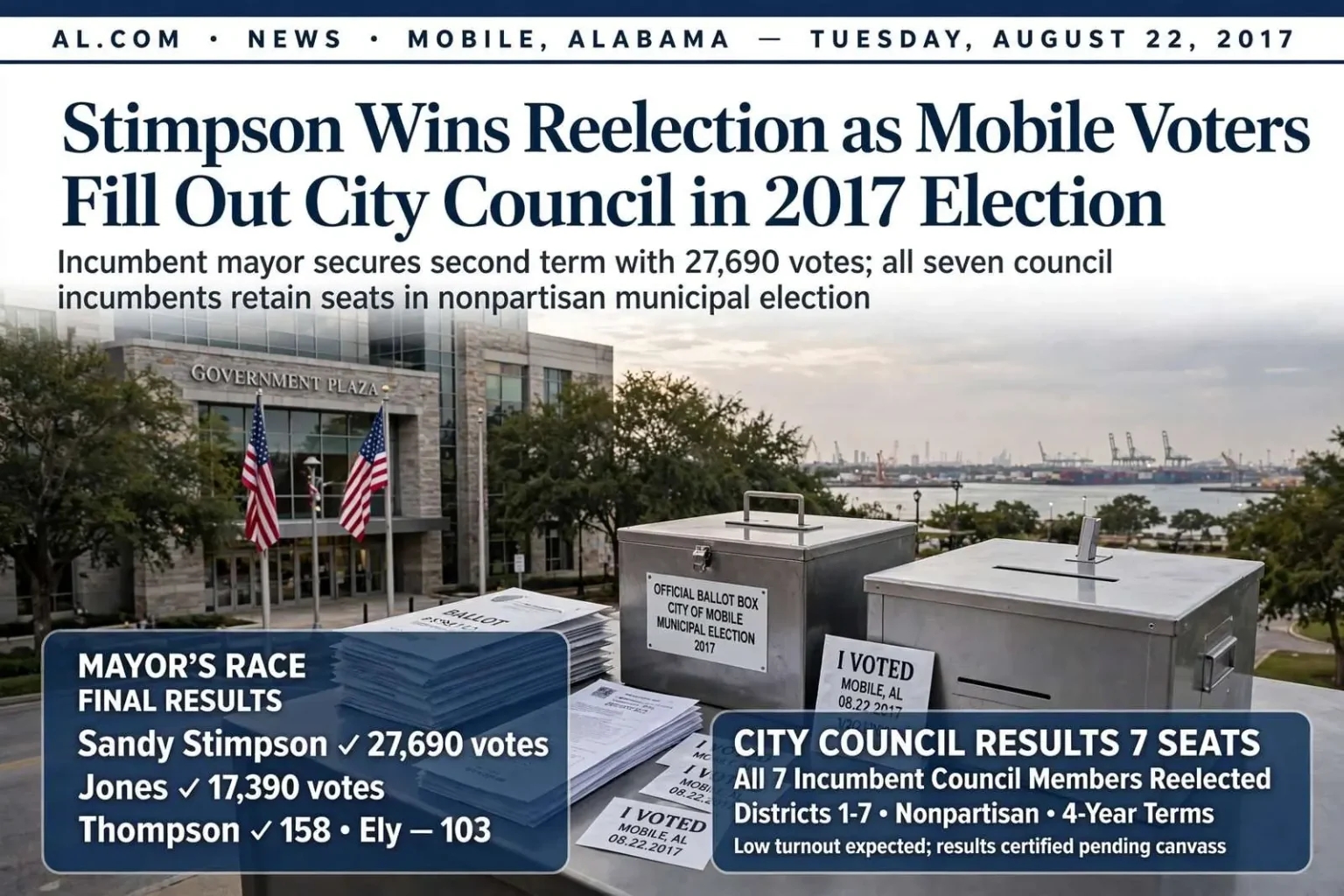
Mobile voters went to the polls Tuesday for the city’s 2017 municipal election, choosing a mayor and filling seven seats on the Mobile City Council. Polls closed at 7 p.m., and returns showed incumbent Mayor Sandy Stimpson turning back his closest challenger by a wide margin. The outcome handed Stimpson a second four-year term at Government Plaza and, for the most part, kept the familiar lineup of the city’s governing body intact around him.
In the mayor’s race, Stimpson collected 27,690 votes to defeat Jones, who received 17,390 votes. Two other candidates, Ely and Thompson, drew smaller shares of the vote with 103 and 158 votes, respectively. The spread between the top two finishers left no suspense about the outcome, and Stimpson’s total comfortably cleared the majority threshold required under state law to avoid a runoff election between the leading candidates.
How Mobile’s city elections work
Mobile’s municipal elections are officially nonpartisan, meaning candidates qualify and run without party labels on the ballot. The mayor is elected citywide, while each of the seven council members represents a single district, giving every section of the city a dedicated voice at City Hall. Terms run four years, and the mayor-council form of government concentrates executive responsibility in the mayor’s office while reserving legislative authority — budget approval, ordinances and zoning decisions — for the council.
Municipal elections in Alabama are run by the cities themselves rather than by county probate offices, which is one reason they are held in separate years from state and federal contests. Polls open at 7 a.m. and close at 7 p.m., and voters who cannot appear in person on Election Day may cast absentee ballots through the city clerk. If no mayoral candidate wins a majority of the votes cast, the top two finishers advance to a runoff four weeks later. With Stimpson drawing roughly six in ten votes on Tuesday, that second round was not needed.
The council results
Down the ballot, City Council races produced a mix of comfortable incumbent wins and closer contests across the districts on the ballot. In one district, incumbent Richardson won reelection with 4,632 votes over challengers Hollis, Penn and Berens, who received 439, 1,737 and 171 votes. The result represented a decisive endorsement of the incumbent, whose vote total was nearly three times that of his closest competitor.
In another district, incumbent Small defeated challenger Chaney, 4,138 votes to 986. Incumbent Williams turned back challenger Martin, 5,138 votes to 2,151 — the closest council race of the evening in raw margin terms, though still a wide gap. Incumbent Daves defeated McArthur, 3,979 votes to 937, and incumbent Rich also won reelection, taking 6,196 votes to challenger Pendleton’s 1,407. In every district where an incumbent faced opposition, the incumbent prevailed, several by margins that left little doubt before all precincts had reported.
Taken together, the results kept the bulk of the sitting council in place while giving Stimpson a decisive mandate for a second term leading Alabama’s third-largest city. The continuity is significant for a city the size of Mobile, where long-serving officeholders accumulate institutional knowledge about budgets, capital projects and the interlocking relationships between city departments, county agencies and private partners that drive major initiatives.
What the mayor and council actually control
Mobile’s mayor and council races are officially nonpartisan, and municipal elections like this one determine who oversees the city’s budget, public safety departments, infrastructure projects and economic development initiatives for the next four years. The mayor submits an annual operating budget to the council and directs the day-to-day administration of city government, from the police and fire departments to public works, engineering and planning. The council, in turn, appropriates the money, passes the city’s ordinances and confirms many of the mayor’s appointments to boards and commissions.
For residents, the practical reach of city government is easy to overlook precisely because it is so routine. Road repaving schedules, garbage and trash pickup, street lighting, traffic signals, building permits, zoning variances, park maintenance and the size and deployment of the police force are all municipal functions. When a pothole goes unfilled or a new subdivision is approved near an existing neighborhood, the decisions trace back to the people elected Tuesday night.
Economic development is another area where the mayor’s office carries particular weight. Mobile’s economy is anchored by the Port of Alabama at Mobile, one of the busiest deepwater ports on the Gulf of Mexico, along with aerospace operations at the Mobile Aeroplex at Brookley, shipbuilding, healthcare systems and a growing tourism sector anchored by attractions downtown and across the bay. Recruiting employers, negotiating incentive packages and clearing the way for industrial and commercial expansion all fall heavily on the executive branch, with the council voting on land sales, tax abatements and zoning changes that make such deals possible.
Low turnout, high stakes
City elections often draw lower turnout than state or federal contests, even though the outcomes have an outsized day-to-day impact on residents, from road repaving and garbage pickup to policing and zoning decisions. Voters who show up reliably for presidential and gubernatorial races frequently sit out municipal elections, which take place in off years and receive a fraction of the advertising and media coverage. The result is that a relatively small, highly motivated slice of the electorate often decides who holds power over the services people use every day.
That dynamic makes each ballot cast in a municipal race worth proportionally more than in a high-turnout contest. Council seats in particular can turn on a few hundred votes, and even the widest of Tuesday’s council margins reflects the participation of only a fraction of the registered voters in each district. Civic groups, neighborhood associations and the local media generally spend the weeks before a municipal election urging residents to study the candidates, since the winner will handle hyperlocal matters — a stop sign at a school crossing, a drainage project on a flood-prone street — that no state or federal office would ever touch.
The four-year term also means the stakes of a single election stretch across an entire planning cycle. Capital improvement projects, annexation questions, street paving programs and public safety staffing plans are typically mapped out in multi-year increments, so the officials chosen Tuesday will shepherd those decisions from drafting through completion until the next municipal election.
Returning leadership heading into 2018
With Stimpson returning for a second term and most incumbents retaining their council seats, the city’s basic leadership structure heading into 2018 remains largely unchanged. That continuity has practical consequences for ongoing initiatives: budget priorities set in prior years, multi-phase infrastructure programs and economic development negotiations that were already underway can proceed with the same leadership that approved them.
Stimpson, who first won the mayor’s office in 2013 after years in the business community, made fiscal management and infrastructure investment centerpieces of his first term. A second term effectively extends that agenda, giving the administration an opportunity to carry long-range plans to completion without the disruption of on-the-job learning that comes with a new executive. Administration officials typically frame a second-term win as a vote of confidence in the direction of the city, and the margin Tuesday gave the mayor a clear statement of public support to point to when pressing the council on his priorities.
For the returning council members, the election results serve the same function at the district level. Each council member acts as the first point of contact for constituents in his or her district, and the incumbent victories mean residents will continue dealing with officeholders who already know the history of local disputes — over drainage, development, code enforcement and public safety — that come before the council week after week.
What happens next
The canvass of returns comes next. Municipal results certified by the city council become official, and the winning candidates take the oath of office for the new term at a ceremony at Government Plaza. Until then, the current administration continues to run the city, and no policy changes occur simply because the votes have been counted.
Residents who want to engage with the returning leadership have standing options. The Mobile City Council holds regular meetings that are open to the public, and each district office fields calls and emails from constituents. Citizens can also serve on the city’s many boards and commissions — from planning and zoning to parks — which feed recommendations to the elected officials.
The broader lesson of Tuesday’s election is the one civic advocates repeat every municipal cycle: local government is the level of government closest to daily life, and the people who oversee it were chosen by a comparatively small group of neighbors. With the mayor and most of the council set to serve through the next election, Mobile enters 2018 with steady hands and a mandate that, measured by the votes, was given willingly and decisively.