University of South Alabama Mobile
$2.9 Million Federal Grant to Fund Innovation PortAL Business Hub in Downtown Mobile
The Mobile Area Chamber of Commerce Foundation has been awarded a $2.9 million federal grant to turn a former downtown building into Innovation PortAL, a hub for local entrepreneurs.
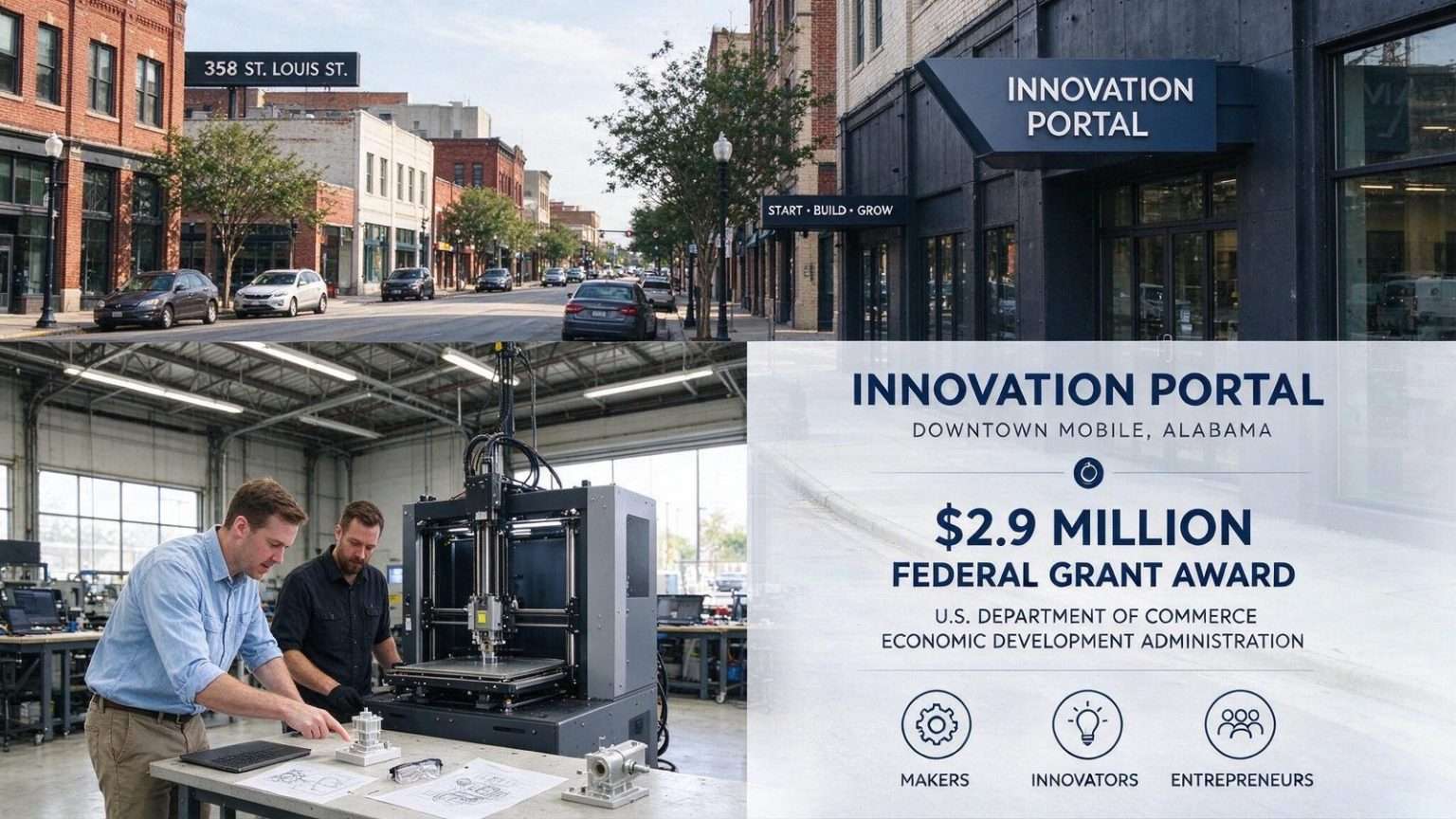
The Mobile Area Chamber of Commerce Foundation has been awarded a $2.9 million grant from the U.S. Department of Commerce’s Economic Development Administration to renovate a downtown Mobile building into Innovation PortAL, a new workspace designed to support local entrepreneurs. The federal investment marks one of the largest single infusions of economic development money into downtown Mobile’s emerging startup infrastructure, and it converts a long-vacant industrial property into a working home for small manufacturers and new companies.
The award was announced by Matt Erskine, deputy assistant secretary of commerce for economic development. The grant will fund renovation of the former Threaded Fasteners building at 358 St. Louis St., which will be transformed into a space aimed at helping entrepreneurs launch new business ideas or accelerate existing companies with support from industry experts, mentors and specialized training programs.
A 35,000-square-foot hub for makers
The project is the brainchild of the Mobile Area Chamber Foundation, according to Hayley Van Antwerp, Innovation PortAL’s executive director. The center is designed around a 35,000-square-foot floor plan geared toward manufacturing technologies and compatible businesses, and will include a prototyping lab once engineering and renovation work wraps up. Building plans also set aside additional space to accommodate future expansion, giving the facility room to grow as its tenant base matures.
A prototyping lab is the piece that small manufacturers and product startups in the region most often lack. Building a first version of a product traditionally requires access to industrial equipment, design software and fabrication know-how that individual entrepreneurs cannot afford on their own. By centralizing that capability downtown, Innovation PortAL aims to lower the barrier between an idea on paper and a product that can be tested, refined and manufactured commercially.
Local private foundations, private industry, the city of Mobile, Mobile County and the University of South Alabama collectively committed an additional $1.9 million in matching funds to the project. The breadth of that local match — spanning philanthropy, private business, two levels of local government and the region’s largest university — signals how broadly support for the project runs across Mobile’s economic development community, and it positions the federal grant as one part of a larger local investment.
Chamber leadership on the award
“We’re thrilled to receive this grant from the EDA. It helps propel the Innovation PortAL forward quickly. This project would have never been possible without Advancing Southwest Alabama and the recognition the manufacturing designation brought to the region,” Mobile Area Chamber president and CEO Bill Sisson said. The manufacturing designation Sisson referenced is a federal recognition that communities can earn to strengthen their position in competing for manufacturing-focused economic development resources, and it framed Mobile’s application to the EDA.
Van Antwerp said the project is expected to generate significant economic impact in its first five years, with projections calling for roughly 500 local jobs and support for more than 300 entrepreneurs whose companies could contribute an estimated $5 million to the local economy. Those projections put Innovation PortAL in the company of the incubators and maker spaces that have reshaped downtowns across the South, where shared workspace and technical support have proven capable of seeding businesses that stay and grow locally.
Innovation PortAL was set to welcome its first clients in the fall following the grant announcement. The pace reflects how much groundwork was already in place before the federal award arrived: the building had been identified, the design work scoped, and the local matching commitments assembled, so the EDA grant functions as the final piece that lets construction begin in earnest.
How entrepreneurs get in
Prospective tenants are required to complete an online application and submit business, promotion and sales plans; companies that are qualified as potential fits for the facility are then invited to pitch their business plans to PortAL staff and a governing board. The vetting process is designed to fill the space with companies that can use its manufacturing focus and mentoring resources rather than simply renting desks, and the governing board’s involvement keeps admission decisions aligned with the facility’s economic development mission.
For the entrepreneurs who are admitted, the value proposition extends beyond floor space. Mentorship from industry experts, specialized training programs, and proximity to other young companies working through similar problems are the amenities that incubators count on to accelerate their clients’ growth, and Innovation PortAL’s model bundles all three under one roof at 358 St. Louis St.
Part of a broader downtown strategy
The project reflects a broader effort by Mobile-area economic development groups to build out infrastructure supporting small manufacturers and startups downtown, part of a push tied to the region’s manufacturing designation and efforts to diversify the local economy beyond its traditional shipbuilding and port-driven industries. Mobile’s economy has long been anchored by big, capital-intensive employers — the port, the aerospace and shipbuilding giants on the river — and civic leaders have argued for years that the region also needs a pipeline of smaller homegrown companies to balance it.
Downtown Mobile has been the focus of that diversification strategy, with revitalized commercial blocks, an expanding residential population and a growing cluster of professional and creative businesses. Adding a 35,000-square-foot innovation hub to that mix links the city’s historic core to its industrial future, placing prototyping equipment and startup mentorship blocks from the waterfront where the region’s trade economy was built.
The EDA, as the federal government’s dedicated economic development agency, directs grant funding toward projects that promise measurable regional returns, and renovation of underused industrial buildings for innovation-focused reuse is among its most common investments. The $2.9 million award to the Chamber Foundation fits that pattern, pairing federal capital with the $1.9 million local match to complete a project that local partners had already committed to seeing through.
For the University of South Alabama, participation in the project ties academic engineering and business programs directly into the region’s startup pipeline, giving students and faculty a pathway to commercialize ideas and connect with local manufacturers. For the city and county governments, the matching investment is a bet that the projected 500 jobs and $5 million in local economic impact will more than repay the public contribution over time.
What happens at 358 St. Louis St. over the coming months will show whether that bet pays off. Renovation crews will transform the former Threaded Fasteners building, the prototyping lab will be fitted out, and the first cohort of client companies will move in and begin pitching their way toward production. If the projections hold, the facility will stand as an early landmark of Mobile’s effort to grow companies of its own — not just recruit them — in the decades after its manufacturing designation put the region on the federal map.
Entrepreneurs interested in the facility will find that the application process asks them to articulate their business, promotion and sales plans before they ever reach a pitch meeting, a discipline that incubator operators say separates viable ventures from wishful ones from the outset. Those who clear the staff screening and win approval from the governing board will join the first wave of tenants in a space built specifically to help Gulf Coast startups manufacture, refine and scale their products close to home.
The grant also carries lessons for how Mobile pursues federal resources going forward. The combination that won the EDA award — a completed building plan, a diverse local match already banked, and a federal manufacturing designation that framed the region’s story — is the same combination economic development groups can assemble for the next project. Civic leaders have described the award as validation of that approach, and the Chamber Foundation’s role as applicant keeps the project’s management within an organization that has decades of experience running regional initiatives.
For the neighborhoods around St. Louis Street, the renovation of a long-idle industrial building removes a visible gap in the downtown fabric and replaces it with daily foot traffic from entrepreneurs, mentors and trainees. Incubators of this kind generate steady activity — orientation sessions, pitch days, training workshops — that spreads to nearby restaurants and shops, which is part of why downtown revitalization advocates have tracked the project closely since the site was selected.
Between now and the fall opening of client services, the remaining work is largely logistical: completing the engineering phase, finishing the renovation the grant funds, and processing the first applications through the staff screening and governing board review. Each step moves the facility closer to operating at the scale its planners described, and each client company that arrives adds to the regional impact the EDA was told to expect when it committed its $2.9 million.
Regional observers will be watching two numbers in particular as the facility ramps up: how quickly the first 300 entrepreneurs move through its programs, and how many of the projected 500 jobs materialize at client companies within five years. Those were the projections presented to the EDA, and meeting them would cement Innovation PortAL’s place in the region’s economic development playbook. The facility’s supporters say the pieces are now in place — the building, the funding, the application pipeline and the mentoring network — and the fall arrival of the first clients will begin the real test of what a federally backed innovation hub can do for downtown Mobile.