Mobile Restaurant Owner Wages Public Battle Against Wells Fargo Over Disputed Fees
A downtown Mobile bar and restaurant owner has hung banners accusing Wells Fargo of mishandling tens of thousands in fees.
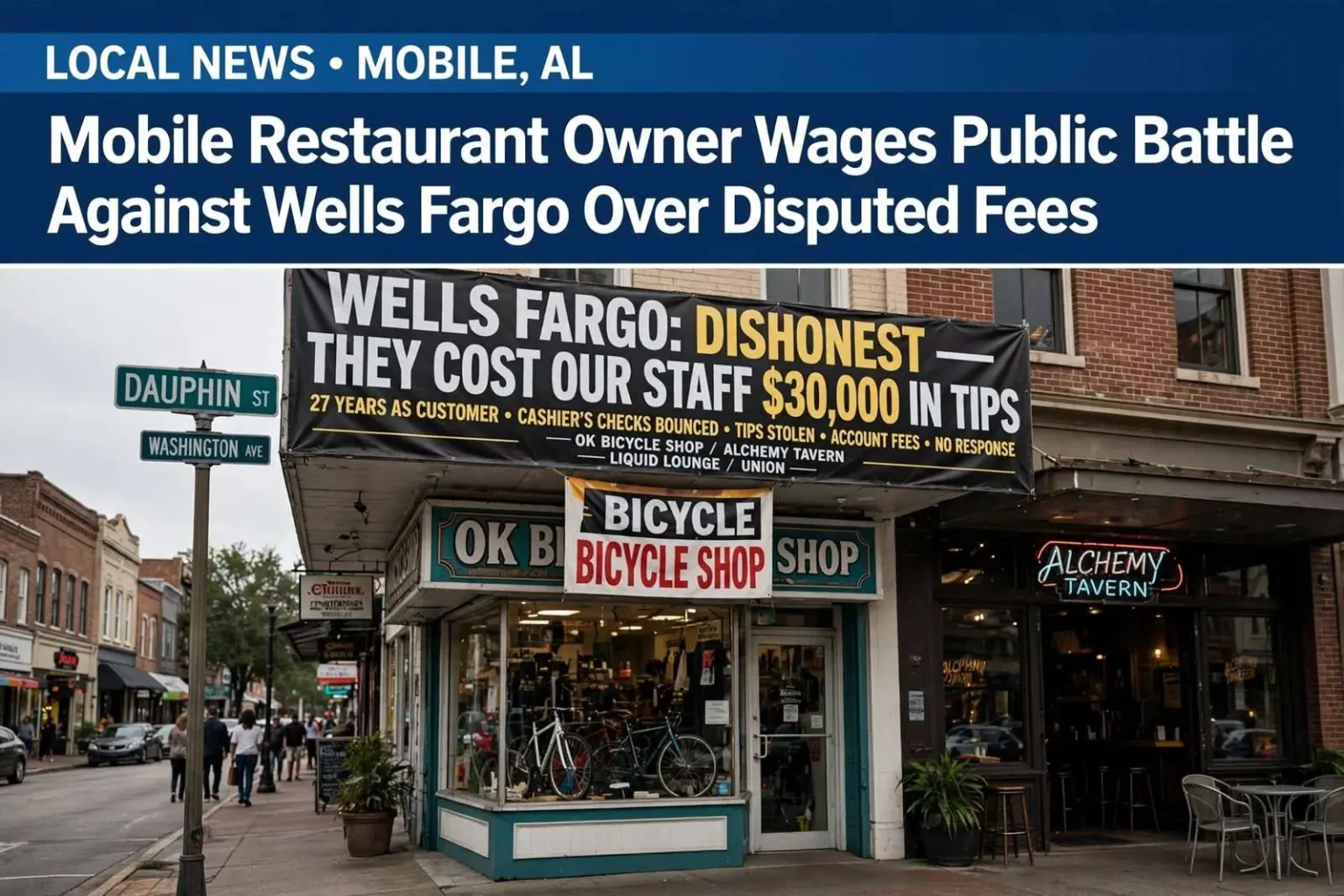
Anyone driving through downtown Mobile in recent weeks may have noticed a blunt message hanging outside a handful of local businesses: a banner accusing Wells Fargo of dishonesty, put up by a local restaurant and bar owner who says the bank has cost him tens of thousands of dollars. The banner is a rare public attack on a major national bank mounted from the front of a small business, and its visibility in one of the city’s busiest entertainment districts has made it a talking point among downtown regulars. Whatever the eventual resolution of the underlying dispute, the display has accomplished what its owner intended: it has gotten people asking what happened.
Jim Walker, who along with his brother Woody owns OK Bicycle Shop, Alchemy Tavern, Liquid Lounge and Union in downtown Mobile, first hung the banner outside OK Bicycle Shop near Dauphin Street and Washington Avenue. Since then, he’s put up matching signs at other properties around downtown, and says he plans to display one over a bridge facing Interstate 10 during a busy holiday weekend to maximize visibility. The four businesses form a notable slice of the local nightlife landscape, and each banner location was chosen for foot and vehicle traffic, extending the message well beyond the block where it started. The planned Interstate 10 placement would carry the accusation to commuters and visitors crossing the river into the city.
Walker says his frustration stems from years of financial disputes with the bank, which held the brothers’ business accounts for 27 years before they switched to a different bank this summer, paying a hefty fee to close out the relationship. A customer relationship of nearly three decades is unusual longevity in the banking world, and Walker has said the decision to leave was not made lightly, coming only after what he describes as years of unresolved problems. The closing fee, he notes, added a final insult to a parting that had already gone badly.
How the Dispute Began
According to Walker, the trouble traces back roughly four years, when the brothers’ credit card processing was moved to Wells Fargo from a previous vendor. He says the bank mistakenly classified their restaurants as retail businesses rather than tip-based service businesses, which meant tips customers left on card payments weren’t reaching the restaurants’ servers as expected. The classification error matters enormously in the restaurant business, where tipped servers depend on card tips being routed to them promptly, and where any interruption in that flow lands directly on the workers least able to absorb it.
Walker estimates the error affected roughly $30,000 in tip income and claims a bank employee initially told them to just keep the money rather than correct the mistake and distribute it properly to staff. Walker says repeated attempts to recover the funds went nowhere, with the bank eventually offering a fraction of what he says is owed. For the Walkers, the tip dispute was doubly corrosive: the money belonged to their employees, and the failure to make the servers whole placed the brothers in the position of owing their own staff for a bank’s error. Small-business advocates note that disputes of this kind are usually resolved quietly through the card processor’s error-resolution channels, and the fact that this one escalated to a public banner reflects Walker’s conviction that normal channels had been exhausted.
The Cashier’s Check Dispute
A second dispute arose last year when the brothers used inherited funds, delivered as cashier’s checks from a Wells Fargo branch out of state, to help purchase a former commercial property along Government Street. Walker says they deposited the checks locally and withdrew funds to complete the purchase, only for the cashier’s checks to bounce afterward through no fault of their own. A bounced cashier’s check is among the most unusual and disruptive banking failures a customer can experience, since cashier’s checks are the bank’s own obligation and are treated in ordinary commerce as nearly as good as cash.
He says the bank temporarily drained their accounts and maxed out credit lines while sorting out the error, leaving the business scrambling for weeks before Wells Fargo corrected the mistake. During that stretch, the Walkers had to keep four downtown businesses operating, meet payroll obligations and cover the property purchase while their own money was effectively frozen, a situation Walker describes as the most stressful period of the entire dispute. The eventual correction did not, in his telling, come with any acknowledgment of the disruption the error had caused in the meantime.
Walker says going public with the banners was less about seeking sympathy and more about giving other small business owners a warning about carefully reviewing account statements and fee structures. He has framed the signs as a form of consumer education born of experience, urging fellow owners to watch how deposits, card settlements and tips are actually posted rather than assuming the machinery is working. That warning has resonance in the restaurant industry, where card processing has grown complicated and where owners often discover errors only when employees or vendors raise questions months later.
Wells Fargo has not issued a public response to Walker’s claims. The absence of a statement is typical for a bank confronting customer complaints that remain private financial disputes rather than legal filings, and it leaves the story as the Walkers tell it standing unchallenged in public view. Without a response from the bank, observers are left to weigh the specificity of the account, the details of the classification error and the bounced cashier’s checks, all of which are the kinds of concrete particulars that are difficult to fabricate and easy to document in bank records.
The banners have drawn mixed reactions around downtown, as public protests against powerful institutions tend to do. Some business owners and patrons have expressed sympathy for the Walkers and admiration for the creativity of the protest, noting that a small restaurant group has few other ways to be heard against a bank of Wells Fargo’s size. Others have quietly questioned whether hanging accusations from a business facade is the most effective route to resolution, particularly if the dispute is ever taken to court, where public statements can complicate legal strategy. Walker, for his part, has said he is prepared to keep the signs up.
The dispute also touches on the changing economics of banking for small restaurants and bars. Card payments now dominate the revenue of most hospitality businesses, and the routing of card-based tips has become a critical operational function that was once handled with a cash drawer at the end of a shift. When the plumbing of that system fails, the consequences fall on tipped workers immediately, and the paperwork needed to prove what went wrong can take months to assemble. The Walkers’ experience, as they describe it, illustrates how a seemingly small vendor classification can cascade into a five-figure problem.
For downtown Mobile, the episode is playing out on one of its most visible commercial stages. The Dauphin Street corridor and surrounding blocks form the heart of the city’s nightlife economy, where restaurants, taverns and music venues depend on reputation and word of mouth, and where a public feud between a well-known local operator and a national bank has become part of the district’s conversation. Regulars at the four businesses have watched the banners go up one by one, and visitors encountering them often stop to photograph the message, extending its reach on social media far beyond what any single sign could accomplish.
For now, the banners remain a visible, if unconventional, form of protest in one of Mobile’s busiest entertainment districts. Walker has said the display will continue as long as the dispute remains unresolved, with the Interstate 10 placement planned for the coming holiday weekend as the campaign’s largest gesture yet. Whether the publicity prompts the bank to revisit the claims or simply stands as an owner’s account of a broken relationship, the episode has already made one thing clear: a small-business owner with a grievance and four downtown storefronts can command an audience that no formal complaint channel would ever provide.
The broader history of disputes between small businesses and large banks suggests why Walker chose publicity over silence. Individual customers in a fee dispute have limited practical leverage: the sums involved are usually too small to justify litigation that can cost more than the claim, and internal complaint processes can leave a customer feeling that the institution is judging its own conduct. Public protest inverts that balance by putting the institution’s name in front of thousands of its potential customers every day, a form of pressure that costs the protester little but the bank something it cannot easily measure. Whether that pressure changes anything in the Walkers’ case is unknown, but the calculation behind it is a familiar one among small-business owners who feel outmatched in private negotiations.