Hastie Seeks Acquittal on Lone Conviction After Corruption Trial Verdict
Mobile County License Commissioner Kim Hastie, cleared of 16 corruption counts, is now asking a judge to overturn her one remaining conviction.
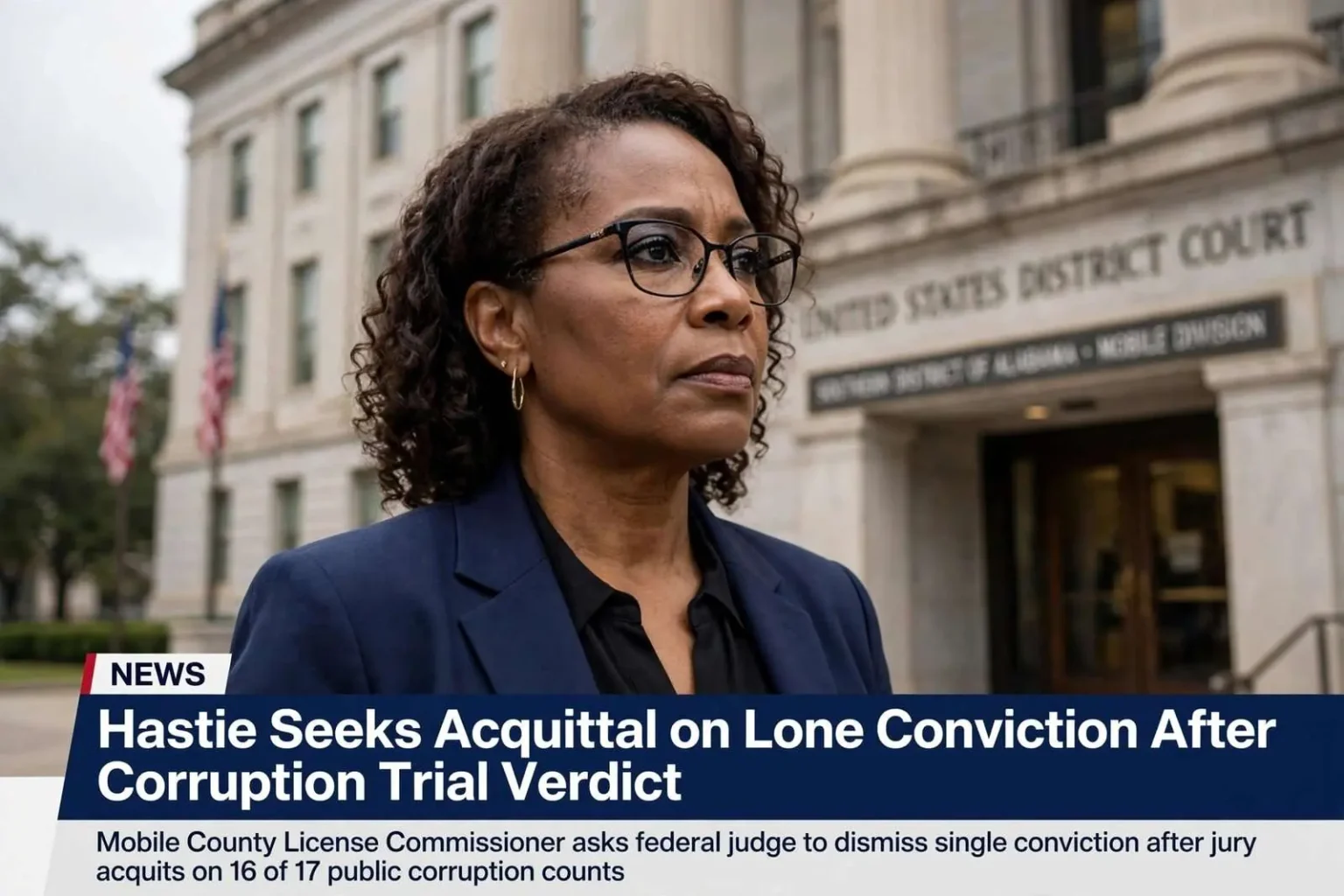
Mobile County License Commissioner Kim Hastie, who was acquitted of every felony public corruption count against her earlier this month, is now asking a federal judge to throw out the single charge on which jurors did convict her. The post-trial fight sets up a summer of legal maneuvering before her September sentencing, with both sides preparing to argue over the meaning and reach of a federal privacy statute.
Jurors found Hastie not guilty on 16 of 17 public corruption counts following her trial, but convicted her on one charge tied to the improper release of an email list compiled from people who had obtained driver’s licenses through her office. Prosecutors said the release ran afoul of the federal Driver’s Privacy Protection Act. The list in question was reportedly used by a mayoral campaign in 2013 to target potential voters.
The conviction carries a maximum penalty of a $5,000 fine, with no possibility of jail time. Sentencing on the charge is currently scheduled for September. The narrow scope of the penalty underscores how the case ended: after weeks of trial on sweeping corruption allegations, the only count that produced a conviction involved a list of email addresses rather than bribes, kickbacks or theft of public money.
What the defense motion argues
Hastie’s attorneys have filed a motion seeking either an acquittal on the remaining charge or a new trial, arguing that the privacy law prosecutors used to convict her does not apply to her office in the first place. In their filing, the attorneys contend that the Mobile County License Commission cannot simply be assumed to qualify as a “state department of motor vehicles” under the statute’s definitions, and that the release of email addresses specifically falls outside the kind of personal information the law was written to protect.
The Driver’s Privacy Protection Act, a federal law enacted in the mid-1990s, was written to stop states from selling or disclosing personal information collected by motor vehicle agencies after several high-profile crimes in which stalkers and criminals tracked victims through license records. The law generally covers photographs, Social Security numbers, driver identification numbers, names, addresses, phone numbers and medical or disability information drawn from motor vehicle records. The defense filing argues that many email addresses, unlike physical identifiers such as hair or eye color, reveal little or nothing about the person behind them and pose no comparable safety risk if disclosed.
Those two arguments — that the License Commission is not the kind of agency the law covers, and that email addresses are not the kind of data it protects — frame the acquittal request. If the judge agreed with either premise, the conviction could not stand. A new trial on the single count is the alternative remedy the defense requested if the court is unwilling to enter a judgment of acquittal outright.
The next deadlines
Prosecutors have until early July to respond to the motion. Once their brief is filed, the judge can rule on the paperwork or schedule a hearing where attorneys for both sides argue the questions in person. Post-trial motions of this kind are a routine stage of federal criminal procedure, but they carry real stakes here, because the motion is Hastie’s first formal chance to undo the verdict short of an appeal after sentencing.
A separate tax case still moving
The corruption case is separate from a related tax evasion charge facing Hastie and her husband, in which a federal judge declared a mistrial last month after jurors could not reach a unanimous verdict. Hung juries leave both sides where they started: the government may retry the case, and the defendants remain charged but not convicted. At the defense’s request, jury selection for that retrial has been pushed back, with the trial itself expected to follow later in the summer.
The scheduling overlap means Hastie will be preparing for two federal proceedings at once — the sentencing on the email list conviction in September and the retrial on the tax charge. Defense attorneys routinely seek delays in these circumstances to avoid splitting a client’s attention and resources between two courtrooms, and the judge’s accommodation of that request pushes both matters into the same busy stretch of the calendar.
The office at the center of the case
The Mobile County License Commission is the county office where residents obtain driver’s licenses, license renewals, vehicle tags, titles and related services. Offices of this kind sit at a peculiar intersection in Alabama government: they handle functions tied directly to state motor vehicle records while operating as county-level entities with their own commissioners and staff. That hybrid status is exactly what the defense motion seizes on, arguing that the Commission should not be automatically treated as a “state department of motor vehicles” for purposes of the federal privacy statute.
The case also drew attention because of the data involved. License offices across the state collect contact information from hundreds of thousands of customers, and the Hastie trial highlighted how little direction governs the handling of email addresses collected during transactions. Whatever the court decides on the motion, the case has already prompted questions from county officials about when and how customer contact data may be shared with outside groups, including political campaigns.
The wider context of the trial
The mixed outcome of the trial — 16 acquittals and one conviction — is likely to figure in both the defense motion and any later appeal. Hastie’s attorneys can point to the jury’s rejection of the bulk of the government’s case as evidence that the theories underpinning the prosecution failed, while prosecutors will note that jurors did agree on the email list count. Federal judges weighing Rule 29-style acquittal motions consider whether the government’s evidence at trial was legally sufficient, not whether the jury was right about the other counts.
For Mobile County residents, the proceedings have been a months-long civics lesson in how license office data, campaign outreach and federal privacy law intersect. A mayoral campaign’s use of an email list drawn from driver’s license transactions sat at the heart of the only conviction, and the defense’s core claim is that the law prosecutors invoked was never meant to reach that kind of information in the first place.
What happens at sentencing
If the motion is denied and the conviction stands, the September sentencing will proceed on a single count with a statutory maximum of a $5,000 fine. Under federal sentencing practice, a judge calculates a guidelines range based on the offense and the defendant’s history, but with no possibility of incarceration attached to this charge, the hearing would focus on the fine and any conditions the court imposes. A successful defense motion, by contrast, would erase the conviction entirely and leave the government to decide whether it wished to retry the count within the time the law allows.
Either way, the September date gives the court and both parties a fixed point on the calendar. Between now and then, the government’s early-July response will signal how hard it intends to fight to preserve the verdict, and any hearing that follows will likely be the last public argument in the case before sentencing.
What it means for the county
Hastie remains the elected License Commissioner of Mobile County while the litigation continues. County offices of this kind operate independently of the Mobile County Commission, with the commissioner responsible for the day-to-day administration of license and tag services that residents rely on for driving legally and registering vehicles. The case has hung over the office throughout the investigation and trial, and the resolution of the post-trial motions will determine how much of it remains outstanding heading into the fall.
The separate retrial on the tax evasion charge, expected later in the summer, means the legal questions raised by the case will remain in the public eye even after the court rules on the email list conviction. Between now and then, the defense’s narrow reading of the Driver’s Privacy Protection Act will get its test: a single judge, a single count and a single question of whether email addresses drawn from a license office database fall within a statute written to protect motor vehicle records from misuse.
Legal observers note that acquittal motions after a jury verdict succeed only in a narrow set of circumstances, but the defense here starts from an unusual position: the theory of the case turns entirely on statutory interpretation rather than disputed facts. Nobody disputes that the email list was released or that a campaign used it. The dispute is purely about whether the law Hastie was charged under covers that release at all. Questions of statutory scope are exactly the kind that judges can resolve on paper after briefing, which is why the motion may be decided without a hearing — and why the outcome is difficult for either side to predict.