Africatown Neighborhood Kicks Off Redevelopment Planning Meetings
Community leaders held meetings this week to gather resident input as Mobile begins a new phase of planning for Africatown's historic redevelopment.
Residents of Mobile’s historic Africatown district had a chance this week to weigh in on the future of their neighborhood as city officials kicked off the next phase of a long-term redevelopment planning effort. The meetings gave the community its first structured opportunity in the current process to shape how the area grows in the years ahead.
The Mobile City Council previously approved funding for a neighborhood revitalization plan covering the community located just north of downtown, hiring an Atlanta-based urban planning firm to guide the process. The consultants are being paid close to $50,000 to help conceptualize a plan aimed at guiding future economic development in the historically significant area. City officials have framed the investment as a down payment on a broader vision for a neighborhood that has waited decades for sustained public attention.
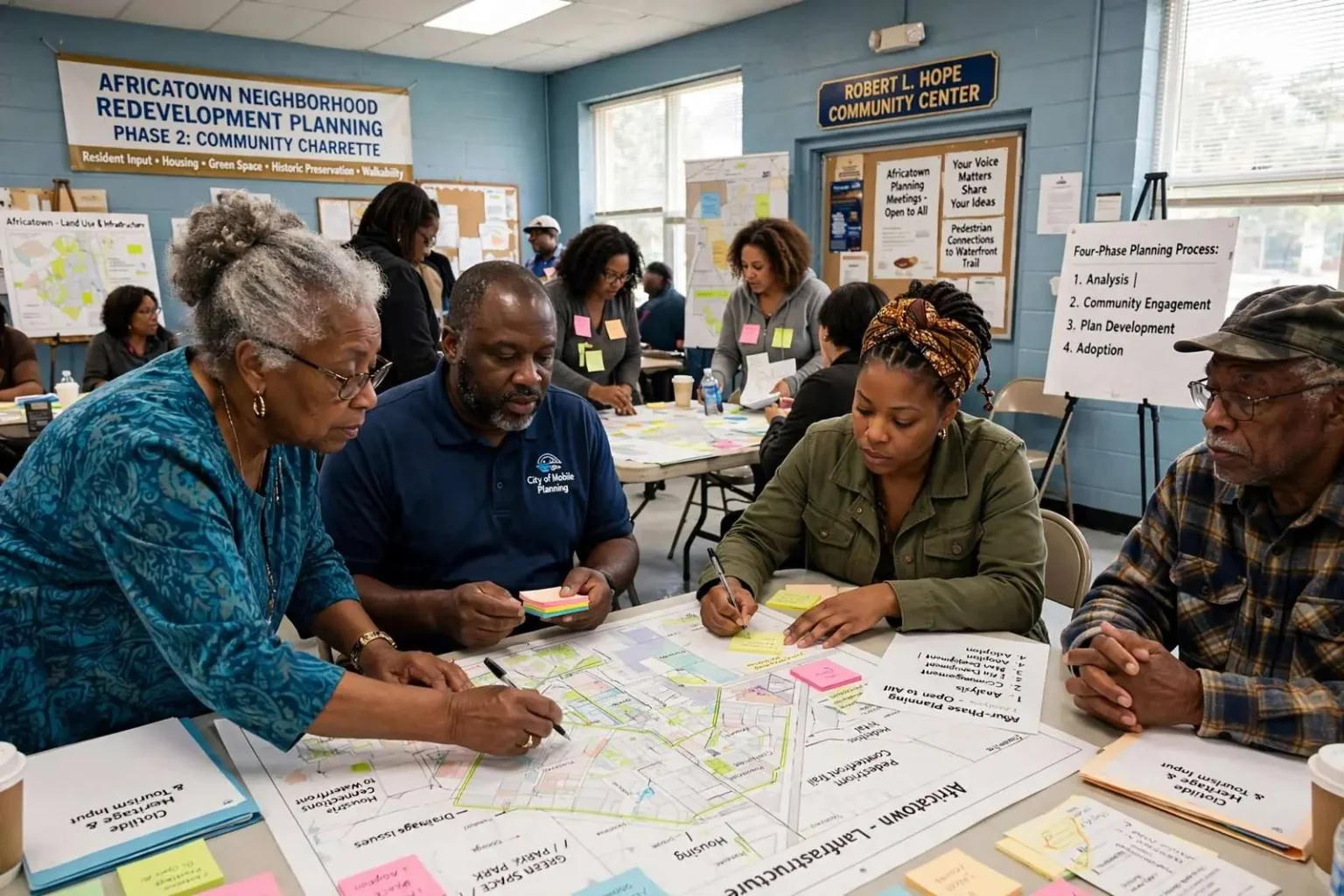
The project is being carried out in four phases: initial project analysis, community engagement and conceptual planning, plan development, and finally plan review and adoption. This week’s meetings mark the beginning of the second phase, giving residents a direct opportunity to shape the plan before more detailed proposals are drafted. The first phase, which examined existing conditions, land use patterns, infrastructure and demographics, laid the groundwork for the conversations now underway with the people who actually live in the district.
How Residents Are Being Heard
A community kickoff meeting was held Thursday evening at the Robert L. Hope Community Center, followed by a neighborhood charette session Friday, also at the Hope Community Center, allowing residents and stakeholders to work through ideas for the area in a more hands-on planning format. At the kickoff, consultants and city staff walked attendees through the purpose of the plan and the schedule for adopting it, while the Friday charette shifted the focus to maps, sketches and small-group exercises where participants could mark up ideas for housing, green space, business development and street improvements.
Planners use charettes precisely because they surface priorities that a standard public-comment session might miss. In Africatown’s case, longstanding community concerns have included industrial encroachment from surrounding heavy industry, blighted and abandoned properties, drainage problems, limited retail and dining options, and the need to preserve and interpret the neighborhood’s singular history. Residents have also pushed for improvements that make the neighborhood walkable and connected to Mobile’s growing waterfront trail network.
City planning officials say the goal of the current process is to produce a community-driven roadmap that can attract further public and private investment once the plan moves through its later phases. An adopted plan gives grant applications and development proposals a documented foundation, and officials note that neighborhoods with current plans are better positioned to compete for state and federal funding.
A Community Like No Other
Africatown holds deep significance in Mobile’s history, tracing its roots to the community founded by Africans who arrived aboard the Clotilda, the last known ship to bring enslaved people to the United States, after it reached Mobile Bay in 1859. After the Civil War and emancipation, the survivors of the voyage purchased land north of Mobile and built a self-sustaining community with its own churches, schools and businesses – one of the few places in America founded and continuously governed by Africans who had endured the Middle Passage.
The neighborhood has faced decades of industrial encroachment and population decline, and local leaders have pushed in recent years for renewed investment that honors its history while addressing infrastructure and economic needs. Paper mills and other heavy industry grew up around the residential core during the twentieth century, hemming in the community and contributing to environmental and health concerns that residents have raised for generations. The population, once in the thousands, has shrunk considerably, and many of the district’s historic structures have been lost to demolition and neglect.
National attention returned to Africatown in dramatic fashion when researchers confirmed the 2019 discovery of the Clotilda shipwreck in the Mobile-Tensaw Delta, decades after the schooner was secretly scuttled by those who smuggled the captives ashore. The discovery spurred a wave of new projects, including the Africatown Heritage House museum, which tells the story of the 110 people aboard the Clotilda and the community they built, and renewed planning efforts by the city, Mobile County and state agencies.
What Residents Want to See
Community input gathered this week and in sessions to come is expected to influence everything from streetscape and drainage improvements to the future of vacant parcels, historic property restoration and tourism development tied to the Clotilda story. Local organizations have long argued that heritage tourism can become an economic engine for the neighborhood, drawing visitors from around the country while keeping the benefits in the hands of residents rather than outside interests.
The planning consultants are expected to synthesize what they hear into concept alternatives, then bring draft recommendations back to the community before a final plan is prepared for review and adoption. That structure is designed to keep residents involved at every stage rather than presenting a finished document for a single up-or-down vote at the end. Officials have encouraged anyone with ties to the district – current residents, former residents, property owners, business operators and descendants of the Clotilda survivors – to participate.
Additional opportunities for resident feedback are expected as the planning effort progresses through the remaining phases, with more meetings anticipated before the plan reaches the Mobile City Council for formal adoption. Residents who missed this week’s sessions at the Robert L. Hope Community Center can follow the city’s planning department for announcements about future meetings and online input opportunities.
For a neighborhood that has watched previous studies sit on shelves, the measure of this effort will be implementation. Community leaders have made clear they expect the final plan to come with funding commitments and a schedule, not just a list of aspirations. City officials, for their part, say the process underway is intended to give Africatown the kind of detailed, community-endorsed blueprint that makes future investment possible – and to ensure that the people whose ancestors built the community have the leading voice in deciding what its next chapter looks like.
Why the Timing Matters
The timing of the planning effort comes amid a broader wave of momentum around Africatown. The heritage house museum has drawn steady visitation, the city and its partners have pursued grants for housing and environmental improvements, and regional organizations continue to promote the district’s story to a national audience. Planning officials say aligning a community-endorsed revitalization plan with that momentum could determine how much of the current attention translates into lasting, resident-centered growth over the next decade.
The Road Through Four Phases
The four-phase structure the city has adopted is a common framework for neighborhood planning. The initial analysis phase assembled baseline data: zoning, land ownership, traffic patterns, flood risk, housing conditions and demographic trends. The current engagement phase is where qualitative knowledge from residents gets added to that statistical picture, and planners say the difference matters – a map can show a vacant lot, but only residents can say whether it floods every heavy rain, whether it once held a beloved business, or whether the community wants it used for housing, gardens or commerce.
Plan development, the third phase, will translate those priorities into specific recommendations with cost estimates and responsibility assignments. The final phase, plan review and adoption, brings the document before city boards and the Mobile City Council, making it part of the city’s official planning framework. Once adopted, the plan can be referenced in zoning decisions, capital budgeting and grant applications for years to come.
Robert L. Hope Community Center itself has long served as the civic heart of Africatown, hosting everything from youth programs to neighborhood association meetings, which is part of why organizers chose it for both the kickoff and the charette. Holding the sessions inside the neighborhood, rather than across town, was a deliberate choice to make participation as easy as possible for older residents and families without transportation.
Planning officials and consultants have stressed that no decisions have been made yet about specific properties or projects – that is precisely what the engagement phase is for. They are asking participants to think big and be specific: what would make it easier to live in Africatown, start a business there, or visit its historic sites. The answers collected this week will be combined with upcoming sessions into a public summary so residents can see how their input shaped the recommendations that follow.
As the process continues, the city says updates on meeting dates, draft materials and comment opportunities will be shared through its planning department and community partners in the district, so that the widest possible cross-section of the Africatown community can stay involved from start to finish.