University of South Alabama Mobile
Overnight Shooting at Mobile Motel Leaves One Injured, Man Jailed
A man was booked into Mobile County Metro Jail after officers responding to reports of shots fired found two men fighting over a loaded handgun.
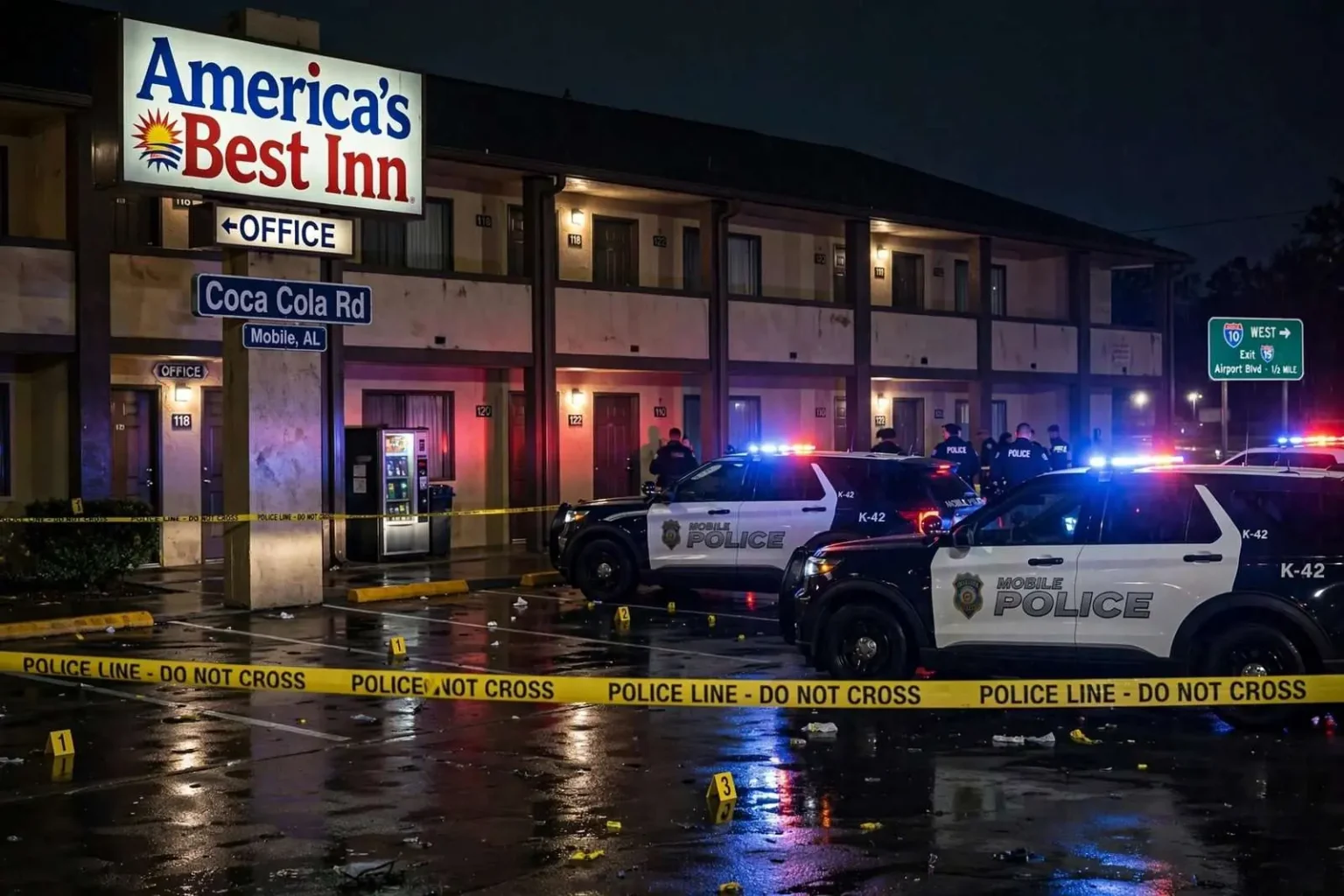
A Mobile man was in the Mobile County Metro Jail by dawn after an early-morning shooting outside a motel near Interstate 10 left another man wounded, according to the Mobile Police Department. Officers responded to a report of shots fired at the America’s Best Inn on Coca Cola Road at around 1:30 a.m. When police arrived, they found two men physically struggling over a handgun, according to a police spokeswoman with the department.
One of the men suffered a single gunshot wound to the stomach during the altercation. Medics transported him to the University of South Alabama Medical Center, the region’s major teaching hospital, where he was listed in stable condition. Police did not release his name, and it was not clear whether he would face any charges of his own once he recovers — a determination that will hinge on what investigators conclude about his role in the fight over the weapon.
Arrest at the scene
Officers detained 47-year-old Edward Cordell Burks of Mobile at the scene. He was booked into Mobile County Metro Jail on one count of second-degree assault around 5 a.m., according to jail records, and remained held as of later that morning. The span of several hours between the shots-fired call and the booking reflects the groundwork that unfolds before an arrest is formalized: securing a motel parking area in the dark, canvassing for witnesses who scattered at the sound of gunfire, photographing and collecting evidence, and sorting out which of the two struggling men had been in control of the weapon when it discharged.
A Mobile Police Department spokeswoman said investigators had not yet determined what led to the confrontation between the two men. No further details about the relationship between the men involved, or what preceded the struggle over the weapon, were released as the investigation continued into the following days. Police also did not indicate whether either man was a registered guest at the motel or whether they knew each other before the confrontation began — questions that will shape both the charging decisions and how the case is ultimately presented.
A corridor long familiar to police
The America’s Best Inn sits along a stretch of Mobile near Interstate 10 that has seen periodic police activity tied to the corridor’s mix of budget hotels and commercial development. The area around Coca Cola Road is one of the city’s crossroads zones, where travelers’ lodging, strip retail and late-night traffic converge along the approaches to the interstate. Corridors like that one present a recurring challenge for patrol officers: the people involved in a late-night incident are often passing through rather than local, witnesses may be checked out and gone by morning, and the evidence trail can narrow quickly once daylight arrives.
Overnight shots-fired calls are among the most resource-intensive runs a patrol shift can face. Responding officers must lock down the scene, call out investigators and coordinate with medics, all while the location itself — a motel with exterior room doors and open parking areas — offers little in the way of controlled access. In this case, officers arriving in the early morning hours found the situation still in motion, with two men grappling over a single handgun and one of them already wounded.
The charge and the law behind it
Second-degree assault is a Class C felony under Alabama law, a category that generally covers the intentional or reckless infliction of serious physical injury on another person. A conviction can carry a prison sentence measured in years, and the charge can carry additional weight if a firearm was involved in the underlying dispute — even when it was allegedly the victim’s weapon that discharged during a struggle rather than one brought by the person now facing charges. How prosecutors ultimately frame the case will depend on the account investigators assemble from the scene, the forensic evidence and the statements of the men involved.
Charges filed in the hours after a shooting are rarely the final word. District attorneys routinely review the file as detectives develop it, and counts can be added, amended or dropped as witnesses come forward and forensic results return. In a case built around a struggle over a gun, the mechanics of the weapon itself — where it was recovered, how many rounds were fired, whether any prints or residue were found — often prove as important as the statements taken at the scene.
What remains unknown
Investigators had released little about the men themselves beyond the suspect’s name, age and city of residence. They had not said who brought the gun to the motel, why the two men were together in the parking area, or what sparked the fight between them. No details about the relationship between the men, or what preceded the struggle over the weapon, were made public in the days after the shooting, and police did not rule out any of the possible roles the wounded man may have played — initial aggressor, intended victim, or simply another participant in a fight that spiraled out of control.
The Mobile Police Department relies heavily on witnesses and public tips in cases like this one, where the physical evidence may explain how the gun discharged but not why two men ended up fighting over it in a motel parking lot in the middle of the night. Anyone with information about the incident was asked to contact the Mobile Police Department. Even small details — a description of the men’s activities earlier in the evening, or who was seen entering or leaving the motel — could help establish the sequence that led to the gunfire.
The timing of the incident also matters for how it moves through the system. An arrest made around 5 a.m. means the initial paperwork, the probable-cause affidavit and the first court appearance all fall into the same day, often before the full picture of the night’s events has emerged. Detectors typically spend the following days re-interviewing participants once their accounts have stabilized, seeking surveillance footage from the motel and neighboring businesses, and waiting on lab results that can confirm or rule out key details about the weapon.
What a second-degree assault case involves
Assault cases built on mutual struggles present particular questions for prosecutors. Alabama’s assault statutes distinguish between degrees of seriousness based on the severity of the injury and the circumstances of the act, and the presence of a firearm raises the stakes of any physical confrontation regardless of whose hand was on the weapon when it went off. A defendant’s awareness that the other party was armed, and any conduct that escalated the dispute toward the gun, can matter as much as the mechanics of the shooting itself when the case is evaluated.
Because the wounded man survived and remained in stable condition, detectives had room to continue their work after the arrest. Police said the case remained under investigation, and additional charges were considered possible pending both the outcome of that investigation and the condition of the man who was shot. Whether he faces charges of his own once he recovers remained an open question — one investigators indicated could not be answered until the full sequence of events in the parking lot is established.
The days ahead
For now, the case sits where many overnight shootings do in their first days: one man recovering in a hospital bed, another in a jail cell booked on a single felony count, and detectives working to fill in the hours before 1:30 a.m. that no one has yet explained publicly. Jail records showed Burks remained held as of later that morning, and police said the investigation would continue into the following days, with any additional charges to be announced if and when the evidence supports them.
The shooting also serves as a reminder of how quickly ordinary late-night stops and encounters along the interstate corridor can turn dangerous. A dispute that might have ended in a shoving match became a felony case the moment a loaded handgun entered the picture, and the outcome for both men now rests with investigators and prosecutors rather than the two people who were struggling over the weapon when police pulled into the lot. Anyone with information was again asked to come forward through the department’s regular channels as the investigation proceeds.
For residents and business owners along the corridor, incidents like this one underscore the importance of reporting what they see in the hours around such events. Motel guests often come and go without realizing they may have witnessed part of a felony investigation, and security cameras at nearby businesses are frequently the only neutral record of who arrived and when. Detectives said the department’s request for information remains open as the case moves forward.
The University of South Alabama Medical Center, where the wounded man was taken, has long served as one of the primary receiving hospitals for serious trauma across the Mobile area, handling cases that smaller facilities are not equipped to treat. A single gunshot wound to the stomach is the kind of injury that typically requires surgery and extended recovery even when the patient is listed in stable condition, which is why investigators said the man’s condition remains a live factor in how the case develops.