New Orleans’ The Bridge Trio Brings Modern Jazz to Mobile’s GCEH Jazz Fest
New Orleans' The Bridge Trio joined Donald Harrison Jr., Karmilla Ali and the Excelsior Band at Mobile's 14th annual Gulf Coast Ethnic & Heritage Jazz Fest.
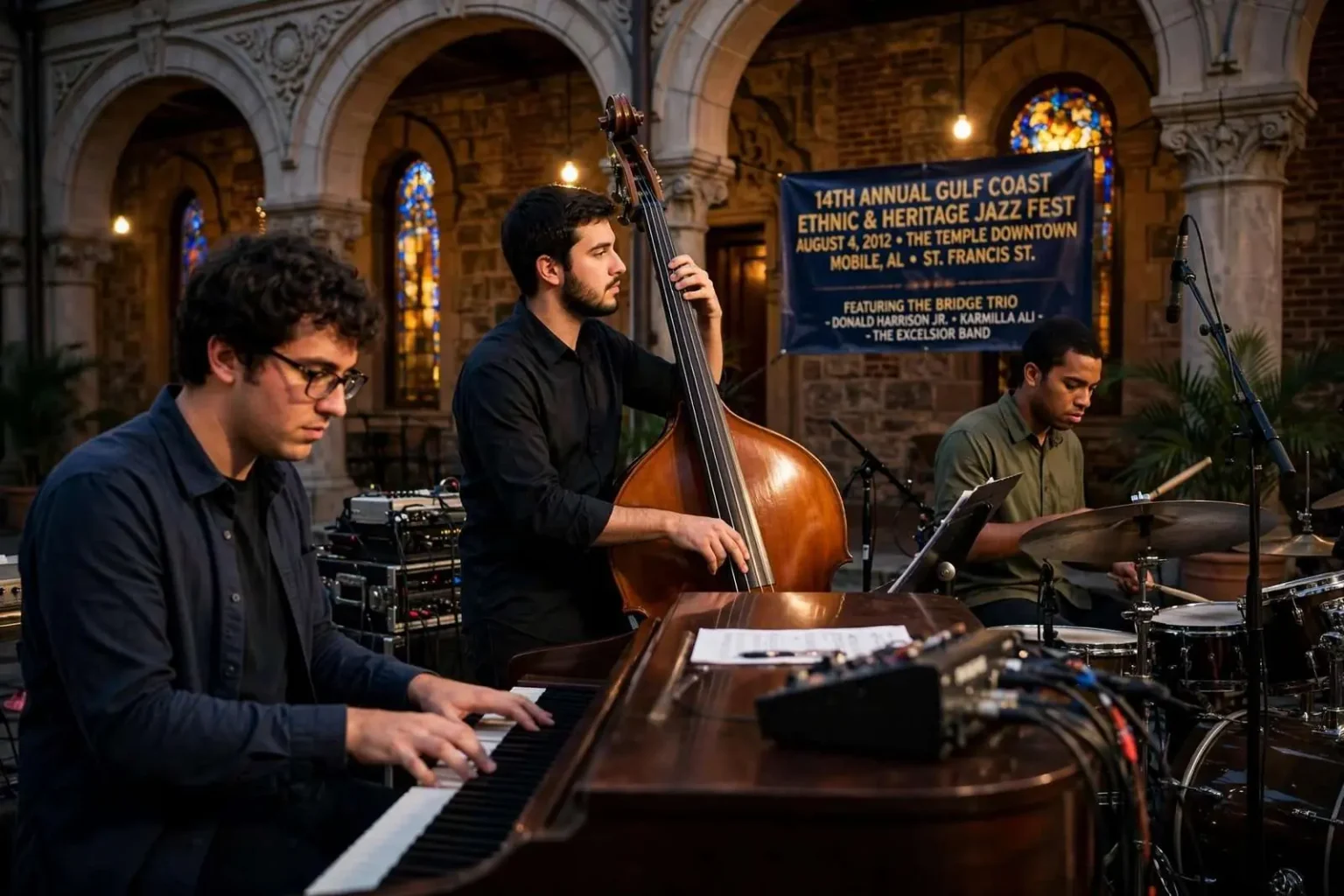
The Bridge Trio, a rising modern-jazz group out of New Orleans, was set to appear at Mobile’s 14th Annual Gulf Coast Ethnic & Heritage Jazz Fest on Saturday, August 4, 2012. The evening program ran from 4:30 to 9 p.m. at The Temple Downtown on St. Francis Street, sharing the bill with saxophonist Donald Harrison Jr., vocalist Karmilla Ali and Mobile’s historic Excelsior Band.
Pianist Conun Pappas, bassist Max Moran and drummer Joe Dyson first came together at the New Orleans Center for the Creative Arts, where they studied with the late Alvin Batiste. The three went on to perform around the world as Harrison’s rhythm section — including a stop at the 2011 edition of the same Mobile festival — before releasing their self-titled debut album.
The trio’s arrival at the festival carried a homecoming quality. Playing Mobile again meant returning to a stage they had shared with their bandleader the year before, this time as leaders presenting their own music to a Gulf Coast audience that had already heard them in another role.
Deep Roots, New Directions
Reviewing the record for Offbeat Magazine, Mark LaMaire wrote that the trio is “deeply connected to the roots of New Orleans music while, similar to their mentor, never shying away from taking the music in new directions,” calling the debut “a modern-jazz gem” of original material “played with soul, dynamism and musical sensibility.”
What sets the group apart, LaMaire argued, is its focus on ensemble playing rather than sheer virtuosity. While each player shows “incredible dexterity,” he noted, the emphasis stays on “making music as an ensemble, gracefully weaving textures over ever-changing dynamics” — a maturity he traced to long stretches onstage and off alongside Harrison and Batiste.
That judgment reflects the trio’s unusual apprenticeship. Batiste, the Baton Rouge-born clarinetist and educator, shaped generations of New Orleans players through his teaching, blending the city’s traditional vocabulary with modern harmonic ideas. His students at the New Orleans Center for the Creative Arts — the performing arts school whose alumni include a remarkable share of the city’s youngest generation of jazz musicians — absorbed both the history and the expectation that tradition be carried forward, not merely preserved.
Playing as Donald Harrison’s rhythm section added the other half of the trio’s education. Harrison, a New Orleans saxophonist with roots in the city’s Indian tradition and a career stretching from the Jazz Messengers onward, tours relentlessly, and his young band learned to listen, react and shape a performance night after night in front of audiences around the world.
A Downtown Mobile Summer Tradition
The 2012 festival marked the 14th annual edition of the Gulf Coast Ethnic & Heritage Jazz Fest, which has long paired New Orleans and nationally recognized artists with Gulf Coast talent such as the Excelsior Band, a mainstay of Mobile music since the 1880s. The Temple Downtown, a historic former temple in the heart of downtown Mobile, has been among the festival’s signature venues.
The festival’s format reflects its mission. By programming established names alongside hometown performers and young ensembles, the event gives local audiences a bridge between the Gulf Coast scene and the wider jazz world — and gives regional musicians a chance to share a bill with the artists whose records they study. An evening that moves from the Excelsior Band’s brass-flecked heritage sound to a modern piano trio and a headlining saxophonist traces, in a single program, the range of what the music has become along the Gulf Coast.
The setting contributes its own atmosphere. The Temple Downtown stands among Mobile’s most distinctive historic buildings, and its sanctuary spaces have hosted the festival’s evening programs with acoustics and architecture that concertgoers rarely encounter. St. Francis Street places the venue in the middle of downtown’s revival, within walking distance of Bienville Square and the restaurants and galleries that have grown up around it.
The Bridge Between Cities
The trio’s name fits its role. New Orleans and Mobile share the deepest musical and cultural connections on the Gulf Coast — Carnival traditions, brass bands, Creole heritage and a century of musicians crossing the bay in both directions. A New Orleans group playing Mobile is less a visit than an exchange along a well-traveled line, and the festival has built its identity on that exchange.
For the young players, the 2012 date also marked a milestone in their own trajectory. A self-titled debut album, international touring credits and a return engagement at a respected festival all arrived before any of the three had reached thirty, positioning the trio among the promising groups emerging from New Orleans in the years after the city’s post-storm musical resurgence.
Audiences at the festival’s evening program got the full arc of a Gulf Coast jazz education in one sitting: the Excelsior Band’s link to the 1880s, a vocalist’s contemporary take, the trio’s modern direction and the headlining mastery of Donald Harrison Jr. — the same musician whose rhythm section had become, by that summer, a band of its own.
The Excelsior Band’s Living History
Sharing the program with the Excelsior Band gave the evening a thread of continuity few festivals can offer. The Excelsior has paraded and performed in Mobile since the 1880s, making it one of the oldest continuously operating bands in the country. Its brass-band sound — the ancestor of the music Mobile audiences hear every Mardi Gras — connects the city’s street culture to the broader jazz lineage, and its presence on festival bills underscores how living that history remains.
The contrast in programming is deliberate. Brass-band heritage and modern trio jazz come from the same root, and hearing them in sequence lets listeners hear the evolution of the music itself — from street parades and social aid clubs to the harmonically ambitious ensembles that New Orleans conservatories now produce.
Batiste’s Legacy on Stage
Alvin Batiste’s influence loomed over the trio’s appearance even after his death. Known to generations of listeners as a clarinetist of rare imagination, Batiste spent decades teaching, and the musicians he mentored populated the bands that define modern New Orleans jazz. For his students, carrying his lessons onto festival stages is a continuing act of homage; for audiences, it means the teacher’s ideas keep circulating through players who were teenagers when they first heard them.
The trio’s own record gave Mobile audiences a preview of what to expect: original compositions, trio interplay built on listening rather than flash, and the rhythmic authority that comes from years of accompanying a saxophonist of Harrison’s stature. Critics had already flagged the group as one worth following; the festival appearance gave Gulf Coast listeners the chance to hear why in person.
For Mobile, the 2012 edition of the Gulf Coast Ethnic & Heritage Jazz Fest did what the previous thirteen had done: it brought the region’s musical family together for an evening — New Orleans and Mobile, veterans and rising artists, brass and piano — under one historic roof on St. Francis Street. The Bridge Trio’s stop was one stop on a long itinerary, but it fit the festival’s purpose exactly, and it left the audience with another thread connecting the Gulf Coast’s jazz past to its future.
NOCCA and the New Orleans Pipeline
The New Orleans Center for the Creative Arts deserves mention for the role it played in the trio’s formation. The school’s jazz program has functioned as a pipeline for decades, admitting young musicians from across the region and putting them in classrooms with working professionals. Students who pass through its doors emerge with repertoires, habits and relationships that shape the city’s music for years afterward — and in the case of Pappas, Moran and Dyson, the program produced not just three players but a working unit, formed while they were still students and preserved as they advanced.
Rhythm sections that survive that long are unusual. Most young musicians cycle through bands as opportunities change, but the three members of the Bridge Trio moved together from classrooms into Donald Harrison’s band and then into a project of their own, a continuity that explains the ensemble instincts critics noticed in their debut. Hours spent sharing a bandstand produce a vocabulary of glances and anticipations that cannot be rehearsed into existence quickly, and the trio had accumulated years of it before recording a note of their own material.
The Festival’s Place on the Calendar
The Gulf Coast Ethnic & Heritage Jazz Fest’s early-August slot has made it a fixture of Mobile’s summer, arriving in the season’s hottest weeks with an evening program that gives audiences a reason to come downtown after sunset. Its longevity — 14 editions by 2012 — placed it among the region’s established cultural events, sustained year after year by organizers committed to celebrating the Gulf Coast’s musical heritage and its present-day practitioners.
The festival’s emphasis on ethnic and heritage traditions also sets it apart from jazz events that program only contemporary headliners. By billing the Excelsior Band and other community institutions alongside touring artists, the event treats the region’s full musical history as part of the show, and audiences leave with a sense of how deeply jazz is rooted in Gulf Coast communities on both sides of Mobile Bay.
For the visiting trio, playing the festival meant joining that lineage for a night — and for the local musicians and students in the crowd, watching three young New Orleanians lead their own band offered a picture of where the music goes next. The evening’s bill, from 1880s brass tradition to 21st-century trio modernism, was the festival’s mission in miniature.