Citronelle Pastor Indicted on 9 Counts Including Rape and Sodomy
Gregory Renee Adams of Citronelle faces nine felony counts including rape; alleged victims include girls as young as 12, per testimony.
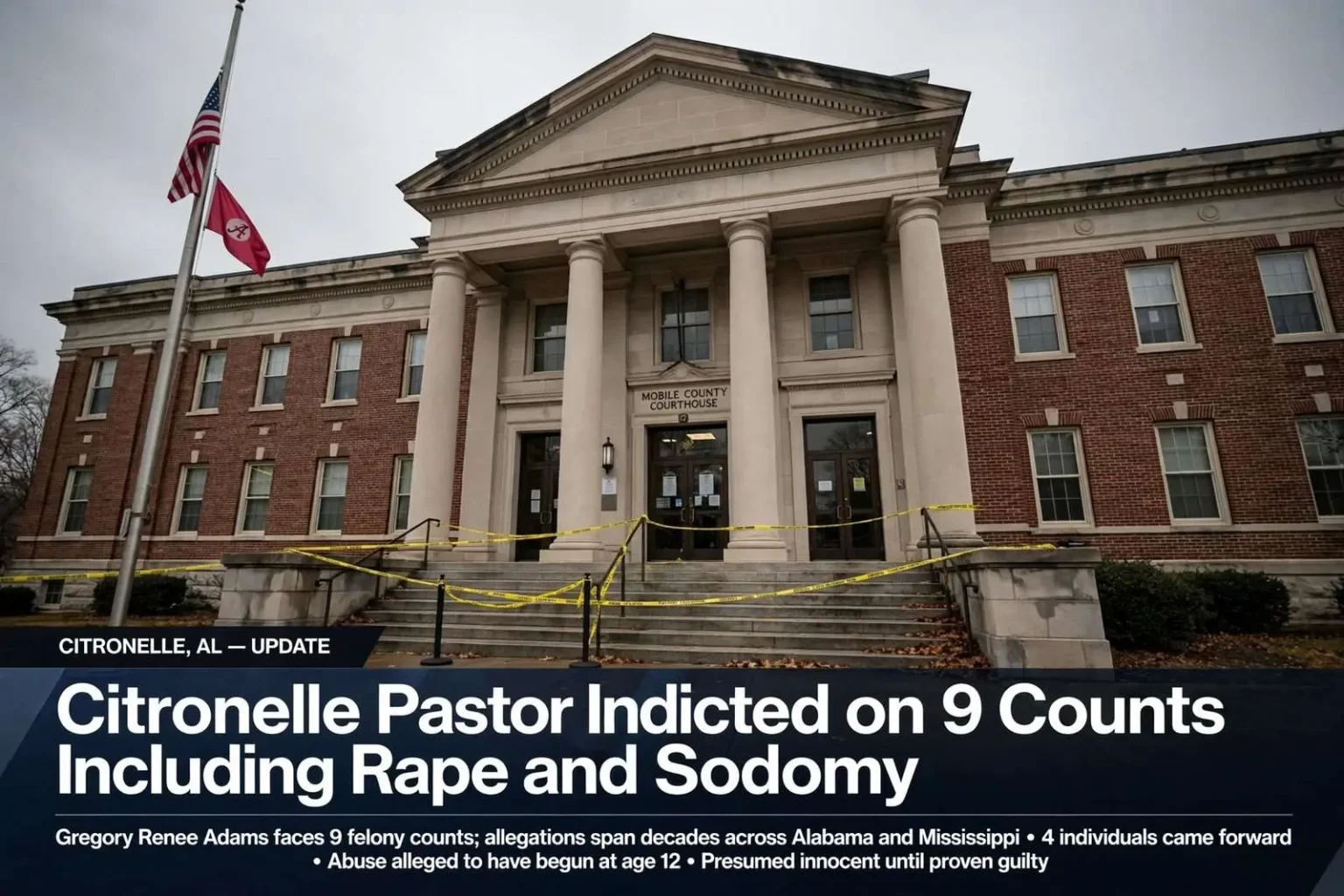
A Citronelle pastor has been indicted on nine felony counts alleging sex crimes against victims as young as 12 years old, according to court proceedings, in a case that investigators say spans decades and crosses state lines.
Court records show Gregory Renee Adams was indicted on five counts of rape, two counts of sodomy and two counts of sexual abuse by force. The charges stem from allegations made by four people who came forward accusing Adams of sexually assaulting them, with two saying the abuse began when they were 12 years old.
Testimony in the case indicated the alleged abuse spanned decades and crossed state lines. Mobile police investigators allege Adams used his position as a pastor to encounter his victims, traveling frequently to churches in Citronelle and in Waynesboro, Mississippi.
Details of those allegations emerged in court testimony, where prosecutors laid out the framework of a case built on accounts stretching back years. Prosecutors have not tried the case, and the indictments are formal accusations — Adams is presumed innocent unless and until proven guilty.
The Indictment and the Charges
An indictment is not a conviction. It is the formal charging document returned by a grand jury after hearing evidence presented by prosecutors, and it sets the case on the path toward trial. In Adams’ case, the nine counts combine three distinct Alabama offenses: rape, sodomy and first-degree sexual abuse by force — each a felony carrying the potential for significant prison time.
The grand jury’s decision to return multiple counts reflects the structure of Alabama’s criminal code, which separates conduct that might seem similar to lay observers into distinct offenses with distinct elements. Prosecutors will have to prove each count on its own terms, and juries in such cases frequently return mixed verdicts, convicting on some counts while acquitting on others.
The ages alleged in the case — with victims as young as 12 — add an additional layer of seriousness under Alabama law, where offenses against children carry enhanced penalties. Two of the four people who came forward told investigators the abuse began when they were 12 years old, according to court testimony.
How the Case Came to Light
According to investigators, the case began to take shape when four people came forward with accounts of sexual assault by Adams. Their accounts, taken together, described abuse spanning decades — a time frame that required investigators to document allegations reaching far into the past, and across state lines.
Mobile police investigators allege that Adams used his position as a pastor to encounter his victims. The role of a clergy member, they said, gave him access to and trust within the congregations he served, and his travel between churches extended his reach across the region.
The alleged conduct stretched between two communities separated by the Alabama-Mississippi line: Citronelle, a city in northern Mobile County where Adams pastored, and Waynesboro, Mississippi, the county seat of Wayne County just across the border. Adams traveled frequently to churches in both communities, according to investigators, and the indictment’s cross-state dimension highlights the coordination required between Alabama investigators and authorities in Mississippi.
The Communities Involved
Citronelle sits at the northern edge of Mobile County, a city of a few thousand residents surrounded by timberland and farmland. It is a close-knit community where churches serve as anchors of civic life, hosting not only worship but youth programs, community gatherings and family events. News of the indictment has reverberated through that fabric, as allegations against a pastor inevitably do in a town of its size.
Waynesboro, Mississippi, about a half-hour’s drive north across the state line, is the seat of Wayne County and similarly rooted in the rural culture of the Pine Belt. The connection between the two communities runs along the highways of south Mississippi and north Mobile County, a corridor where families routinely cross the state line for work, worship and shopping.
That regional pattern is central to investigators’ account of the case. Allegations that span both states and multiple church communities required detectives to piece together a timeline reaching across jurisdictional boundaries, and the testimony describing that timeline has now become part of the public court record.
Abuse in Institutional Settings
Cases alleging sexual abuse by clergy members draw on a body of hard experience accumulated by prosecutors and victim advocates over decades. Research and case histories have shown that abusers in positions of religious authority often maintain access to victims across long periods, relying on the trust conferred by their role and on the reluctance of victims — and sometimes their families — to come forward against a figure of standing in the community.
Alabama law provides avenues for prosecuting abuse that took place years or decades ago in certain circumstances, particularly where the victims were minors at the time. The length of time between the conduct and the charges is often a central battleground in such cases, both in the courtroom and in the grand jury room, where prosecutors must persuade jurors that delayed reports are consistent with the way victims of childhood abuse commonly come forward.
Advocates for survivors note that most victims of childhood sexual abuse do not report it immediately, and that many wait years — often until adulthood — before disclosing. The four people who came forward in this case, according to testimony, did so as adults describing abuse that began when some of them were children.
What Happens Next
With the indictment returned, the case moves into the pretrial phase of the Mobile County court system. Adams will be arraigned on the nine counts, where the charges are formally read and a plea is entered. From there, the case proceeds through pretrial motions, discovery and, unless it is resolved earlier, trial.
Prosecutors have not tried the case, and no trial date has been announced. The evidence they will present — testimony from the four people who came forward, investigator accounts, and documentation of the alleged timeline — will be tested in court, where Adams has the right to confront the witnesses against him and to present a defense.
Until that process runs its course, the presumption of innocence governs. The indictments are formal accusations, and whether the nine counts are proven will be determined by a jury — the same mechanism through which the four people who came forward will have their accounts heard in a public courtroom.
The Role of the Grand Jury
The grand jury occupies a distinct place in Alabama’s criminal process. Unlike a trial jury, it does not decide guilt; it decides whether prosecutors have presented enough evidence to justify formal charges. Its proceedings are closed to the public, the standard of proof is far lower than at trial, and the accused has no right to appear or present a defense at that stage.
That structure explains why indictments are described as accusations rather than findings. When the grand jury in this case returned nine counts against Adams, it determined that the evidence presented by prosecutors warranted putting the allegations before a trial jury, where the state will bear the burden of proving each count beyond a reasonable doubt.
The nine-count structure also gives prosecutors flexibility. At trial, they can present the full range of alleged conduct, and jurors can evaluate each count separately — a significant difference from an all-or-nothing single charge, and one that shapes how cases alleging long-running abuse are ultimately resolved.
The Penalties at Stake
The offenses named in the indictment carry some of the stiffest sentences in Alabama’s criminal code. Rape convictions can carry terms measured in decades, and when the alleged victim was a child, the sentencing ranges grow steeper still. Sodomy and first-degree sexual abuse likewise carry substantial maximum terms, and consecutive sentences on multiple counts can extend any eventual sentence dramatically.
Sentencing in Alabama also involves the state’s Habitual Felony Offender Act, which enhances penalties for defendants with prior felony convictions, and sex offense convictions carry additional consequences after release, including mandatory sex offender registration and community notification requirements under state law.
Those stakes help explain why cases of this kind are contested vigorously and why they take time. Both sides know that a single trial can determine the course of a defendant’s life, and the pretrial phase — motions, hearings and discovery — is where much of that contest is fought before a jury is ever seated.
Resources for Survivors in the Gulf Coast Region
Cases like this one draw attention to the resources available to survivors of sexual abuse in the region. In Mobile County, the district attorney’s office works with victim service officers who guide survivors through the criminal process, and the family justice center model brings prosecutors, counselors and advocates under one roof for people reporting abuse.
Statewide, the Alabama Department of Child Abuse and Neglect Prevention funds local prevention programs, and child advocacy centers across the region conduct forensic interviews with children in settings designed to be less traumatic than repeated questioning by investigators. Hotlines operated by rape crisis centers and the national child abuse hotline accept calls around the clock.
Advocates emphasize that reports can be made decades after abuse occurs, and that law enforcement agencies, including Mobile police, accept reports of abuse committed years earlier. In cases where the alleged conduct crossed state lines, as investigators describe here, reports can be made to agencies in either state, which coordinate through multi-jurisdictional task forces.
A Case That Will Take Years to Resolve
From indictment to resolution, felony cases of this magnitude typically move through the courts over the course of years, and a nine-count indictment spanning decades of alleged conduct is likely to involve extensive pretrial litigation. Hearings will address the admissibility of testimony about events long past, and both sides will prepare for the trial that will decide the outcome.
For Citronelle and Waynesboro, the proceedings will unfold under the scrutiny that accompanies any allegation against a community’s religious leadership. Congregations in both communities now face the task of reckoning with allegations against a pastor while the courts determine whether the accusations are proven.
The next scheduled milestones — arraignment and pretrial hearings — will be set by the Mobile County court where the case is pending. Until a verdict is reached, the nine counts remain what the law says they are: formal accusations, to be tested in an open courtroom against the presumption of innocence.