East side of Dauphin Street corridor work set for November completion as Mobile moves toward end-of-next-year finish
The City of Mobile says the east side of the Dauphin Street Corridor Improvements Project will wrap up in November before work shifts to the west side of I-65, with the full project due to finish by the end of next year.
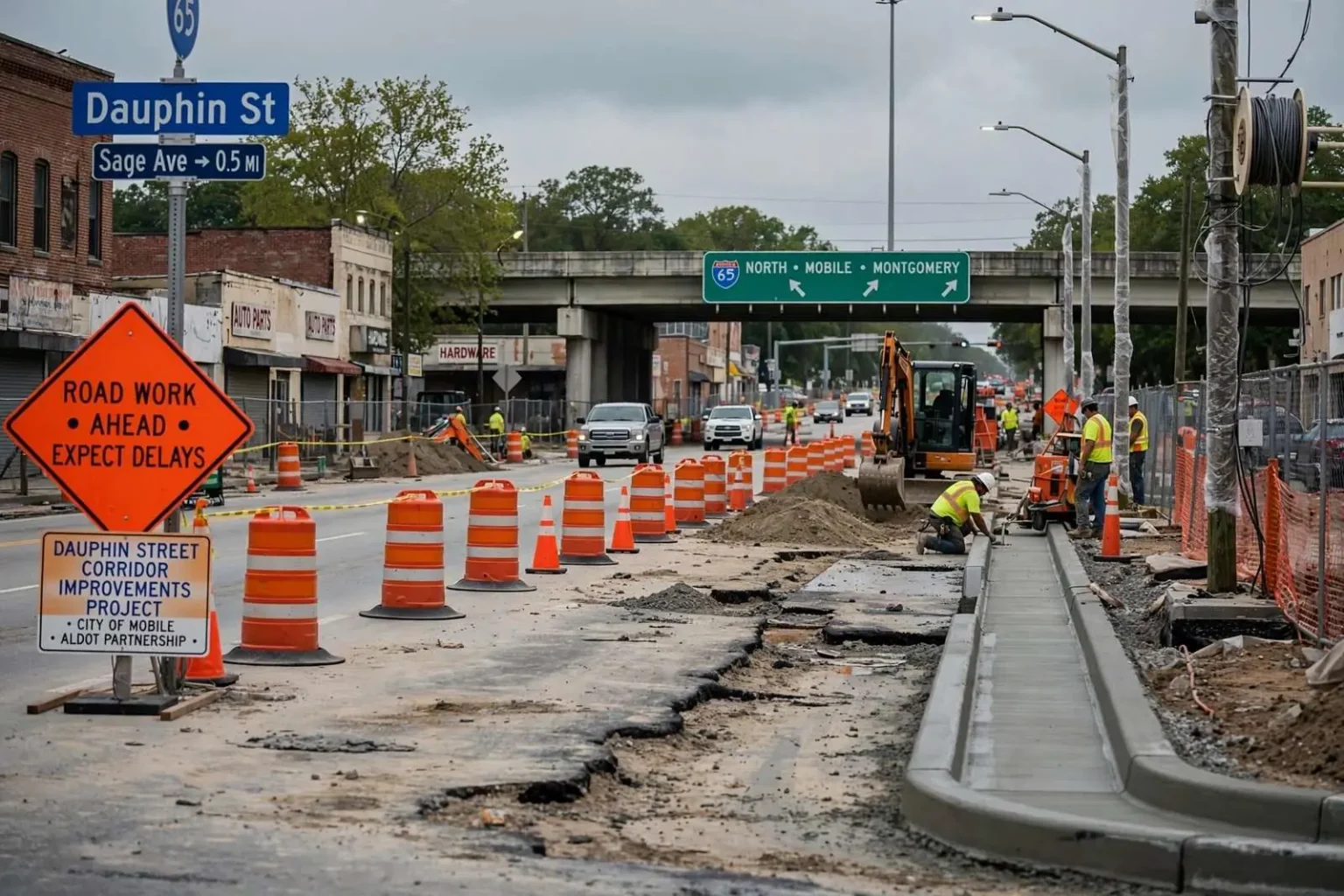
Anyone who has driven eastbound on Dauphin Street in Mobile in the last several months has seen it: the work zones, the orange barrels, the new curbs appearing in places that had not seen new concrete in decades. The Dauphin Street Corridor Improvements Project, a multi-year effort led by the City of Mobile in partnership with the Alabama Department of Transportation, is now in the middle of its busiest stretch of construction, and city officials say the most disruptive phase of the work is on track to wrap up by the end of November.
That is a meaningful timeline for the tens of thousands of drivers who use the Dauphin Street corridor each week, and for the businesses that line it. The project, which got under way in February, is meant to address long-standing safety and efficiency problems along one of the city’s most important east-west thoroughfares. Six months into the work, much of the visible construction is concentrated on the east side of Interstate 65, between the interstate and Sage Avenue. Once that section is finished, the work will shift to the west side of I-65, and the entire corridor is scheduled to be done by the end of next year.
What the project covers
The Dauphin Street Corridor Improvements Project is, in essence, a comprehensive rebuild of the roadway, the curbs, the drainage, the lighting, and the traffic-signal system along the Dauphin Street corridor from Rimes Road to Sage Avenue. The improvements include a new fiber-connected traffic-signal system that allows the individual signals to communicate with one another, the installation of new and brighter lighting along the corridor, the reconstruction of curb and gutter infrastructure, modifications to the medians to allow for safer, controlled turning movements, the resurfacing of the roadway itself, and the restriping of the travel lanes.
For City Engineer John Forrester, who has overseen the project from the engineering side, the work is a long-overdue correction of the small mistakes and shortcuts that had accumulated over decades of incremental maintenance. “There was multiple connections to the roadway that led to inefficiencies,” Forrester said. “The unsafe conditions. And that prompted us for this project. And it had been years in the making.”
Forrester’s framing matters because it underscores the point that the work is not, despite its visibility, a cosmetic upgrade. The fiber-connected signal system, in particular, is a substantial piece of infrastructure that will change how the corridor moves traffic. By allowing each signal to coordinate with the next, the new system can adjust timing in response to actual conditions, smoothing out the kind of stop-and-go driving that has long been a frustration for anyone trying to make it from one end of Dauphin Street to the other during peak hours.
Why the corridor needed the work
Dauphin Street has long been one of the most heavily traveled east-west corridors in Mobile, and the roadway has accumulated a list of deficiencies that no amount of routine maintenance could fix. Older curb and gutter infrastructure had begun to fail in places, contributing to drainage problems during heavy rains. The traffic-signal system along the corridor dated back several decades and was not designed to coordinate across intersections, which meant drivers frequently encountered a string of red lights in sequence. Lighting along portions of the corridor was inconsistent, leaving some stretches noticeably darker at night than others.
There were also safety concerns that went beyond the inconvenience of bad timing. The medians along Dauphin Street, many of which had been built to older standards, did not always allow for clean turning movements, and several intersections along the corridor had a history of angle and rear-end crashes. By rebuilding the medians to allow for controlled turning movements and by synchronizing the signals, the project is meant to address the underlying geometry of the road in a way that routine resurfacing never could.
That is why city officials have framed the project as a long-overdue investment, not a temporary inconvenience. The work is meant to address problems that the city and ALDOT have known about for years, and to do it in a way that will not need to be redone in another five or ten years.
What the public is seeing
For most drivers, the most visible part of the project so far has been the curb and gutter work on the east side of I-65. Crews have been removing the old curb, regrading the drainage in places, and pouring new curb in longer, smoother runs. The work has required periodic lane closures and, in a few cases, full closure of side streets where the new curb ties into the existing pavement. The pace of the work has been steady, and Forrester has credited the project team with keeping the disruption as contained as possible.
Behind the scenes, the fiber-connected signal system has been a quiet but substantial piece of the work. Running the fiber and connecting each signal to the network is a careful, technical job that has to be coordinated with the resurfacing and restriping phases. The new signals themselves, which are scheduled to be installed later in the project, will be more visible to drivers and will include better pedestrian accommodations at intersections where appropriate.
The median modifications are also underway in places, with crews removing segments of older curbed median and replacing them with configurations that allow for cleaner left-turn movements. The work is meant to reduce the kind of awkward turning situations that have historically contributed to crashes along the corridor.
What is left to do
City leaders have said the east side of the Dauphin Street renovation project will be done in November. Once that phase is finished, crews will move on to the west side, with much of the visible work there scheduled to begin in 2027. The west-side work will broadly mirror the east-side scope: new curb and gutter, new signal infrastructure tied into the same fiber network, median modifications, and resurfacing and restriping.
The full project is expected to wrap up by the end of next year, a timeline that Forrester has described as both ambitious and achievable. The end-of-next-year target depends in part on weather, on the supply chain for the signal equipment, and on the coordination required with ALDOT, but the project team has indicated that they see a clear path to finishing on schedule.
Forrester has also asked drivers to be patient as the work continues. “I’m excited every time we can make an improvement to the city and, you know, to help the citizens, you know, travel safer and more, you know, more efficient,” he said. The sentiment is, in part, a public-relations message, but it is also a genuine reflection of how a long-planned infrastructure project works: there is a substantial period during which drivers endure the inconvenience, and a much longer period after the work is done in which the benefits are felt.
What the new corridor will look like
When the project is finished, the Dauphin Street corridor will look and function substantially differently than it did before. The new signal system will allow traffic to move more smoothly through the corridor, particularly during peak hours, and the new lighting will make the road noticeably brighter at night. The reconstructed curbs and gutters will reduce the kind of localized flooding that has been a chronic problem in some sections, and the median modifications will make the turning movements along the corridor more predictable for drivers.
For the businesses along Dauphin Street, the new infrastructure is also an opportunity. Several of the corridor’s longstanding commercial tenants have weathered the construction period with patience, and the expectation is that the finished project will make the corridor a more attractive place to visit, shop, and invest. Mobile’s economic-development officials have, in recent years, made a point of emphasizing the importance of Dauphin Street as both a transportation corridor and a commercial spine, and the infrastructure work is part of that broader strategy.
The bigger picture for Mobile
Dauphin Street is not the only major infrastructure project underway in Mobile, but it is one of the more visible ones, and the way it is being managed will set expectations for similar projects elsewhere in the city. The partnership with ALDOT, which is responsible for the state-maintained portions of the corridor, is also a useful case study in how the city and the state can collaborate on a complex, multi-year road project.
For now, though, the most important number is November. If the east side of the project is substantially complete by then, the work shifts to the west side, and the finish line comes into view. Drivers, businesses, and residents along the corridor have been waiting for the kind of comprehensive rebuild that is now underway, and the months ahead will be the final stretch.
The orange barrels will not be out there forever. The new signals, the new lighting, the new curbs, and the new pavement, once they are in place, will change how the corridor works for decades. That is the kind of payoff that makes the patience worth it, even on the days when the lane closure seems endless.