Federal Judge Dismisses MGM Mothers’ Lawsuit Against AHSAA Over Sons’ Football Eligibility
U.S. District Judge Bill Lewis dismissed the lawsuit by two Mary G. Montgomery mothers whose sons were ruled permanently ineligible, finding the AHSAA's recruiting rule rationally related to preventing recruiting.
MONTGOMERY, Ala. — A federal judge has dismissed a lawsuit against AHSAA, the Alabama High School Athletic Association, that was brought by two Mary G. Montgomery High School mothers after their sons were declared permanently ineligible to play football at the Semmes school.
U.S. District Judge Bill Lewis issued his order Friday, Oct. 23, and found that the association’s recruiting rule served a legitimate purpose.
“Here, the AHSAA has a legitimate interest in preventing recruiting and protecting fair competition,” Lewis wrote.
The ruling is a significant win for the AHSAA in one of the most closely watched high school sports disputes in the Mobile area this year. It also leaves in place the eligibility rulings against the plaintiffs’ sons, which grew out of the AHSAA’s investigation into recruiting at Mary G. Montgomery, known as MGM.
Who sued and why
The lawsuit was filed by Tameka Dale and Ashley Davis, the mothers of two MGM students, through attorney Michael Kidd. According to the lawsuit, the AHSAA ruled the boys permanently ineligible to play football at MGM because they attended the school’s “Signing Day Party” in 2024.
The AHSAA declared multiple students permanently ineligible to play sports at MGM as part of the case. In earlier court proceedings, it was reported that 21 students had been ruled permanently ineligible for attending what the association described as an improper recruiting event, and that 19 of them had since left the school. The two sons, described in court papers as honor students and identified only by their initials, had completed paperwork to transfer to MGM from Clark-Shaw Magnet School but were not formally enrolled when they attended the ceremonies, according to testimony at an earlier hearing.
Kidd argued in the lawsuit that the AHSAA’s recruiting rule is “arbitrarily applied” and limits the plaintiffs’ free speech. The mothers had asked the court for a temporary restraining order and a permanent injunction to restore their sons’ eligibility, along with compensatory damages. They claimed the association violated their constitutional rights to free speech and equal protection, as well as those of their sons.
The AHSAA’s attorney, Joe Espy, argued in a motion to dismiss that the lawsuit amounted to just “buzz words.”
What the judge decided
In his order, Lewis concluded that the association’s rule was reasonably connected to its goal of preventing recruiting. He noted that the rule limits athletic communications with prospective students while leaving room for schools to talk about other programs.
“Limiting athletic communications with unenrolled, out-of-district prospective students, while allowing talk about academics, band, and other programs, is rationally related to that interest because those programs do not raise the same risk of athletic recruiting,” Lewis wrote.
That language reflects the legal standard known as rational basis review. Under that test, which courts apply to many constitutional challenges that do not involve a protected class or certain fundamental rights, a rule is generally upheld if it is rationally related to a legitimate interest. It is the most deferential standard courts use, and challengers carry the burden of showing that a rule has no reasonable connection to its stated goal.
The decision also fits a long pattern in Alabama, where courts have been reluctant to second-guess the AHSAA’s decisions on its own rules. In a 2018 case involving St. Paul’s Episcopal School, the federal court in Mobile wrote that “the Alabama Supreme Court has repeatedly emphasized the AHSAA’s near absolute authority in its own affairs.”
The sanctions against MGM
The case stems from the AHSAA’s investigation of the MGM football program, which became public in May. According to the lawsuit, the association sanctioned the school and its former head football coach, Zach Golson. MGM’s football program was placed on restrictive probation for one year and ruled ineligible for postseason play during the 2026 season. The school was fined $300, and Golson was barred from coaching at an AHSAA member school for one year.
The association found that the violations were connected to MGM freshman football signing ceremonies. The school self-reported the violations, and MGM’s principal placed Golson on administrative leave before the sanctions were issued. Golson was later removed as head coach and replaced by Alex Page, who had been the Vikings’ defensive coordinator. The Mobile County Public School System then transferred Golson to a teaching job at another school.
The postseason ban has had a visible effect on the field this fall. The Vikings have continued to play their regular-season schedule under Page, including a 20-19 win over Daphne on Oct. 16 and a 24-13 win over Foley on Oct. 23, but they cannot compete in the Class 6A playoffs. Their absence is one reason every other eligible team in Class 6A, Region 1, apart from winless Davidson, qualified for the postseason this year.
Inside the federal courtroom
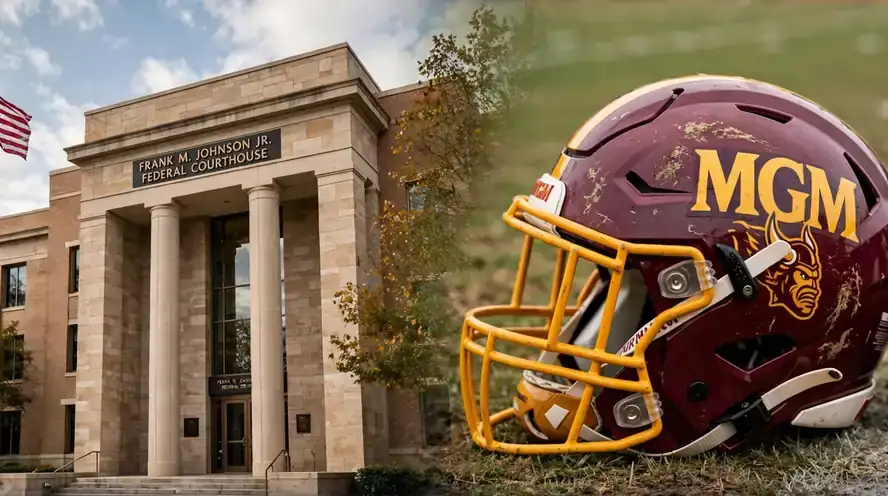
Lewis heard testimony in the case during a hearing of about four and a half hours on Monday, Oct. 5, at the Frank M. Johnson Jr. Federal Courthouse in Montgomery. It was the first time the MGM recruiting case had been aired in a courtroom.
Dale, Davis and Golson each testified that no inducements were offered to the boys and that the students had not been invited to the ceremonies. AHSAA attorneys pointed to testimony that the boys signed a creed agreeing to uphold standards Golson had set, briefly put on MGM jerseys and had their photos taken.
Much of the hearing focused on whether the AHSAA’s recruiting bylaw had been properly amended over the years. Kidd argued that the rule had been changed in later handbooks without approval from the association’s Legislative Council. AHSAA Executive Director Heath Harmon testified that he had not verified whether every change had been approved by the council, and noted that he was not the executive director when the disputed changes were made.
Golson, who was not a party to the federal case, testified that he did not recruit players. Asked by the judge how he keeps up with rule changes, Golson said he tries to “skim the rulebook every year.”
About Judge Bill Lewis
Lewis serves on the U.S. District Court for the Middle District of Alabama, which sits in Montgomery. He was nominated by President Donald Trump in September 2025 and confirmed by the U.S. Senate in October 2025.
Before joining the federal bench, Lewis served briefly on the Alabama Supreme Court after Gov. Kay Ivey appointed him in May 2025. Ivey had earlier appointed him to the Alabama Court of Civil Appeals in 2024. He previously served as a circuit judge in Alabama’s 19th Judicial Circuit and worked as a prosecutor and in private practice. He holds a bachelor’s degree from the University of the South and a law degree from Cumberland School of Law.
Other MGM cases still pending
Friday’s ruling closes one chapter of the legal fight, but other cases tied to the MGM sanctions remain active in state court.
- Golson has his own lawsuit in Montgomery County Circuit Court. He claims he was defamed and denied due process, and he has sued the AHSAA, Harmon, AHSAA investigator Chuck Anderson, Mobile County Public School System Superintendent Chresal Threadgill and MGM Principal David Diaz. The defendants have filed motions to dismiss, and Circuit Judge Tiffany N. McCord has set a hearing on those motions for 9 a.m. Nov. 4.
- A separate state-court case, J.H., a minor, et al., v. Alabama High School Athletic Association, was filed by a parent on behalf of an MGM student-athlete seeking reinstatement to the Vikings’ football team. A preliminary injunction hearing in that case was scheduled before Circuit Judge Gregory Griffin.
Decisions from the U.S. District Court for the Middle District of Alabama can be appealed to the 11th U.S. Circuit Court of Appeals in Atlanta. Whether the plaintiffs plan to seek further review had not been announced.