University of South Alabama and ASMS students showcase drone, rover, boat and submarine research for first responders
The University of South Alabama and the Alabama School of Mathematics and Science showed off autonomous drones, rovers, boats and a submarine designed to help first responders, including a live AED delivery demonstration.
It is one thing to read about autonomous vehicles in a textbook. It is another to watch a small quadcopter lift a few pounds of medical equipment off the ground, navigate to a designated drop point, and lower it gently into the grass while a small crowd of first responders and university faculty looks on. That is roughly the scene that played out on the campus of the University of South Alabama this week, when the university and its partner institution across town, the Alabama School of Mathematics and Science, gathered to show off the kind of work their students and faculty have been quietly building for the better part of two years.
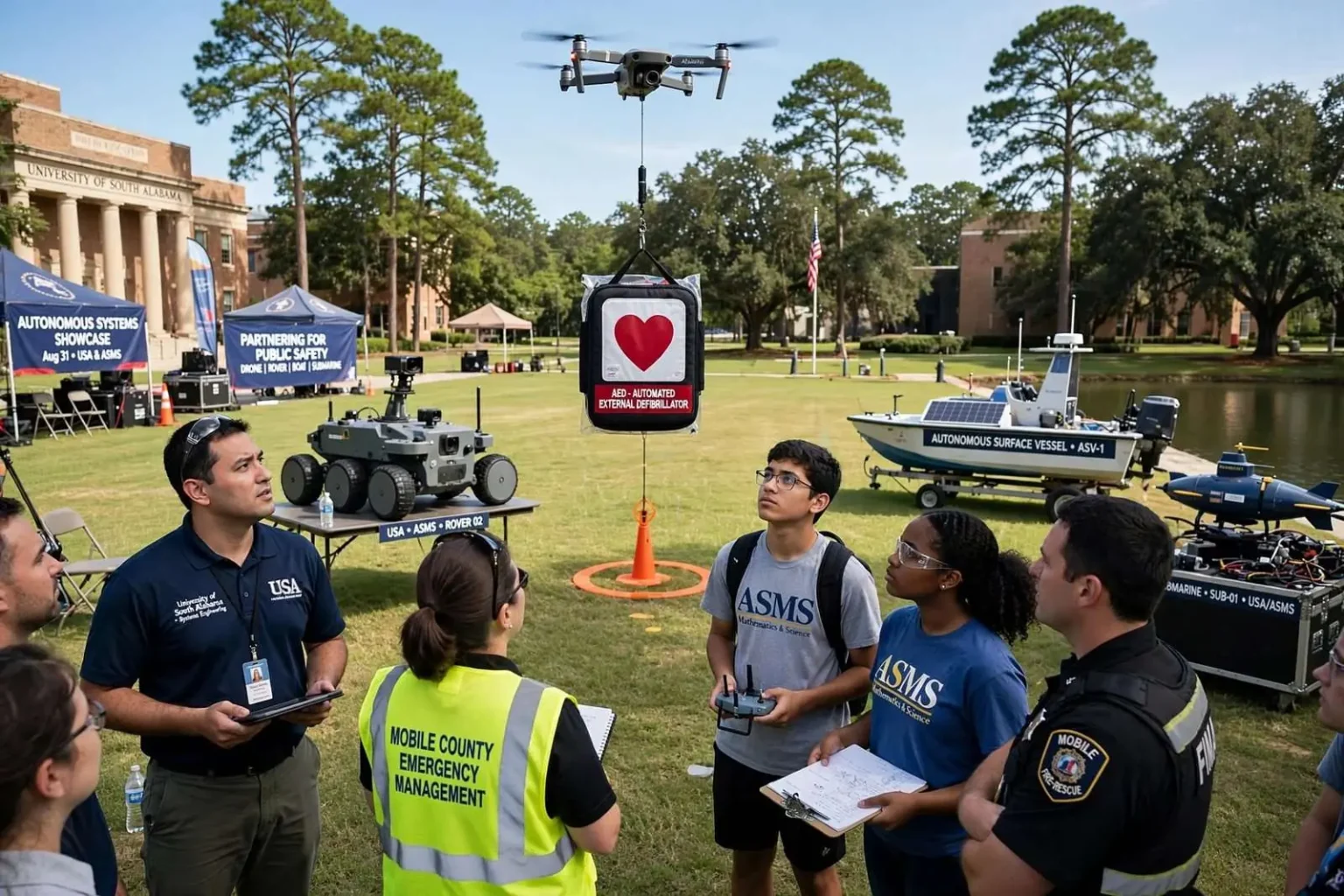
The showcase, held on a clear late-summer morning, featured a fleet of faculty- and student-built autonomous vehicles: drones, rovers, boats, and a small submarine. Each of the platforms has been designed with the same broad mission in mind: giving regional first responders new tools to find people, deliver supplies, and gather information in the kinds of disaster-recovery and life-saving scenarios where minutes and hours matter.
A live AED delivery
One of the most striking moments of the morning came when a small drone lifted a packaged automated external defibrillator off a launch pad, flew a short programmed route across a section of the demonstration field, and lowered the device to a designated drop point. The test, organizers said, was intended to simulate the kind of response a first-responder agency might want to mount in the minutes before an ambulance can reach a remote or difficult-to-access location. AEDs are a logical early candidate for drone delivery because the devices are relatively light, the medical need is time-sensitive, and the geographic range from a small launch site can extend well beyond what a road-bound ambulance can cover.
It is not a new idea, of course. Drone-delivered AEDs have been tested in small pilots in several U.S. cities and in Scandinavia, and at least one European country has flown real-world AED-delivery missions. What the Mobile research team is working on, however, is a more regionalized system, one that takes into account the specific terrain, weather, and response-time challenges of the northern Gulf Coast. The project is still in its prototype stage, the team emphasized, and full deployment remains a year or more away.
The submarine that Lohar likes best
Of the platforms on display, the small autonomous submarine was the one that Bushan Lohar, an assistant professor in systems engineering at the University of South Alabama, singled out as his personal favorite. The professor, who joined the university’s faculty in recent years and has been building out the school’s autonomous-systems research program, said he sees particular long-term potential in underwater platforms working in the shallow waters of Mobile Bay.
“In the future, I want to see this submarine going into the water and diving 10 feet down and see what’s happening in Mobile Bay, as well as the last drone that we were flying that connects to the VR goggles, you don’t see that happening every day,” Lohar said. The quote, captured during the demonstration, captured both the realistic near-term goals of the project and a sense of the broader ambition. The drone-to-VR-goggle configuration Lohar referenced allows a remote operator to see through the drone’s camera as if they were sitting in the air with it, a configuration that has obvious applications for inspecting infrastructure or assessing a hazard from a safe distance.
For Lohar, the appeal of the submarine is partly about the unique research opportunities presented by Mobile Bay. The shallow, estuarine bay is a productive ecosystem and a working waterway, and an autonomous submarine that can map the bottom, monitor water quality, or inspect submerged infrastructure has obvious value. The challenges are also substantial: the water is murky, the currents can be tricky, and the bay’s marine traffic means any autonomous platform has to be designed with appropriate situational awareness.
What the students are learning
The other half of the partnership is, in many ways, the more important one. The Alabama School of Mathematics and Science, the state’s only public residential high school for high-achieving students, has long had a strong science and engineering program, and several of its current students are working directly on the USA-led autonomous-systems projects. The collaboration gives ASMS students access to USA’s laboratories, faculty mentorship, and graduate-student collaborators, and it gives USA a pipeline of well-prepared undergraduates who are already familiar with the lab’s work.
For the high schoolers, the experience is something that is hard to replicate in a traditional classroom. The students who showed their work at the demonstration had spent the summer designing, building, and refining the platforms on display. Several of them talked through the engineering trade-offs they had to make: how to balance payload weight against flight time, how to keep an autonomous system stable in a crosswind, how to write the software that turns a single-board computer into something capable of executing a programmed mission. It is the kind of project that, in a more traditional high school, would be a senior capstone. At ASMS, it is part of an ongoing summer program.
Why first responders care
For the regional first-responder agencies that attended the demonstration, the appeal of the work is practical. Search-and-rescue operations along the Gulf Coast, particularly in the immediate aftermath of a hurricane or tropical storm, often involve large geographic areas, flooded roads, and limited visibility from the air. A drone that can autonomously scan a stretch of coastline, a rover that can check a flooded neighborhood for heat signatures, or a boat that can map a submerged hazard all have the potential to give incident commanders information they cannot get any other way.
The Mobile County Emergency Management Agency, the Mobile Fire-Rescue Department, and the Alabama Law Enforcement Agency were among the agencies that sent representatives to the demonstration. Each has, in recent years, begun to incorporate small unmanned aircraft into their daily operations, particularly for accident-scene documentation and post-storm damage assessment. The next step, several of those representatives said, is to think about how more capable autonomous systems could expand the menu of options available to a first responder on the ground.
A year out, at least
Lohar cautioned that the project remains in its prototype stage, and that a fully deployable system is still some distance away. “A project like the drone is in its prototype stage,” he said. “It could take another year for it to be fully ready.” That timeline, while not unusual for a research-stage engineering project, is a useful reminder that the work being done at USA and ASMS is exactly that: research. The platforms on display are not off-the-shelf products. They are experiments, designed to test ideas, identify failure modes, and educate the next generation of engineers in the process.
That said, the demonstration was a clear sign of how far the program has come in a relatively short period of time. A few years ago, the autonomous-systems group at USA was a small operation with limited funding and a handful of graduate students. The current team, which now includes ASMS high schoolers, undergraduate and graduate students at USA, and a growing slate of industry partners, has built and flown multiple platforms and has its sights set on the next phase of work. The early results are promising, and the institutional support for the program appears to be durable.
What comes next
In the months ahead, the research team plans to continue refining the autonomous navigation software, expand the test flights to include longer-distance missions, and begin preliminary conversations with regional emergency-management agencies about how a future deployable system might actually be used. There are also questions to be answered about regulatory compliance: flying drones beyond visual line of sight, operating them over people, and using them to carry medical devices all require specific Federal Aviation Administration waivers, and the team is working through that paperwork in parallel with the engineering work.
For the students, the demonstration was a moment of well-earned pride. For the faculty, it was a chance to show off a body of work that has been building quietly for several years. And for the first responders in the audience, it was a glimpse of a future in which a small unmanned system might, in the right circumstances, save a life that would otherwise be lost. That is the long-term bet the program is making, and the showcase was a small but real data point in support of it.
It is not every day, after all, that you see a submarine of any size being prepped for a dive in Mobile. Even if that dive is still a year or so away, the engineering that will make it possible is happening now, in a university laboratory and a high school shop class that have figured out how to share students, software, and ambition.
Why this matters for Mobile
The Mobile area has, in recent years, been working to broaden its identity beyond its traditional strengths in shipbuilding, port logistics, and aerospace. Investments in autonomous-systems research, particularly the kind that pairs a research university with a specialized high school, are part of a longer-term bet that the city can be a center for technology and engineering work in addition to the more established industries. The kind of research on display at the demonstration is exactly the sort of activity that supports that bet. It produces graduates with skills that are marketable well beyond the Gulf Coast, it attracts grant funding that flows through the local economy, and it positions the city as a place where serious engineering work is being done.
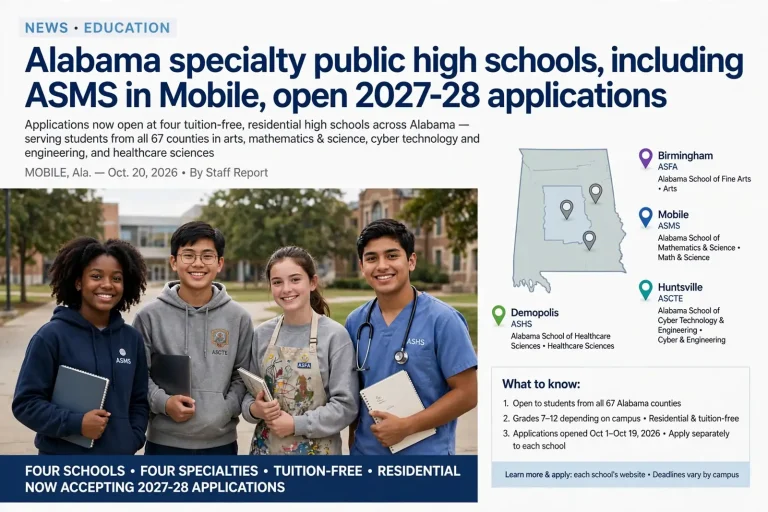
For the Alabama School of Mathematics and Science specifically, the partnership is a recruiting tool as much as it is a research collaboration. The school draws students from across the state, and the chance to work on a real autonomous-vehicle project before finishing high school is the kind of opportunity that distinguishes ASMS from a more typical high school experience. Several of the students who participated in the demonstration said they had been drawn to ASMS in part because of the kinds of projects the school makes possible, and the drone research is one of the more visible recent examples.
For the University of South Alabama, the collaboration is a way to engage high-ability students who might otherwise consider out-of-state engineering programs. The university’s College of Engineering has been working to grow its research profile in recent years, and the autonomous-systems work is one of the more public-facing examples of that effort. Faculty members like Lohar see the high school partnership as an investment in the future of the program: the students who get an early look at the work are exactly the ones the university would like to see in its undergraduate and graduate programs a few years later.
None of that, of course, diminishes the immediate value of the work itself. The platforms on display are real engineering accomplishments, and the demonstration was a useful milestone for the team. But the longer story, the one that will play out over the next several years, is about whether the institutional and educational infrastructure that produced this demonstration can be sustained and grown. The early signs are encouraging.
University Leadership Weighs In
University President Jo Bonner and Executive Vice President and Provost Andi Kent both described the Aug. 31 showcase as a milestone for faculty and students at the two institutions.
“In a multidisciplinary effort, South is championing high-impact research that directly protects and serves our coastal and small-town communities,” Kent said. “The future is now. This showcase proves the depth of Mobile’s regional science, technology, engineering and mathematics talent pipeline through the work of South’s researchers, students and those of the Alabama School of Mathematics and Science.”
Dr. Joel Billingsley, the university’s vice president for community engagement, framed the partnership with the Alabama School of Mathematics and Science as central to the effort rather than incidental to it.
“South’s partnership with the Alabama School of Math and Science showcases our commitment to community collaborations,” Billingsley said. “By bringing high school students alongside South’s researchers and students, we are cultivating the next generation of technology leaders and first-responder innovators. The faculty and students are actively shaping the future of public safety in our region.”