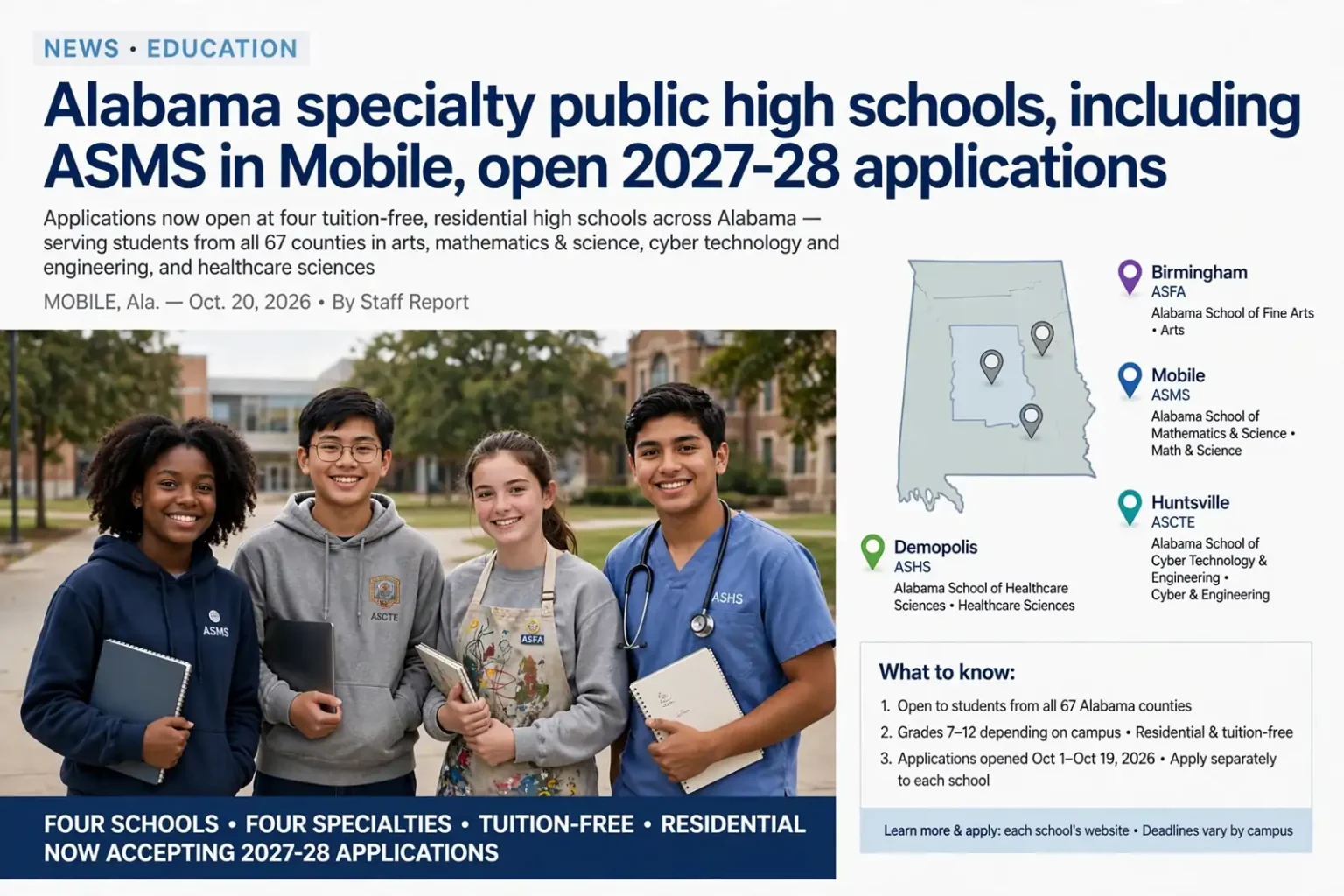
MOBILE, Ala. — Applications are now open at four Alabama specialty public high schools for the 2027-28 school year, giving students from all 67 counties a chance to apply to tuition-free, state-funded schools focused on fine arts, mathematics and science, cyber technology and engineering, and healthcare sciences. One of the four, the Alabama School of Mathematics and Science, is based in Mobile, and its application is already accepting submissions.
The four schools are the Alabama School of Fine Arts in Birmingham, the Alabama School of Mathematics and Science in Mobile, the Alabama School of Cyber Technology and Engineering in Huntsville and the Alabama School of Healthcare Sciences in Demopolis. Each is funded by the State of Alabama, charges no tuition and includes a residential component, which allows students who live far from campus to attend. School leaders describe the schools as a form of statewide school choice, open to families regardless of where in Alabama they live.
Four schools, four specialties
While the schools share a common purpose of serving the state and preparing students for its future, each has its own focus and personality. According to the schools, every campus offers specialized academic opportunities that let students go deeper into the subjects and career paths that interest them most.
- Alabama School of Fine Arts (ASFA), Birmingham: A school centered on the arts, where students pair academic coursework with intensive study in artistic disciplines. Its admissions application opened Oct. 19, 2026.
- Alabama School of Mathematics and Science (ASMS), Mobile: A residential school for students with strong interests in science, technology, engineering and mathematics. Its application is open now.
- Alabama School of Cyber Technology and Engineering (ASCTE), Huntsville: A school built around cybersecurity, computing and engineering, located in a city known for its aerospace, defense and technology industries. Its application opened Oct. 2, 2026.
- Alabama School of Healthcare Sciences (ASHS), Demopolis: A school focused on preparing students for careers and further study in health care. Its application opened Oct. 1, 2026.
The Alabama School of Fine Arts is the oldest of the group. Established in the early 1970s in downtown Birmingham, it serves students beginning in seventh grade and combines a full college-preparatory academic program with specialized training in areas such as dance, music, theatre arts, visual arts and creative writing. The Huntsville cyber and engineering school is a much newer addition, opening its doors in 2020, and the Demopolis healthcare sciences school is the most recent to join the lineup, extending the specialty school model into the Black Belt region of west Alabama.
The schools serve students from seventh through 12th grade, depending on the campus. Curriculum and co-curricular offerings differ from school to school, and each school manages its own admissions process, including its own requirements, deadlines and selection procedures. Families interested in more than one school should plan to complete a separate application for each.
What sets the specialty schools apart
Most Alabama students attend public schools assigned by the district where they live. The specialty schools work differently. Because they are funded by the state rather than a local district, they draw students from every corner of Alabama, from rural counties to the largest metro areas. Their residential programs mean a student from the Wiregrass, the Tennessee Valley or the Black Belt can live on campus during the school week and take part in coursework that may not be available at a home high school.
That combination of tuition-free education and on-campus living is what school officials point to when they describe the four campuses as school choice options for every family in the state. Admission is competitive and based on each school’s own criteria, but cost of attendance and home ZIP code are not the barriers they can be for private or out-of-district options.
Living away from home as a teenager is also part of the learning experience. Students at residential schools manage their own schedules, study habits and day-to-day responsibilities with support from staff, which school leaders say builds maturity and independence that carries over into college and the workplace.
A student’s view from ASMS
For Elsie Beaver, a senior at ASMS from Lee County in east Alabama, the move to Mobile has been transformative. She said the hands-on science and the chance to take on responsibility outside the classroom have shaped her both academically and personally.
“Coming to ASMS is the best decision I could have made for my academic career. I liked that there were weekly laboratory classes and a lot of opportunity to participate in research and leadership.”
Beaver said living on campus has been as important as the coursework. “On top of our rigorous courseload, I have become my own person through the residential style of the school,” she said. “ASMS teaches students real-life skills such as time-management, communication, independence, and even life balance.”
Her experience reflects what the residential model is designed to do: give motivated students from anywhere in the state access to advanced academics while helping them develop the habits they will need after high school.
Mobile’s own specialty school
ASMS has been part of Mobile’s educational landscape for more than three decades. The school was created by the Alabama Legislature in the late 1980s and enrolls students in grades 10 through 12, offering an advanced curriculum in mathematics, science and the humanities along with research opportunities and residential life on its campus in Mobile.
For families in Mobile and Baldwin counties, ASMS offers a specialty option close to home, though students from the local area apply through the same admissions process as students from elsewhere in the state. Coastal Alabama families also have the option of applying to the other three campuses if a student’s interests lie in the arts, cyber technology and engineering, or health care.
New consortium links the four schools
The four schools are also beginning to work more closely together. In June 2026, Gov. Kay Ivey signed Senate Joint Resolution 84, sponsored by Sen. Arthur Orr, which directs the specialty public high schools to form a consortium. The resolution is intended to encourage collaboration, partnerships and the sharing of information among the campuses.
Administrators from all four schools met together for the first time in August, according to the schools. While each will continue to operate independently with its own leadership, mission and admissions, the consortium gives the schools a formal framework for coordinating efforts and learning from one another.
Because the schools sit in four different regions of the state and focus on four different fields, closer coordination could make it easier for families to compare options and for the schools to share approaches to issues they have in common, such as recruiting students statewide, supporting teenagers who live away from home and partnering with colleges and employers.
A joint resolution of the Alabama Legislature is a measure passed by both the Senate and the House of Representatives that expresses the will of the Legislature on a particular matter. It is often used to give direction or guidance, as in this case, rather than to create or change a statute.
How families can apply for 2027-28
School officials are encouraging families to start by researching each school, then visiting campuses and applying to the school or schools that best match a student’s interests. A few practical steps can help families get organized:
- Visit each school’s website. Each school posts its own admissions information, eligibility requirements, grade levels served and application timeline.
- Plan a campus visit. The schools invite prospective students and parents to tour campuses, meet faculty and learn about residential life before applying.
- Note each school’s dates. Applications opened on different dates this fall, and each school sets its own deadlines and steps such as interviews, auditions or assessments.
- Apply separately. Because each campus runs its own admissions process, a student interested in more than one school will need to apply to each.
- Ask about residential life. Families should ask how weekday living, weekend schedules, transportation and student support work at each campus.
Application opening dates for the 2027-28 school year are:
- Alabama School of Healthcare Sciences, Demopolis: opened Oct. 1, 2026
- Alabama School of Cyber Technology and Engineering, Huntsville: opened Oct. 2, 2026
- Alabama School of Fine Arts, Birmingham: opened Oct. 19, 2026
- Alabama School of Mathematics and Science, Mobile: open now
Why it matters for Alabama
The specialty schools describe their shared mission as serving Alabama and advancing the state’s future. In practice, that means preparing students for fields that matter to the state’s economy, including science and engineering, cybersecurity and computing, health care and the arts. Graduates of these schools often go on to universities in Alabama and elsewhere, and the schools see their role as developing talent that can strengthen communities across the state.
For students who are ready for a more specialized path and comfortable with the idea of living on campus, the opening of the 2027-28 application season is the first step. Families who want to be considered are encouraged to review each school’s requirements now, schedule visits during the fall and winter, and complete applications well ahead of the deadlines each school has set.