A man who was shot by Mobile police officers during a domestic violence call last week made a brief escape attempt from the hospital where he was recovering, according to Mobile police records. The unusual episode, an arrestee slipping away from his own security detail inside a hospital, added a strange second act to an encounter that had already put two officers in a gunfight.
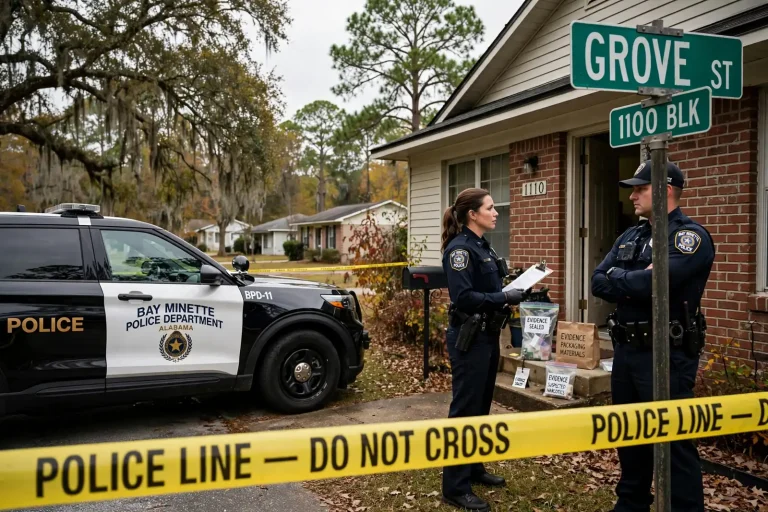
The incident began late on a Friday night when officers responded to a report of domestic violence at a home near John Will Elementary School. Police say a man had shoved his girlfriend into a sofa during an argument and was armed with a semi-automatic handgun. As officers approached the residence on foot, the suspect allegedly opened fire on them, and officers returned fire, according to Mobile police spokesman Officer Terence Perkins.
The man was struck in the chest and arm and was transported to University of South Alabama Medical Center for treatment. Neither of the two officers involved in the shooting was injured. His injuries from the shooting were not considered life-threatening.
Two Veteran and Newer Officers in the Gunfight
One of the officers involved had been with the department for more than a decade and had previously been recognized as an officer of the month, while the other had been sworn in a few years earlier, according to department records. The pairing of a decorated veteran with a newer officer on a night domestic call is typical of how patrol shifts are staffed, and it meant the exchange of gunfire was witnessed by officers at very different stages of their careers.
Domestic disturbance calls are among the most dangerous assignments in patrol work, a fact that department leaders have repeated often. Officers arrive at a private residence, in the dark, knowing only the outline of a dispute, with no way to know whether weapons are present or how the parties inside will react to police at the door. When the person involved is armed, the encounter can go from a calm interview to gunshots in seconds, which is precisely the sequence described in this case.
Departments across the country track the pattern. Calls involving family or household disputes consistently rank among the leading circumstances in which officers are assaulted or killed, and Mobile is no exception. Training emphasizes approach tactics, cover, and communication, but the fundamental unpredictability of a domestic scene involving weapons remains one of the hardest problems in policing.
The Hospital Escape Attempt
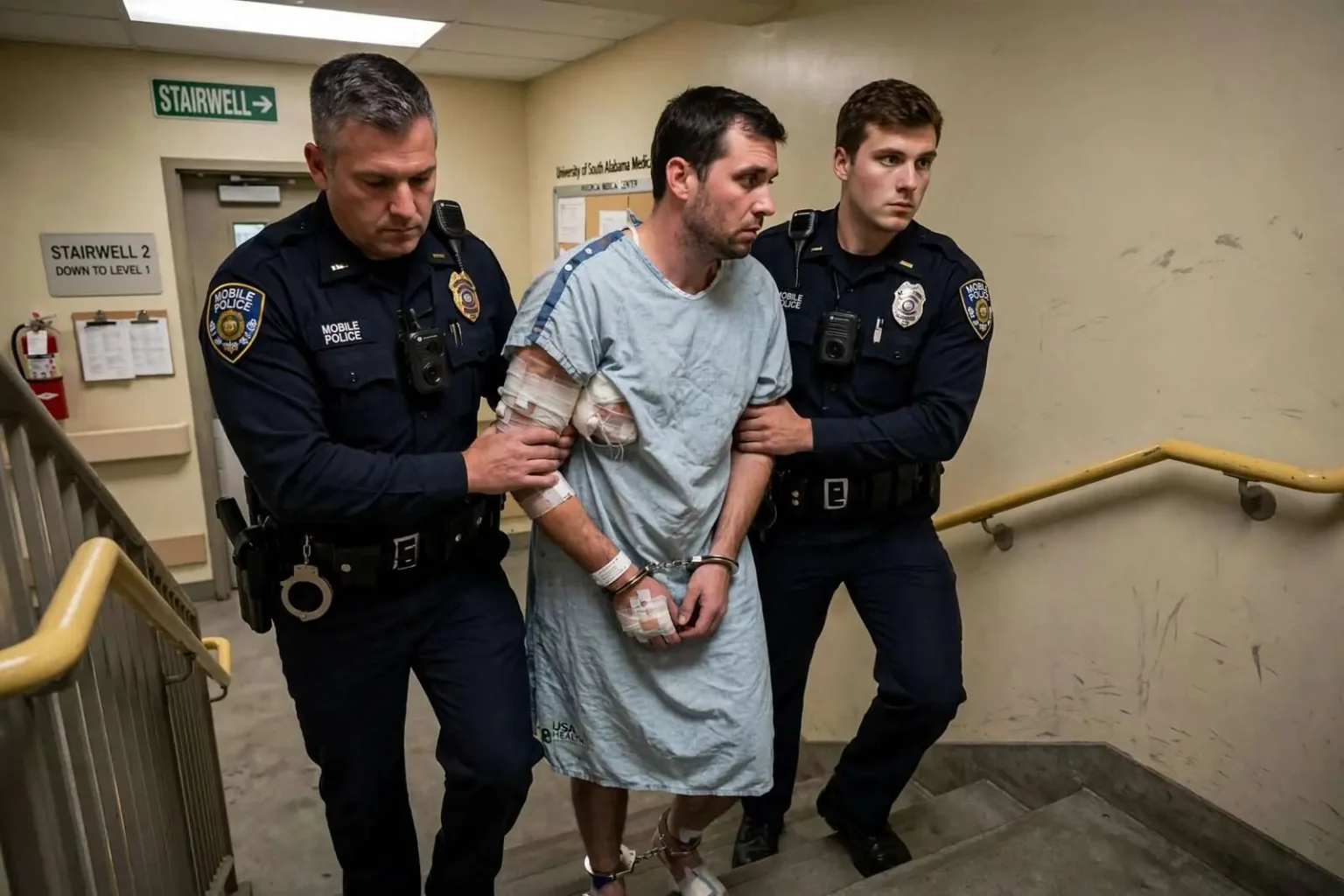
Court records show that four days after the shooting, while still recovering at the hospital, the man attempted to walk away from his officer guard. According to an incident report filed in Mobile County District Court, the suspect was not handcuffed when he asked the officer watching him if he could use the restroom. Instead, he reportedly walked out of the hospital room and headed toward a nearby stairwell.
An arrest narrative filed with the court states that the man made it down two flights of stairs before he was located by authorities. He was taken back into custody and secured with handcuffs and leg shackles for the remainder of his hospital stay.
Guarding an injured suspect in a hospital is one of the awkward duties that falls to patrol officers. The setting is a public building filled with visitors, elevators, and stairwells, and medical care requires that a patient be accessible to nurses and doctors, which limits how tightly he can be restrained. Whether and how a prisoner is cuffed is typically a judgment call balancing medical necessity against security, and this case shows how quickly such a judgment can be exploited.
The consequence of the escape attempt was immediate. Following it, the man was booked into Mobile County Metro Jail on two counts of attempted murder, along with charges of third-degree escape and third-degree domestic violence. The attempted murder counts reflect the allegation that he fired at the two officers, and each officer is named in a separate count.
The escape charge is a separate felony-adjacent matter under Alabama law, which treats escape from custody as its own offense regardless of the underlying charges. Adding it to the case file means that even as the shooting allegations proceed, the man now answers for the stairwell walkout as well.
The domestic violence victim in the case was not identified in court records. That omission is standard practice in domestic cases, where protecting the identity of the victim is treated as part of protecting the victim herself, particularly in matters involving household members who may face pressure or retaliation.
Mobile police have not indicated whether additional charges are expected as the case moves through the court system. prosecutors will typically review the complete investigation, including forensic results from the scene and the officers’ accounts of the exchange of gunfire, before presenting the case, and charge decisions at the district court level can be revised as that review proceeds.
A String of Violent Calls
The incident adds to a string of violent calls Mobile officers have responded to in recent weeks, and department leaders have continued to stress the unpredictability officers face when responding to domestic disturbance calls involving weapons. The stretch has kept patrol shifts busy across the city’s precincts and has drawn renewed attention to the volume of gun-related calls that Mobile officers handle.
For the department, each officer-involved shooting triggers the standard review process, in which the circumstances of the exchange of fire are examined to determine whether departmental policy was followed. Those reviews are routine in police agencies, and the two officers’ records, one an officer of the month recipient with more than a decade of service, the other sworn within the past few years, will be part of the administrative picture alongside the physical evidence.
For residents of the neighborhood near John Will Elementary School, the episode was a jarring one. A late-night exchange of gunfire on a residential street is a rare event in most Mobile neighborhoods, and the sight of police activity continuing through the following week, including the aftermath at the hospital, kept the case in view locally.
The case also illustrates the long tail of a single violent night. What began as a domestic argument in a home near a school produced, in sequence, a street gunfight, hospital treatment under guard, an escape attempt down two flights of stairs, and a jail booking on charges spanning attempted murder, escape, and domestic violence. Each stage drew in more of the criminal justice system: patrol officers, investigators, hospital security, district court clerks, and eventually prosecutors.
What remains to be seen is how the charges resolve. The man remains in custody at Mobile County Metro Jail as the case proceeds, the two officers involved have returned to duty pending the outcome of the standard reviews, and police leadership continues to use the episode as a reminder of what a Friday night domestic call can become when a weapon is in the home.
The hospital where the man was treated, University of South Alabama Medical Center, serves as one of Mobile’s primary trauma facilities, and it is where officers injured in the line of duty and suspects wounded in police encounters alike are routinely taken. That role means the hospital’s staff are familiar with the logistics of treating patients under police guard, but the stairwell episode shows the limits of even familiar procedures when a patient decides to test them.
Officers assigned to hospital guard duty face a set of constraints that street patrol does not have. A recovering patient must be moved for scans and procedures, visited by medical staff at all hours, and given room to heal, while the officer must maintain constant custody. Handcuffing a patient to a bed rail can interfere with medical care and with the hospital’s own safety requirements, so departments typically permit lighter restraints for patients judged to be low risk. The judgment in this case allowed the man to be unhandcuffed long enough to ask a simple question, use the restroom, and turn it into an escape attempt.
Two flights of stairs is not far, but in a hospital corridor with the officer’s attention divided, seconds matter. The arrest narrative filed with the district court captures how the pursuit unfolded: the man walked out of the room, reached the stairwell, and descended two floors before authorities located him. Had he reached an exit, the episode would have ended very differently, with an armed man, charged in a police shooting, loose on the streets of Mobile.
Department procedure after such an attempt is predictable: restraints are escalated, in this case to handcuffs and leg shackles for the remainder of the stay, and the escape becomes its own criminal charge. The booking at Mobile County Metro Jail consolidated all of the charges in one file, giving prosecutors the full picture of the case as it moves forward.
The attempted murder counts are the most serious element. Under Alabama law, attempted murder carries severe penalties when proven, and firing a handgun at two police officers who were approaching on foot presents prosecutors with a straightforward theory of the charge: an intentional act, with a deadly weapon, directed at peace officers engaged in their duties. The domestic violence charge stems from the original report, the allegation that the man shoved his girlfriend into a sofa during an argument, which set the entire night in motion.
Mobile police have released few details beyond the official accounts filed with the court, and the department has not identified the officers publicly beyond describing their tenure. Officer Terence Perkins, the department spokesman, provided the initial account of the exchange of gunfire, and the arrest narrative and incident report filed in Mobile County District Court form the public record of the escape attempt.
As the case works through the courts, the neighborhood near John Will Elementary School returns to its routine, the two officers continue their duties, and the man at the center of it all remains in jail, this time with the lessons of the stairwell written into his custody terms.