Baldwin County School Board Weighs Whether a Split Vote Could Derail Superintendent Pick
Baldwin County school board members and finalists for the superintendent job discussed whether a narrow vote could create problems.
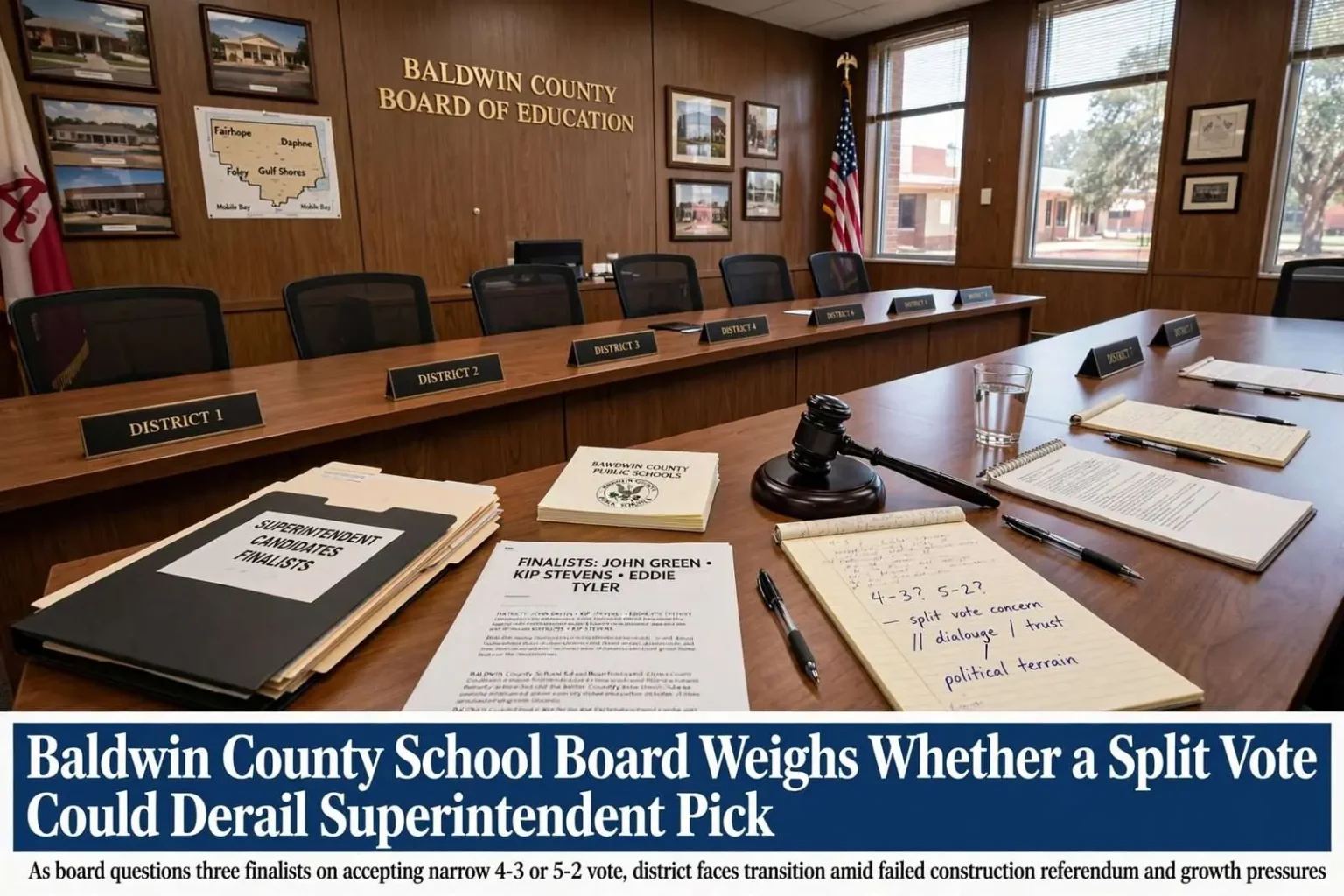
As the Baldwin County school board moves toward a final decision on its next superintendent, board members have been pressing an uncomfortable question with each of the three finalists: if you are hired by a razor-thin vote, will you still take the job? The question gets at more than courtesy. A superintendent who arrives with a divided board behind him starts the job at a disadvantage, and members of the seven-person board wanted to know before they voted whether any of the candidates would walk away rather than govern with a fracture at the top. All three finalists — John Green, Kip Stevens and Eddie Tyler — told the board they would accept the position even if it came on a narrow vote such as 4-3 or 5-2, though none of the three answered without reservations.
Green and Tyler took the most direct view of a split decision. Both said that if the vote divided the board, their first act in the job would be to open a dialogue with the members who voted against them, working to understand the objections and to build the trust needed to move the district forward. They framed a narrow win not as a rejection but as a starting point for conversation. Stevens was more cautious. He told the board he would need time to think it over if he won by only a single vote, saying he would want to understand who opposed him and, just as important, when those board members would next be up for election. His answer acknowledged the political arithmetic that a new superintendent inherits: opposition that survives until the next election cycle can harden into standing resistance.
The exchange came in the final stretch of a search that has drawn unusual public attention across the county. Each of the three candidates also took part in a public meet-and-greet with residents and school system employees earlier in the week, giving taxpayers, teachers and parents a chance to weigh in face to face before the board casts its votes. The board’s final decision is expected in the coming days, and the community sessions were the last structured opportunity for public input before that vote.
A community pushing for consensus
Some residents have urged the board to reach a unanimous choice, arguing that a fractured vote could undermine confidence in the new leadership from the very first day. In a district as large and as fast-growing as Baldwin County’s, the argument goes, a superintendent who takes office on a bare majority starts with half the board already lined up against him, and every difficult budget or zoning decision that follows risks becoming a proxy fight over the hiring itself. Supporters of a unanimous vote say the board owes the community a show of unity precisely because the challenges ahead are so large.
The timing adds weight to those concerns. The district is in the middle of a transition from interim superintendent Hope Zeanah to a permanent replacement, and school leaders say stability at the top matters most during exactly this kind of handoff. Zeanah has held the district together while the search ran its course, but an interim administration by its nature defers big decisions. Whoever takes over will be expected to move quickly on planning questions that have stacked up during the search, and a divided board would make that harder from day one.
Board members whose terms run through 2016 and 2018 would remain in office regardless of how the vote breaks down, which means any lingering disagreement among members would not be resolved at the ballot box anytime soon. A 4-3 or 5-2 decision could therefore leave the same seven people — and the same fault lines — in place for years, shaping district politics well into the new superintendent’s tenure. That arithmetic is not lost on the candidates themselves, and it is one reason the board’s question about accepting a split vote was more than rhetorical.
District 6 representative Cecil Christenberry said he is comfortable with a majority vote, even a narrow one, but he believes the board owes it to the top candidate to be transparent about any division before the hire is finalized. A new superintendent should not be blindsided by internal discord, in his view, and the members who intend to vote no owe their colleagues — and the community — a clear statement of why. Christenberry’s position reflects a pragmatic streak on the board: unity is preferable, but it cannot be manufactured, and pretending consensus exists where it does not only delays the reckoning.
Christenberry also addressed the alternative. Restarting the search process entirely, rather than working through disagreement, would cost the district valuable time it cannot afford to lose, he said. A second search would mean months of additional uncertainty, another round of interim leadership questions and the risk that strong candidates simply move on to other systems. For a district managing steady growth, the clock is not a neutral party, and Christenberry made clear he sees the cost of delay as greater than the awkwardness of a divided vote.
The fiscal and political backdrop
The stakes of the decision extend beyond boardroom politics. Lou Campomenosi, who leads the local Common Sense Campaign tea party group, has raised concerns about how the vote could shape the district’s direction, particularly in the aftermath of a March referendum on increased property taxes for school construction — a measure that failed, and a defeat that Campomenosi’s group helped drive. The referendum’s collapse left the district with a multi-million-dollar facilities wish list and no new revenue to pay for it, and it signaled a taxpayer mood that the next superintendent will have to navigate regardless of how he is hired.
In the wake of the referendum’s failure, some in the community have speculated that had the tax measure passed, the district might not have needed an outside superintendent search at all. The reasoning follows the district’s recent history: the previous superintendent chose to return to his role as a school principal rather than continue in the top job, a departure that set the search in motion. Observers who draw the connection argue that confidence in district leadership and confidence in district finances feed each other, and that the referendum’s failure rattled both at once. It remains speculation, but it captures how closely the community ties the superintendent question to the tax question.
Among the three finalists, community members widely see Tyler as the frontrunner, though board members have not signaled how they intend to vote and no public head count has emerged. The meet-and-greet sessions gave each candidate a chance to make a direct impression on the employees and residents who will live with the decision, and the board has kept its deliberations private. Whatever the members’ individual preferences, the willingness of all three candidates to serve under a split vote gives the board room to act without fear that a narrow result forces a restart.
What the next superintendent inherits
Whatever the outcome of the vote, Baldwin County’s rapidly growing student population means the incoming superintendent will inherit a district under sustained pressure over facilities, funding and long-term planning. New rooftops follow new subdivisions across the county, and every added classroom of students brings the same trio of questions: where to build, how to pay for it, and how to keep pace without asking taxpayers for more than they proved willing to give in March. The failed construction referendum did not make those pressures disappear; it simply left them without a funding answer.
The geography of the district compounds the challenge. Baldwin County’s schools stretch from communities along the Mobile Bay eastern shore to the beach towns at the county’s southern end, and growth does not arrive evenly across that map. Some attendance zones are adding students faster than classrooms can be built while others hold steady, and each year the board must redraw lines, shift portable classrooms and prioritize construction projects against a finite budget. A superintendent who can balance those competing demands — and keep countywide politics from fracturing along the same lines — will be worth the difficult hire the board is weighing.
The candidates’ answers on a split vote, in the end, said as much about each man as any prepared remarks at the meet-and-greets. Green and Tyler presented themselves as bridge-builders prepared to win over a skeptical board one conversation at a time. Stevens presented himself as a careful steward who would want to map the political terrain before committing to the job. The board, for its part, emerged from the questioning having established something useful for the community: whichever candidate it selects will walk into the job with a clear understanding that the vote was contested, and with no excuse to claim surprise at the politics that follow.
The final vote is expected in the coming days. When it comes, the count itself will be watched as closely as the name announced, by a community that has made clear it would prefer unanimity, by a board that must live with its own arithmetic for years to come, and by a new superintendent whose first task — whichever of the three men he turns out to be — will be turning a majority into a team.