Courtroom gavel representing a Mobile County bond revocation hearingA Mobile County judge revoked bond for a defendant awaiting trial on a vehicular homicide charge.

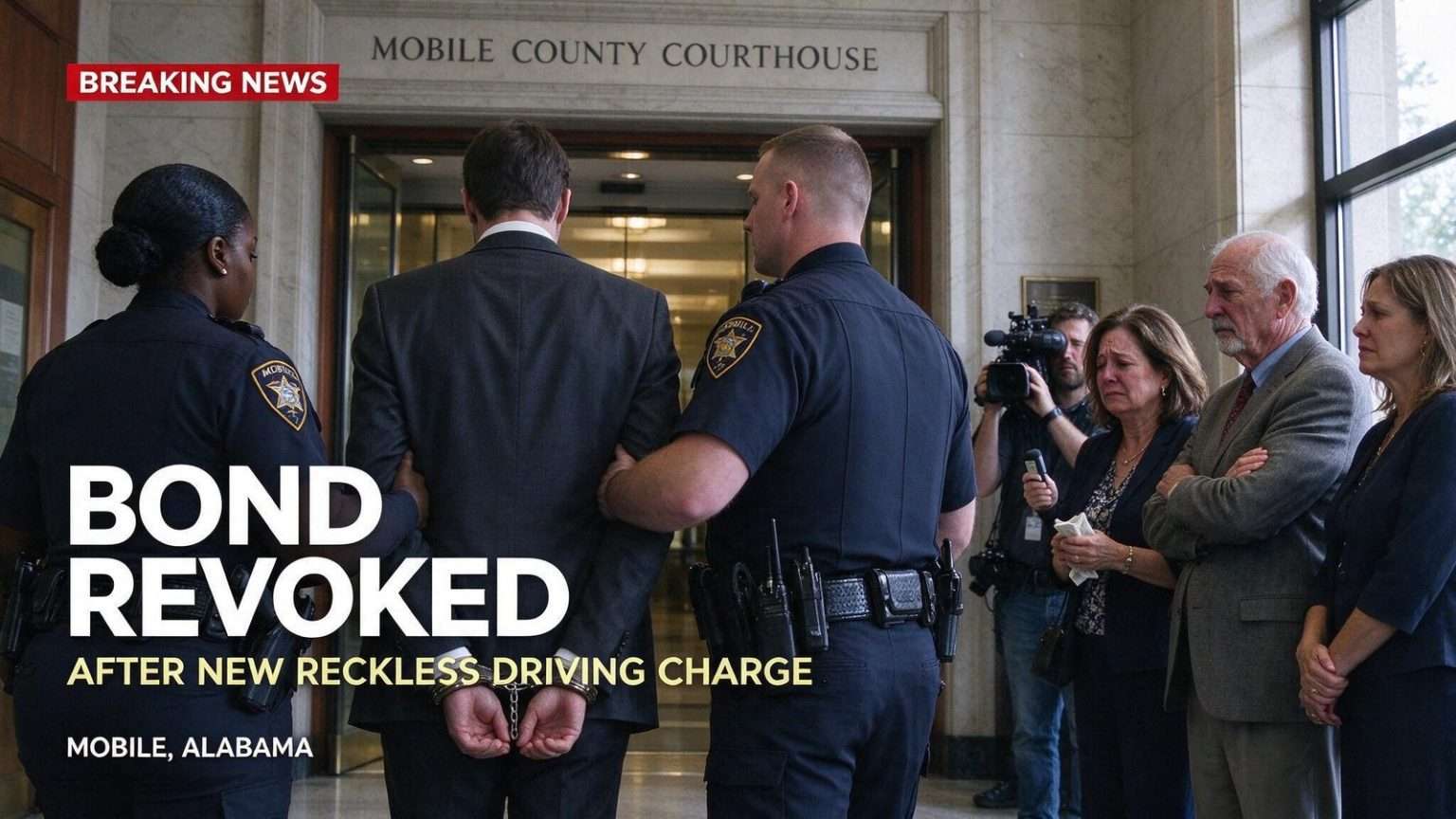
A bond revocation hearing filled with pointed questions about possible favoritism and personal grudges ended with a former Mobile veterinarian sent back to jail on a pending vehicular homicide charge.

The defendant is charged with vehicular homicide in the 2013 death of a 68-year-old man killed in a crash in west Mobile. He had been staying with relatives while awaiting a grand jury’s decision on whether to indict him on the felony charge, after a judge allowed him to post bond and retain his veterinary license earlier this year.

Family members of the man who died reacted with visible relief outside the courtroom as the judge’s decision was announced. “It’s a step in the right direction,” the victim’s daughter said, adding that she had been disappointed by the earlier decision to grant bond. “We were concerned with the safety of all the citizens of the state of Alabama,” she said, describing a sense of relief after Thursday’s ruling.

The bond revocation stemmed from a separate reckless driving charge tied to a Sept. 23 traffic accident that led a Mobile County district judge to reconsider the defendant’s release conditions on the original homicide charge. Witnesses testified that the defendant swerved across a highway “at least 10 times” over several miles before crashing into a culvert.

One witness, who said he followed the defendant’s vehicle out of concern that the driver might be suffering a medical emergency, testified that the defendant nearly struck oncoming vehicles head-on at least three times before the crash. The defendant has maintained that severe stomach cramps caused him to swerve and lose control.

Defense attorneys pressed the witness on cross-examination, suggesting a possible personal motive tied to a dispute involving the defendant’s father and a former pastor. The witness denied any ulterior motive, saying he called authorities that night purely out of concern for public safety, with no connection to any prior dispute.

Testimony also revealed that no field sobriety test was administered at the scene of the September crash, despite a responding deputy recommending one to a state trooper who had jurisdiction. The trooper, who had known the defendant since high school decades earlier, testified that the defendant appeared fine after the crash and that he gave him a ride home, denying that any personal familiarity influenced his decision not to test for impairment.

Prosecutors argued that any new criminal charge filed while a defendant awaits trial on a serious felony should trigger bond revocation, and the judge agreed, ordering the defendant taken into custody immediately. He is expected to remain in the Mobile County Metro Jail while the grand jury considers the original homicide charge, and faces a separate court date on the reckless driving charge in a different county early next month.

See also  Joe Jefferson Players to Stage Disney's 'Frozen' This August

Mobile is the county seat of Mobile County in southwest Alabama and the state’s only saltwater port. Situated where the Mobile River meets Mobile Bay near the northern Gulf of Mexico, the city has long served as a commercial and cultural gateway between Alabama and the wider Gulf Coast. Founded in 1702 as Fort Louis de la Louisiane and ruled in turn by France, Britain, and Spain before joining the United States in 1813, Mobile carries a layered heritage distinct from the rest of the state.

Today Mobile anchors a metropolitan area spanning Mobile County and neighboring Baldwin County, and it remains a center for shipping, aerospace, healthcare, and higher education in the region. Its downtown and waterfront have seen sustained revitalization, while historic neighborhoods preserve architecture from its colonial and antebellum past. The city’s identity is shaped as much by its working port and industrial base as by its festivals and food culture, making it a frequent focal point for news about growth and change in southern Alabama.

Alabama is a state in the southeastern United States bordered by Tennessee, Georgia, Florida, the Gulf of Mexico, and Mississippi. Often called the Heart of Dixie, it spans Appalachian foothills in the north and flat coastal plains in the south. Its largest cities include Birmingham, Montgomery, Huntsville, and Mobile.

Alabama’s history encompasses Indigenous roots, Spanish and French colonial settlement, a cotton-plantation economy, the Civil War and Reconstruction, and the Civil Rights Movement of the 1950s and 1960s, followed by a shift toward manufacturing, aerospace, and technology. Local news across the state frequently reflects this mix of tradition and change.

Probate courts in Alabama handle matters distinct from the trial courts that hear criminal and civil cases, including wills, estates, guardianships, and involuntary commitments for mental-health treatment. In Mobile County the probate judge is an elected official with broad administrative and judicial duties.

Cases involving involuntary psychiatric commitment require the court to balance an individual’s liberty interests against concerns for their safety and the safety of others, a sensitive legal threshold that has drawn scrutiny in many jurisdictions. The procedures governing such hearings, including who must appear and testify, are set by state law and local rule.

See also  Coastal Alabama Salvation Army Passes $30,000 as Red Kettle Drive Gains Momentum

Disputes over those procedures often surface tensions between healthcare providers, the court, and advocates for patients. Because the stakes involve both liberty and wellbeing, courts and clinicians alike face pressure to honor the law while ensuring that people in crisis receive timely and appropriate care.

Local government in the Mobile area operates through a combination of mayor-council or commission structures at the municipal level and a county commission in Mobile County, with elected officials handling budgets, public safety, infrastructure, and zoning. Baldwin County has its own commission and a collection of incorporated municipalities.

Decisions made in council chambers and commission meetings affect roads, school funding, economic development, and quality of life, which is why coverage of local government is a staple of regional journalism. The interplay between city, county, and state authorities often determines how effectively the area can address shared challenges.

Because many services residents rely on are delivered at the local level, the choices of elected officials have direct, everyday consequences. Budget priorities, in particular, reveal a community’s values and shape the trajectory of growth and public welfare for years to come.

Local law enforcement across South Alabama is carried out by municipal police departments, county sheriff’s offices, and state agencies that together cover a mix of urban, suburban, and rural territory. City departments handle policing within municipal limits, while sheriff’s offices provide courthouse security, jail operations, and patrol in unincorporated areas.

Cooperation among these agencies, and with federal partners, is central to tackling problems that cross jurisdictional lines, from drug trafficking to violent crime. Joint task forces that pair federal agents with local officers have become a standard mechanism for sharing information and concentrating resources on threats that no single agency could address alone.

Public-safety agencies in the region also contend with staffing, training, and community-relations challenges common to departments nationwide. How they allocate patrols, respond to calls, and engage neighborhoods is a regular subject of local oversight and news coverage, particularly where residents expect both accountability and visible protection.

Healthcare in the Mobile area is anchored by several hospital systems and provider networks that serve patients across southwest Alabama, the Gulf Coast, and into parts of Mississippi and Florida. Large employers in the sector include regional health systems operating hospitals, clinics, and specialty centers, alongside university-affiliated providers.

See also  Mobile County Confirms First COVID-19 Case: A Child Isolated at Home

Access to care, the financial health of nonprofit hospitals, and the integration of behavioral and physical health are ongoing priorities. As in many parts of the country, local healthcare institutions navigate workforce shortages, changing reimbursement models, and the particular demands of serving both dense urban neighborhoods and far-flung rural communities.

The ties between healthcare and the local economy are strong. Hospitals are among the region’s largest employers, and decisions about service lines, expansion, or closure reverberate through surrounding neighborhoods, making health-system news a staple of regional journalism.

Education in South Alabama spans public school systems in Mobile and Baldwin counties, a network of private and parochial schools, and institutions of higher learning including the University of South Alabama, Spring Hill College, and community colleges. Public-school governance rests with locally elected boards.

Boards oversee budgets, curricula, and facilities, often amid debates over funding equity and student achievement. The region’s colleges contribute not only to the workforce pipeline but also to healthcare, research, and cultural life, and education policy set in Montgomery frequently shapes what local districts can do.

Schools are also central to community stability. Enrollment trends, facility conditions, and graduation outcomes are watched closely by families and employers alike, making education a persistent focus of public attention and news coverage across the Gulf Coast.

Local journalism serves as the connective tissue of communities like those across South Alabama, informing residents about government, schools, public safety, and the events that shape daily life. Outlets covering Mobile and Baldwin County help hold institutions accountable and give voice to neighborhood concerns larger media may overlook.

In an era of shifting advertising revenue and the rise of digital platforms, community news organizations have had to adapt how they gather and deliver information. The persistence of regional reporting remains important for civic engagement, particularly on issues such as coastal development, education, and local governance that directly affect residents.