Mobile County Schools Approve $5 Million Cost-Cutting Plan
Mobile County Public School System approved a plan to save $5 million by freezing overtime and long-vacant positions to rebuild its reserve fund.
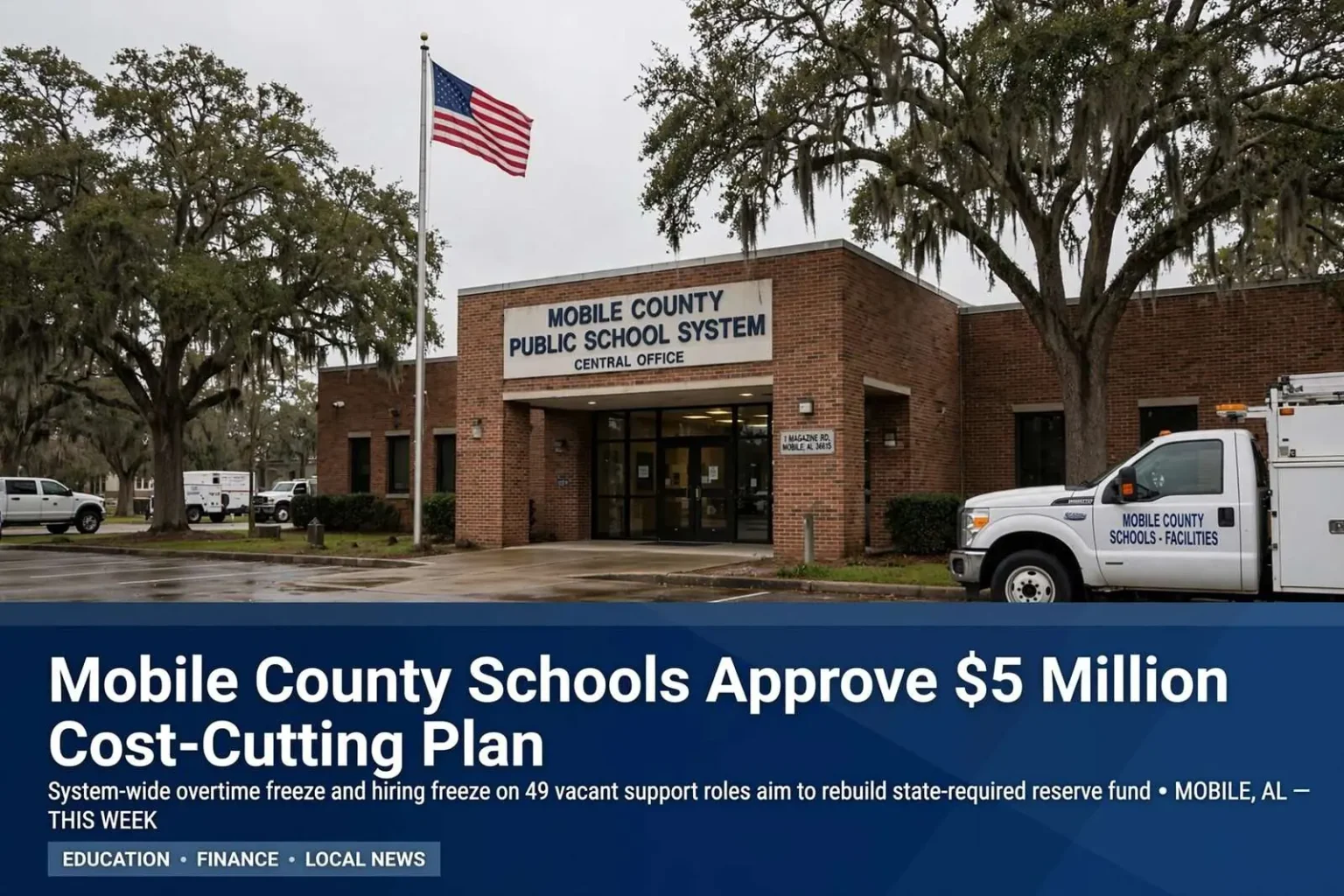
The Mobile County Public School System has approved a cost-cutting plan aimed at saving roughly $5 million next year, a package built around a system-wide freeze on overtime pay and dozens of long-vacant support staff positions. The measures are part of a state-approved recovery plan designed to help the district rebuild a legally required reserve fund, and the school board voted this week to implement the plan without changes. The vote puts Mobile County’s largest employer of public educators on a defined path back to financial compliance after years of shortfall.
The driving force behind the plan is a state law that requires school systems to maintain operating reserves equal to at least one month of expenses. For Mobile County, one of the largest school districts in Alabama, that threshold sits at roughly $34.8 million. According to Chief Financial Officer Dinish Simpson, the district has not fully met that requirement in about a decade, though the gap has been narrowing steadily in recent years as budgets have tightened and revenues have stabilized.
The shortfall stood at $7.6 million in 2013 and had improved to $5 million by this year. District officials describe that progress as meaningful but incomplete, since the reserve fund must reach its full legal minimum before the system is considered compliant with state rules. When a school system falls short of its reserve requirement, state law requires it to develop a recovery plan in coordination with the Alabama Department of Education, spelling out exactly how the gap will be closed over time.
That plan was approved by the state this spring. Rather than relying on a single dramatic cut, the recovery plan spreads savings across several categories of spending, combining the overtime freeze, the hiring freeze on vacant positions, tighter control of outside contracts, and long-term questions about under-enrolled school buildings. The board’s vote this week put all of those measures into motion at once, giving administrators a clear mandate to begin the next budget year under the new rules.
An Energy Partnership Doing Heavy Lifting
The plan leans heavily on an existing energy-savings partnership with a Texas-based conservation company. The firm has already recouped nearly $4 million in utility costs since being hired in 2014, and total projected savings over the life of the agreement approach $60 million. Those savings come from efficiency upgrades and utility management rather than from classroom programs, which is one reason the district has leaned on the partnership as a cornerstone of its recovery effort.
Utility costs are a major recurring expense for a system of Mobile County’s size, with dozens of campuses spread across a county that stretches from the city of Mobile down to communities along Mobile Bay. Every dollar saved on electricity, water, and building systems is a dollar that can be redirected toward the reserve fund without touching instruction. The performance-based structure of such conservation contracts means the vendor is paid from verified savings, limiting upfront cost to the district.
The No Overtime Policy
A new “No Overtime Policy” will apply to the district’s roughly 7,500 employees, from teachers and aides to custodians, bus drivers, and front-office staff. Superintendent Martha Peek said most historical overtime spending has come from the facilities department, where maintenance and repair work often extends beyond normal business hours. Overtime has averaged more than $455,000 annually since 2009, peaking near $693,000 in 2013, numbers that administrators concluded could no longer continue under a recovery plan.
The overtime freeze also carries a cultural component that district leaders have emphasized in past budget talks. Keeping a close watch on premium pay encourages departments to think first about preventive maintenance rather than emergency repairs, and well-timed upkeep of aging buildings generally costs less than the after-hours calls that generate overtime in the first place. Officials expect the annual overtime figure to drop well below its historical average in the first full year under the policy, with the difference flowing directly into the reserve account the recovery plan is designed to rebuild.
Peek said the tighter policy would require some belt-tightening but should not affect the district’s day-to-day operations. In practice, the policy shifts routine after-hours work toward scheduling adjustments rather than premium pay, and it forces departments to plan maintenance windows more carefully around the school calendar. Administrators view the change as one of the most direct savings levers in the plan because it does not require eliminating any jobs or reducing services to students.
Frozen Vacancies and Contract Oversight
The plan also freezes 49 classified support-staff positions that have sat vacant for six months or longer, out of 124 total vacancies districtwide as of March. Classified positions cover roles such as aides, clerical staff, custodians, and other support jobs rather than teachers. Those unfilled jobs represent more than $1.4 million in salary, money the district will hold onto as long as the positions remain open during the recovery period.
Peek said the district may eventually eliminate some of those positions outright rather than simply leaving them open. Deciding which jobs disappear for good will depend on how schools and departments absorb the work while the freeze remains in place, and officials have signaled that any permanent eliminations would be reviewed carefully before recommendations reach the board.
Administrators are also tightening how outside education service providers request funding. Those providers are currently budgeted for roughly $17 million in contracts this year, a significant slice of discretionary spending. Under the recovery plan, the district is moving from an ad hoc, year-round request process to a defined approval window ahead of each fiscal year, a change that gives budget planners a complete picture of contractual commitments before the year begins rather than encountering them one request at a time.
Officials estimate that change alone could save up to $1 million annually. The savings come from avoiding mid-year contract growth, eliminating duplicative services, and giving the district leverage to negotiate renewals on a predictable schedule instead of approving requests piecemeal as they arrive. Contract transparency has been a recurring theme in district budget discussions, and the recovery plan formalizes that discipline for outside vendors.
Under-Enrolled Schools on the Table
The recovery plan additionally flags enrollment capacity across the system. Roughly 72 percent of the district’s 90 schools are operating below capacity, with three schools at or under 25 percent capacity. Consolidating or closing even two of the most under-enrolled schools could save an estimated $1.6 million a year, according to the plan, by reducing duplicated administrative overhead, utility costs, and maintenance obligations that come with running half-empty buildings.
Peek declined to identify which schools were flagged as severely under-populated. While closures remain a valid option on paper, she said she does not expect the board to pursue that step in the near term, noting that school closures tend to be among the most divisive decisions a district can make. Such moves reshape attendance zones, lengthen bus rides for some families, and can leave neighborhoods without a walkable campus, which is why most Alabama systems treat consolidation as a last resort rather than a first tool.
The capacity figures also reflect broader demographic patterns across the county. Enrollment in large urban and suburban systems rarely rises and falls evenly across every attendance zone, and older schools built for previous generations of students can end up far below their designed capacity even as newer suburban campuses operate near their limits. That imbalance is what the recovery plan asks the board to keep in view as it weighs long-term facility decisions, since every under-used building carries fixed costs that must be paid regardless of how many students walk its halls.
What the Recovery Plan Means Locally
For parents and employees across Mobile County, the most visible effects in the coming year will be the overtime freeze and the continued vacancies in support roles. School schedules, teaching positions, and academic programs are not part of the cuts under the plan as adopted. Reserve requirements exist because unexpected expenses, from storm damage to enrollment shifts, can arrive without warning, and a system without a cushion is forced into emergency borrowing or mid-year reductions that hurt students more than planned savings would.
District officials say the combination of measures is intended to restore the reserve fund to its legal minimum without resorting to broader cuts to classroom instruction. The recovery plan’s structure also gives the state education department a framework for monitoring progress, with the reserve gap expected to close as annual savings accumulate and the district reports back on each category of the plan.
The board’s implementation of the plan without changes signals confidence that the district can meet its reserve obligation on the timeline the state has approved. If the projections hold, Mobile County will close out a decade-long shortfall one budget year at a time, restoring the financial footing that state law requires and shielding classrooms from the deeper cuts that inaction would eventually force.