Baldwin County Residents Want Outside Leader as Next Schools Superintendent
A survey of more than 3,100 Baldwin County residents and school employees shows strong support for an outside candidate with financial expertise as the next superintendent.
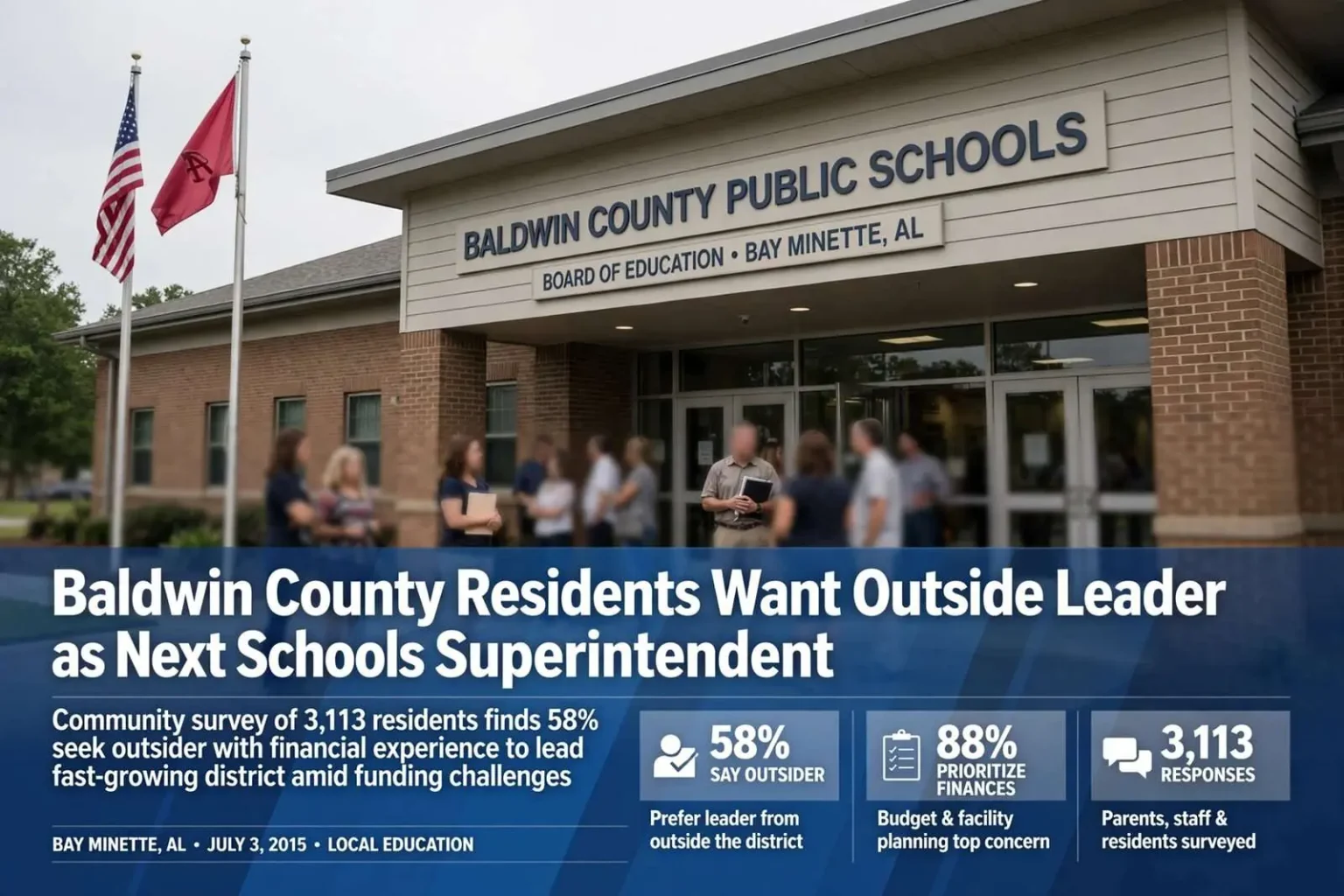
A majority of Baldwin County residents want their next public school superintendent to be a trustworthy outsider with proven experience and a strong handle on financial challenges, according to results of a community survey presented to the school board this week. The survey, one of the more extensive community input exercises a Baldwin County board has conducted for a personnel search, offered a detailed portrait of what parents, employees, and residents expect from the district’s next chief executive.
Board President Shannon Cauley presented the findings from the questionnaire, which drew 3,113 responses, including nearly 1,000 from school system employees, during a special board meeting. The volume of participation — more than three thousand responses to a voluntary survey — reflected how closely the superintendent question has been followed in a county where the school system touches nearly every household and is one of the largest employers on the Eastern Shore and across south Alabama.
The eight-question survey also invited written suggestions for the board as it searches for a replacement for outgoing Superintendent Robbie Owen. Owen announced in May that he would not seek a second year in the role, opting instead to exercise a contract clause allowing him to return to his previous post as principal of Rockwell Elementary in Spanish Fort, a school he has led since it opened 18 years ago. His decision returned one of the county’s best-known educators to the school where he built his reputation, and left the board searching for someone to fill a job he held only briefly.
His decision followed the defeat of several property tax measures earlier this year that would have funded system growth for decades to come. The tax votes loomed over the search: Baldwin County’s enrollment growth has been among the fastest in Alabama, driven by subdivision construction from Daphne and Fairhope down through Foley and Gulf Shores, and the failed measures left the incoming superintendent facing the same long-term funding gap the taxes were meant to close.
What residents said they want
The seven-member board is conducting the superintendent search on its own, without hiring an outside search firm, and board members also completed the same survey, sharing their own responses alongside the public results. Handling the search in-house saves the district the cost of a professional search firm and keeps the process directly in the board’s hands, though it places the logistical burden of screening, interviewing, and vetting candidates on the members themselves.
Asked to describe the most important quality for the next superintendent in a single word, more than 1,300 respondents wrote “trust,” with “leadership” and “experience” close behind. Among board members, “leadership” and “integrity” topped the list. The word-choice question produced one of the survey’s most quoted findings, and the dominance of “trust” suggested a community still working through the turbulence of the tax defeat and the brief, interrupted tenure of the superintendent who resigned in its aftermath.
An overwhelming majority of respondents identified funding as the biggest challenge facing the incoming leader, and nearly 88 percent said skills in budgeting, finance and facility planning would be essential. In a district adding students by the hundreds each year, facility planning is not an abstract skill: it means forecasting where new schools are needed, prioritizing construction against a constrained budget, and making the case to county commissioners and voters for the revenue to build them.
The timing of the survey placed it at a pivotal moment in the district’s calendar. With the job posting still open and the interview schedule not yet set, the board used the results to firm up the profile it would screen candidates against — effectively turning community opinion into the search’s job description. Cauley’s presentation marked the transition from the community-input phase of the search to the decision-making phase, where the board’s own preferences, as recorded in the same questionnaire, would now be applied to a field of applicants.
An outsider, with experience
Roughly 58 percent of respondents, about 1,800 people, said the next superintendent should not currently work within the Baldwin County school system, while 1,380 said the replacement should have at least four years of experience in a superintendent role. The preference for an outsider — coming from the same community that had watched the last search end in a quick resignation — marked a clear signal that residents wanted a clean break rather than a promotion from within.
The board itself was evenly split on the experience question, with three members favoring one to three years of prior experience, three favoring four or more years, and one saying no prior experience was necessary. Public opinion was similarly divided between candidates with four-plus years of experience and those with none at all. The split reflects a familiar tension in superintendent searches: experience in the top job reduces the risk of on-the-job learning, but candidates who have already led other districts often come with higher salary expectations and their own established methods.
In a shift from earlier sentiment following Owen’s resignation announcement, board members unanimously agreed the next leader should come from outside the Baldwin County school system entirely. The unanimity mattered, given that the board had been divided on the experience question. On the outsider question, there was no disagreement — a consensus that effectively sets the terms of the search before the first resume arrives.
The search timeline
The board laid out a tentative hiring timeline during the meeting. Once the job posting closes on July 8, the board attorney will distribute resumes for qualified applicants to each member. Centralizing the initial screening through the board attorney is a common approach for districts searching without a firm, giving all seven members the same complete file rather than filtered summaries.
The board plans to narrow the field to five candidates for initial interviews, then to two or three finalists by August, potentially visiting the school systems where top candidates currently work. Site visits are a standard step in Alabama superintendent searches, letting board members see candidates in their current environments — how their districts’ campuses are maintained, how their staffs talk about them, and how their communities respond to their leadership — before committing to a hire.
Public meet-and-greet sessions with finalists would follow before a final contract offer, with the board hoping to have a new superintendent in place within the first few weeks of the 2015-2016 school year, which begins Aug. 17. The public sessions give parents, employees, and residents a chance to question finalists directly, and they represent the last checkpoint before a contract that will define the district’s leadership for years to come.
The compressed schedule leaves little room for delay. A posting that closes July 8, interviews through the summer, and an Aug. 17 start-of-school deadline mean the board must move from a full applicant pool to a signed contract in roughly six weeks. Missing that window would leave an interim leader in place well into the school year — an outcome the board has already had a taste of, and one the survey suggests residents are eager not to repeat.
What the search means for the county
The stakes in the search extend well beyond the boardroom. Baldwin County Public Schools serves a geographic area larger than the state of Delaware, stretching from Bay Minette in the north to the beaches of Gulf Shores and Orange Beach in the south, and its enrollment growth has made new school construction a near-permanent item on the county’s political agenda. The next superintendent will inherit ongoing facility decisions, a budget shaped by the failed tax measures, and a community that has just told the board, in detail, what it expects.
The survey results give the board a written yardstick against which candidates can be measured. When applicants describe their leadership philosophy, board members can compare those answers against the qualities residents ranked highest — trust, leadership, experience, and financial skill. When finalists meet the public at the scheduled sessions, attendees can judge them against the same list. In that sense, the 3,113 responses function as both guidance and accountability for the seven members making the final choice.
For school system employees, the near-thousand staff responses carried their own message. Teachers, support workers, and administrators told the board they want a leader who will listen, fund the classrooms fairly, and bring stability after a period when the district’s top job changed hands quickly. Employee sentiment tends to shape morale well before a new superintendent’s first policy decision, and the board’s willingness to survey staff alongside the public signaled that those voices were meant to count.
The search now moves into its screening phase with the community’s priorities on record: an outsider, trusted, experienced in the financial and facility demands of a fast-growing district, and hired in time to lead the schools through the year ahead. Whether the board’s do-it-yourself process can deliver that candidate by mid-August will be the first test of the approach the survey helped define.