Fairhope Welcomes Female Pilots as Local Girls’ Aviation Program Marks Milestone Year
Fairhope hosted Air Race Classic pilots in June 2015, spotlighting a Boys and Girls Club of South Alabama program mentoring girls in aviation careers.
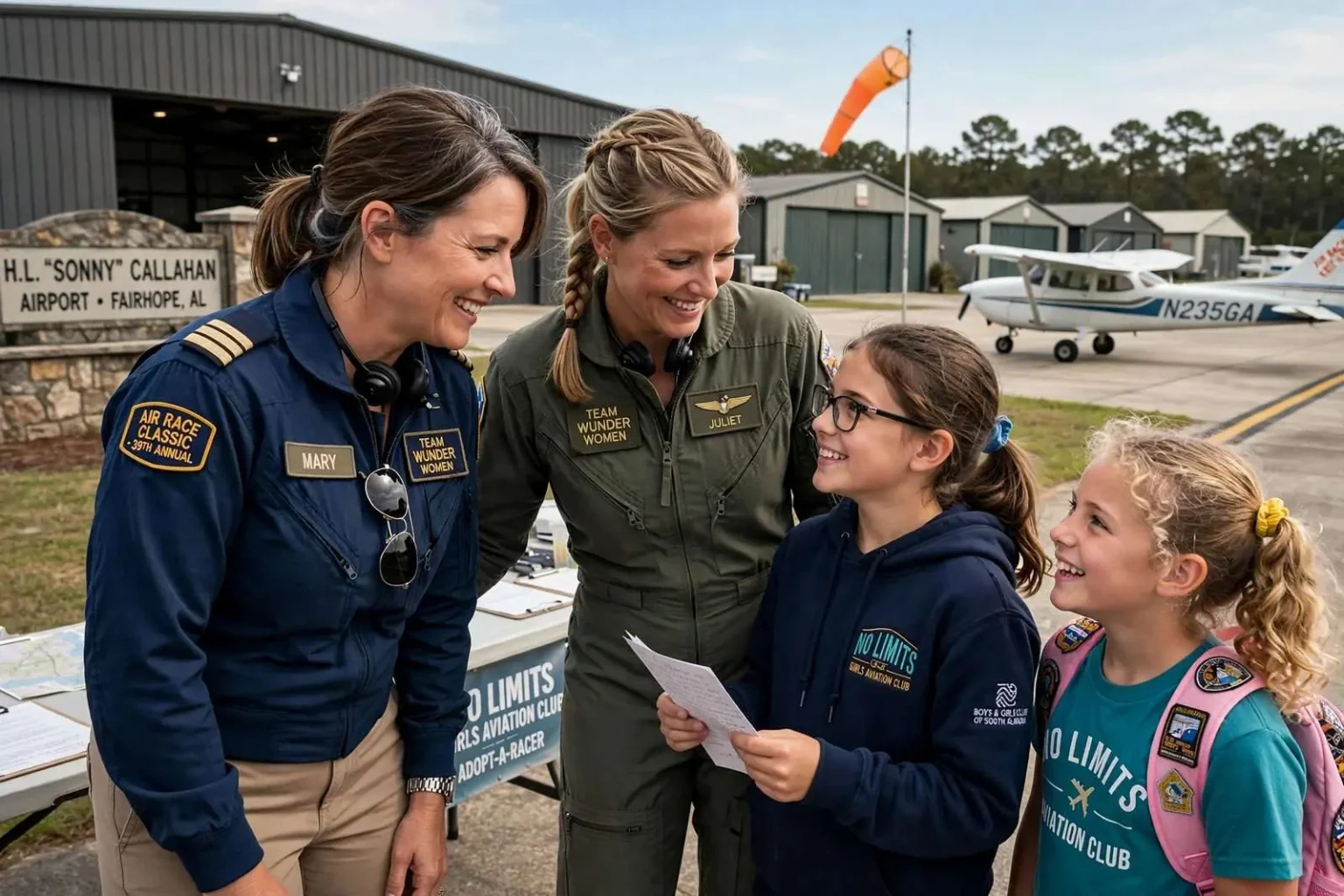
Two veteran pilots touched down at Fairhope’s municipal airport on a Thursday in June to an enthusiastic welcome from two young girls who had spent weeks writing letters to the flyers before ever meeting them in person. The arrival turned a routine race finish into a reunion, as the pen pals who had tracked the pilots’ progress across half the eastern United States finally stood face to face on the ramp. For the small crowd gathered at the field, the moment captured what a weeks-long mentorship experiment can become when it lands, literally, in a hometown’s own hangar row.
The moment capped months of anticipation built through an “Adopt-a-Racer” mentorship program pairing local girls with competitors in the Air Race Classic, an all-women cross-country air race now in its 39th year. The Classic traces its lineage to the 1929 Women’s Air Derby, the famous transcontinental race that carried Amelia Earhart and nineteen other pioneering female aviators from Santa Monica to Cleveland. Today’s version carries that tradition forward with modern general aviation aircraft, flying teams of two or more women pilots across roughly 2,500 miles of staged daylight legs, with timing — not raw speed — determining the winners.
Pilots Mary Wunder and Juliet Lindrooth, flying under the name Team Wunder Women, had just wrapped a 2,500-mile route that began in Virginia days earlier. Each leg of the Classic is timed between specified airports, and teams must fly during daylight hours under visual flight rules, landing at overnight stops where local aviation groups frequently roll out the welcome. The race serves as both competition and moving classroom, pushing pilots through weather briefings, route planning and fatigue management across four demanding days.
Waiting for them at H.L. “Sonny” Callahan Airport were Ivy Laubinger, 15, of Semmes, and Lydia Stroud, 10, both members of the No Limits Girls Aviation Club, a program run through the Boys and Girls Club of South Alabama in partnership with the nonprofit Aviation Adventures. The airport, named for the late Fairhope mayor who championed its development, sits in the rolling terrain north of the city and serves as home base for the area’s growing general aviation community — flight instructors, banner towers, charter pilots and the student pilots who take their first lessons over Mobile Bay’s eastern shore.
A Program With Roots in Mobile
The club traces back to 2011, when Mobile served as the race’s finish line and organizers launched a program to introduce local girls to aviation careers. That year’s Air Race Classic terminus brought dozens of women pilots and their aircraft to the Gulf Coast, and the visit left behind something more durable than a fly-in crowd: a structure for connecting local girls with working aviators year after year. The Adopt-a-Racer format grew out of that energy, matching club members with a race team whose progress they follow by letter, map and internet tracking until the racers arrive.
This year, the club’s original members, Ivy among them, returned as mentors guiding about 30 younger girls who had joined more recently, while the effort has since spread to other Boys and Girls Club chapters along the Gulf Coast, including one on the Florida Panhandle. The passing of the torch from the founding class to the current one marks the kind of institutional maturity youth programs rarely achieve — the fifteen-year-old who once wrote letters to a racer now helps a ten-year-old write hers. Expansion to neighboring chapters means the pipeline of Gulf Coast girls exposed to aviation now stretches along the coast rather than stopping at one club’s door.
More Than Flying Lessons
Club leaders said the program’s goal extends well beyond flying lessons. Organizers described watching participants grow from shy and withdrawn into confident young women willing to speak up and explore fields such as air traffic control, aircraft maintenance and engineering alongside piloting. Airport visits put members inside control towers, maintenance hangars and avionics shops, where the range of aviation careers becomes concrete rather than abstract — a dispatcher’s console, an engine on a stand, a radar screen tracking aircraft across the Gulf.
The program’s founder, an experienced air racer, said the point is showing girls the breadth of careers the aviation industry offers, not just the cockpit. That framing matters in an industry facing a widely acknowledged shortage of pilots and technicians, where airlines, repair stations and aerospace employers actively recruit from high schools and colleges. For students on the Gulf Coast, the message is that aviation jobs exist close to home — at regional airports, at the aerospace facilities scattered along the I-10 corridor, and at major hubs a short flight away.
The visiting racers echoed that message directly to their young pen pals, encouraging them to pursue their interests regardless of skepticism from others. One pilot, who began flying as a teenager and now flies commercially, urged the girls not to let anyone talk them out of an aviation path. The exchange between working aviators and their young admirers is the heart of the Adopt-a-Racer model: the letters build the relationship in advance, and the airport meeting makes the career real.
Why Fairhope’s Airport Matters
H.L. “Sonny” Callahan Airport has grown into a genuine community asset for eastern Baldwin County. Its runway and hangar facilities support flight training, medical transport flights, business aviation and the recreational flying that thrives in a region where good flying weather stretches across most of the calendar. Events like the racers’ arrival give the airport a public face, and local officials have long pointed to general aviation as an economic contributor that brings visitors, investment and workforce opportunity to the county’s eastern shore.
The Air Race Classic’s stop schedule also underscores how general aviation knits communities together. In a single week, the race moves through dozens of small and mid-size airports across the eastern half of the country, and at each stop a local welcome committee — airport staff, EAA chapters, civic groups, youth aviation clubs — turns a fuel stop into an event. Fairhope’s role this year placed the city on that map, and the No Limits club’s pen-pal program ensured the connection did not end when the racers departed for the next leg.
Girls in Aviation on the Gulf Coast
The club’s growth mirrors a broader national push to draw more women into a field where they remain a small minority of pilots and mechanics. Organizations across the country hold Girls in Aviation Day events each fall, women-focused flying organizations offer scholarships and mentorship, and airline cadet pipelines increasingly reach into middle and high schools. The No Limits club operates on the same logic at the local level: exposure early enough, and repeatedly enough, that an aviation career seems ordinary rather than exceptional for a girl from Semmes, Fairhope or Prichard.
The Boys and Girls Club partnership is central to that reach. By operating inside an organization that already serves hundreds of young people across South Alabama, the aviation program reaches girls who might never seek out an airport on their own. The partnership with Aviation Adventures adds the aviation-specific expertise — aircraft access, instructor time, and the connections that make airport visits and race-week events possible.
For Ivy and Lydia, the racers’ touchdown was the payoff for weeks of letters, maps and race tracking. For the roughly thirty younger girls watching their mentors greet the pilots, it was a preview of the role they may one day play themselves — standing on the ramp, welcoming the next generation’s racers to the Gulf Coast, and passing the program along again.
Educators and program organizers note that mentorship programs like Adopt-a-Racer succeed precisely because they are personal rather than programmatic. A girl who has exchanged a dozen letters with a named pilot, followed her race route on a map, and finally shaken her hand on the ramp carries that connection into her own decisions about school subjects, first jobs and flight lessons. Aviation educators have long observed that a single face-to-face encounter with a working pilot or mechanic can redirect a young person’s ambitions more effectively than any brochure.
The race itself offers a lesson in disciplined aviation that the club members absorb along the way. Teams flying the Classic must balance fuel planning against weather, manage the timing legs that decide the standings, and cope with the mechanical realities of flying an aging general aviation fleet across the country in four days. Following that effort letter by letter gives club members a working picture of what competence in aviation looks like — not just the glamour of flight, but the preparation, judgment and teamwork that make it routine.
As the Air Race Classic wrapped another edition of its 39th-annual tradition, the Fairhope stop stood out for the crowd on the ramp and the program behind it. What began in Mobile in 2011 as a finish-line outreach effort has matured into a Gulf Coast institution that trains its own mentors, spreads to new chapters every few years, and keeps introducing coastal Alabama girls to a sky full of careers. The racers flew on to their next stop; the letters, and the ambitions they carry, will keep flying long after.