An empty theatre stage lit by a spotlight, illustrating Theatre 98's production of Radium Girls in Fairhope, Alabama'Radium Girls' runs July 17 through August 2 at Theatre 98 in Fairhope.

Theatre 98 in Fairhope opens its production of “Radium Girls” on July 17, bringing to the Eastern Shore one of the most quietly devastating true stories in American industrial history.

The Play

“Radium Girls” is based on the young women who painted luminous watch dials for the U.S. Radium Corporation in the 1920s. The work paid well. It was considered desirable. And the women were instructed to shape the tips of their brushes with their lips — a technique called “lip-pointing” — ingesting radium with every dial they painted.
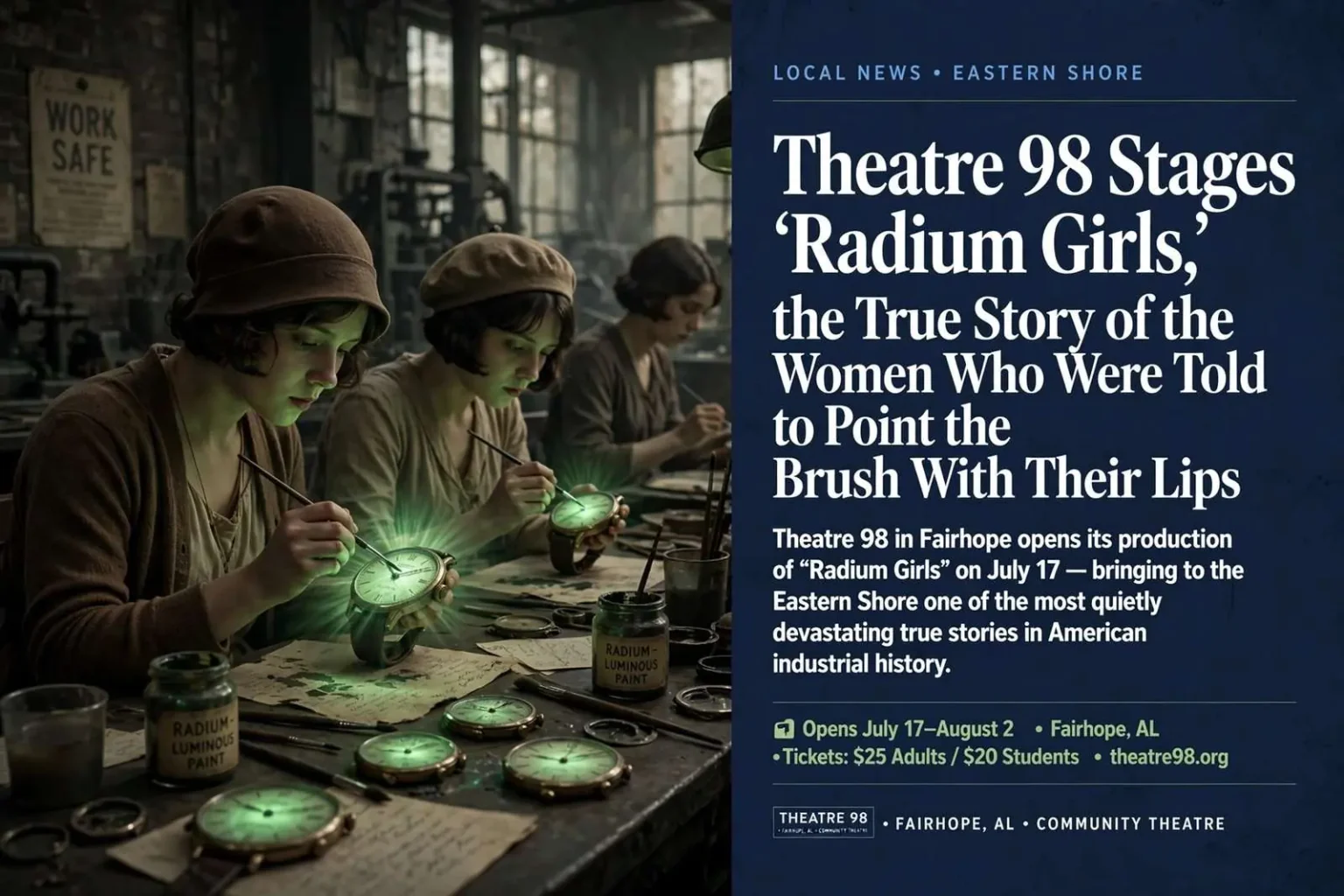
Company executives, who handled the same material behind lead shields and with tongs, told them it was harmless.

The play examines what happens when profits are prioritized over people, and it asks a question that has not aged a day: who should society hold responsible for unintended consequences? Described as at times both heartbreaking and uplifting, it is a work of theatre that trusts its audience to sit with a hard story.

Why the Story Still Matters

The women who sued U.S. Radium — sick, dying, and in several cases too weak to raise their arms to take an oath in court — helped establish something that outlived every one of them: the legal principle that a worker has the right to sue an employer for occupational disease.

Their case reshaped American labor law and contributed directly to the development of workplace safety standards and, eventually, the regulatory architecture that became OSHA. It is not an exaggeration to say that protections most American workers now take for granted were purchased by a small group of young women whose bones were literally disintegrating.

That is the weight a community theatre takes on when it puts this play on its season. It is a considerable one, and it is a credit to Theatre 98 for doing it.

See also  Elderly Saraland Man Dies While Burning Yard Debris

Performance Schedule

The production runs across three weekends:

  • July 17–19
  • July 23–26
  • July 30–August 2

Show times: 7:30 p.m. Thursday, Friday and Saturday; 2:30 p.m. Sunday.

Tickets: $25 for adults, $20 for students.

More details are available at theatre98.org.

About Theatre 98

Theatre 98 is Fairhope’s long-running community theatre, and it has been a fixture of the Eastern Shore’s arts scene for decades. Community theatre at this level is one of the more underrated assets a small city can have — it puts serious work in front of local audiences at a price a family can actually pay, and it does it with neighbors on the stage.


Theatre 98 has served Fairhope and the wider Eastern Shore as a community theatre for decades, staging works that range from lighthearted comedy to challenging drama. Choosing “Radium Girls” places the company in the tradition of community theatres that use the stage to confront difficult history rather than avoid it. For audiences on the Eastern Shore, the production offers a close-to-home reminder that the labor protections many take for granted were won through litigation and loss.

Fairhope, long known for its arts-friendly community and its position on the eastern side of Mobile Bay in Baldwin County, has sustained a lively performing-arts scene that includes Theatre 98 among its anchors. A true story drawn from the 1920s resonates in a region where shipbuilding, seafood processing, and other industrial work have shaped working life for generations. The play’s questions about corporate responsibility and worker safety remain live ones, and a community theatre is precisely the kind of venue where they can be asked without the distance of a textbook.

See also  Carnival Ecstasy Sails From Mobile One Last Time Before Retirement

The three-weekend run gives Eastern Shore audiences multiple chances to take in the production, and the modest ticket prices keep it accessible to families and students. For Theatre 98, mounting a work of this weight is a statement about what a small community theatre believes its stage is for.

The Radium Girls case also helped lay groundwork for the modern understanding of occupational illness. The women’s lawsuits, filed in the early 1920s, forced courts to confront injuries that developed slowly and invisibly, long after the responsible exposure. That legal reckoning predated any federal workplace safety agency, and the public attention it generated contributed to a broader shift in how the country thought about the duty an employer owes to the people it puts to work.

For a Fairhope audience, the story carries a regional echo. The Gulf Coast’s own industrial heritage — from the shipyards of Mobile and Pascagoula to the paper mills and chemical plants that dot the coastline — has its own long account of workers exposed to hazardous materials on the job. A play about young women poisoned by a substance they were told was safe lands differently in a place where that struggle is part of living memory.

Theatre 98’s staging runs for nine performances across three weekends, with evening shows Thursday through Saturday and a Sunday matinee. At $25 for adults and $20 for students, the production is priced to draw both dedicated theatre-goers and families curious about a piece of history they may know only in fragments. Tickets and additional information are available through theatre98.org, and the Eastern Shore arts community has rallied around the run as one of the summer’s more ambitious offerings.

See also  Mobile's Political Class Sizes Up an Unsettled 2008 Presidential Field

Community theatre has long been one of the engines of civic life on the Eastern Shore, and Theatre 98 sits among the institutions that give Fairhope its reputation as an arts-minded town. Productions like “Radium Girls” demonstrate why that role matters: a community stage can host conversations that a multiplex screen never would, and it can do so for a few dollars a seat. The company’s decision to mount a difficult true story in the height of summer, when lighter fare might draw bigger crowds, is a quiet argument for the value of local theatre as a place where a town thinks out loud about its values.

The radium dial painters’ story has been told and retold for a century because it sits at the intersection of science, commerce, and human cost — a cautionary account that resonates far beyond the 1920s factory floor. The women’s fight helped seed the legal and regulatory recognition that worker health is a matter of rights, not favors, and that recognition now undergirds everything from Occupational Safety and Health Administration standards to modern occupational medicine. Bringing that history to a Fairhope stage lets a new audience sit with it, and perhaps leave asking the same question the play poses: who is responsible when the cost of doing business is paid by the people who do the work.