New Left-Turn Signals Coming to U.S. 98 Between Spanish Fort and Fairhope
ALDOT began installing flashing yellow arrow signals at 17 intersections along U.S. 98 between Spanish Fort and Fairhope to improve turn safety.
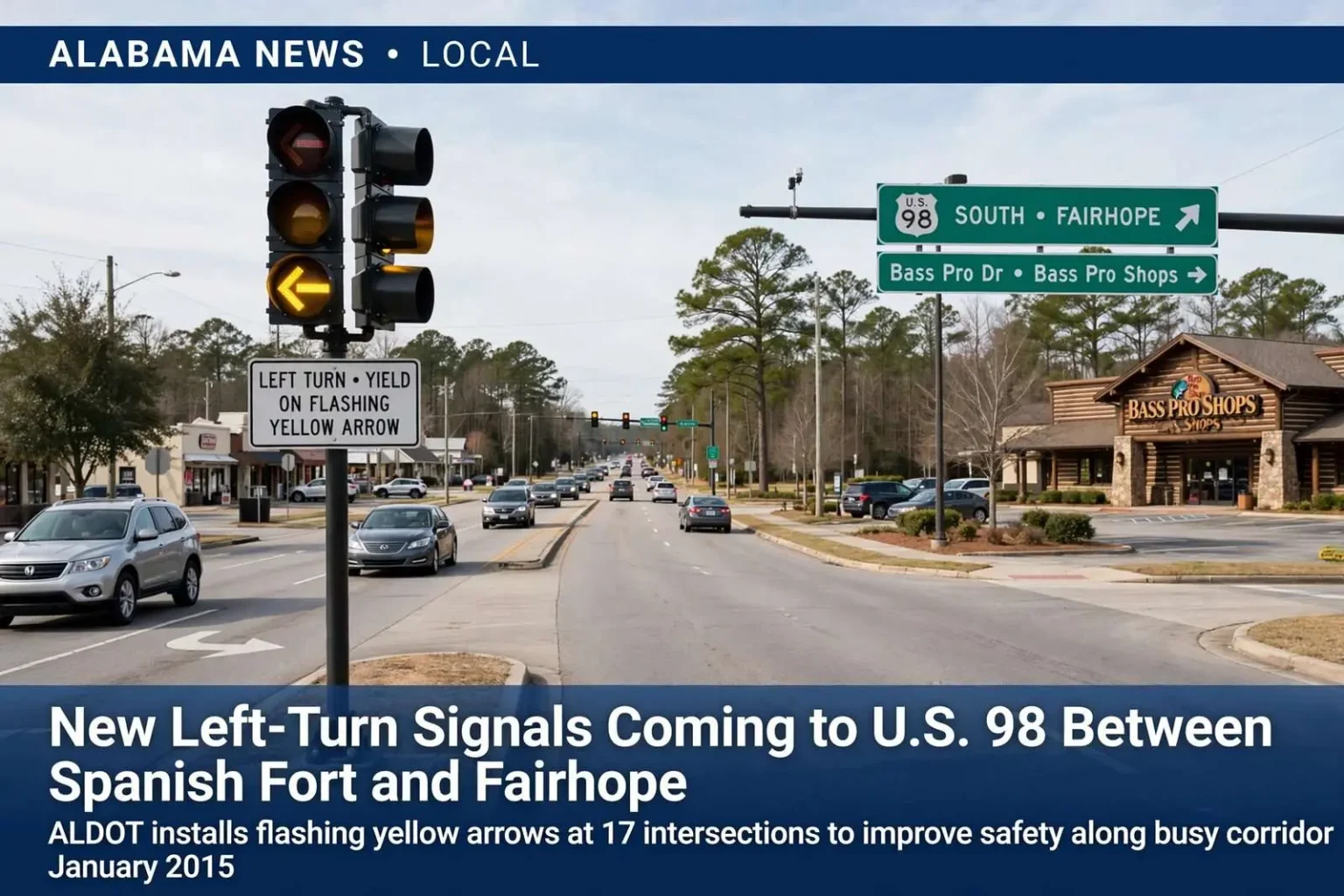
Motorists traveling U.S. 98 between Spanish Fort and Fairhope began seeing a new kind of traffic signal in January 2015, as the Alabama Department of Transportation started installing flashing yellow left-turn arrows meant to make the busy corridor safer for drivers making left turns. The rollout included the intersection of U.S. 98 and Bass Pro Drive in Spanish Fort, a heavily traveled crossing near the Bass Pro Shops retail development that draws significant traffic from across Baldwin County.
State transportation officials said the new signal configuration would replace older setups at that intersection with a system considered a meaningful safety upgrade over traditional turn signals. In total, the project called for flashing yellow arrow signals to be installed at 17 intersections along U.S. 98 stretching from Spanish Fort to Fairhope, alongside new signage to help drivers understand the unfamiliar signal.
The corridor’s intersections have long been ranked among the region’s more crash-prone crossings, with left-turn movements accounting for a disproportionate share of injury collisions. Turning left across oncoming traffic is one of the most demanding maneuvers a driver makes at a signal, and engineers have spent decades looking for configurations that reduce the split-second judgment calls it requires.
How the new signal works
Baldwin County was among the first areas in Alabama to adopt the technology at this scale, though the concept itself was not new nationally, having been the subject of national coverage and gradual adoption in other states for several years before reaching south Alabama. Communities across the country began converting older signal heads to the flashing yellow arrow format after federal research found consistent safety benefits, and the design has since become the standard for new and rebuilt left-turn signals in much of the United States.
The flashing yellow arrow works differently than a standard green arrow or solid yellow light. Instead of a fixed protected turn phase, the flashing yellow arrow tells drivers they may turn left when it is safe to do so, factoring in oncoming traffic, rather than assuming the turn is automatically clear. A solid green arrow still appears at times, giving drivers a fully protected window to turn without conflicting traffic, and a steady yellow warns that the protected phase is ending.
Traffic engineers have found the format reduces certain types of collisions compared to older signal designs, particularly left-turn crashes that occur when drivers misjudge gaps in oncoming traffic under a standard green light setup. Under the old configuration, a driver facing a green ball had to decide both whether to go and whether the light was still a permissive indication, a combination studies found produced hesitation, driver error and rear-end collisions. The flashing yellow arrow separates those decisions, reserving the solid green arrow for protected turns and using the flash for permissive ones.
The signals also give engineers flexibility that fixed-timing setups lack. Because the flashing indication is controlled separately from the through phases, signal timing can be adjusted throughout the day — protecting left turns during peak commuter hours when gaps in oncoming traffic are scarce, and relying on the flashing arrow during quieter periods when traffic flows freely. That adaptability means less waiting for a turn arrow to cycle when there is no opposing traffic to yield to, which reduces delay as well as frustration.
A corridor under pressure
The U.S. 98 corridor has long been one of the busiest and most congested stretches of roadway connecting the Eastern Shore communities of Baldwin County, carrying commuter and retail traffic between Spanish Fort’s shopping districts and Fairhope’s downtown and residential areas. The route funnels shoppers toward the big-box retail clustered near Bass Pro Drive, serves school traffic in both cities, and carries commuters headed toward the Bayway and Mobile. As Baldwin County’s population has grown, the corridor has drawn increasing attention from state and county officials looking for ways to improve traffic flow and reduce crashes without the cost of full intersection redesigns.
County growth has made the safety question more urgent in recent years. Baldwin County has ranked among the fastest-growing counties in Alabama, and its road network — much of it built for a far smaller population — has absorbed steadily increasing traffic volumes. Upgrading signal hardware is among the least expensive tools available to transportation planners, delivering measurable crash reductions at a fraction of the cost of adding lanes or rebuilding intersections.
Safety data collected in other states after similar conversions showed reductions in left-turn crashes of significant magnitude, which is why the Federal Highway Administration has encouraged the flashing yellow arrow as the preferred design nationwide. Planners in Baldwin County pointed to that track record when the project was proposed, arguing that a corridor with U.S. 98’s volume of turning movements was an ideal candidate for the upgrade.
ALDOT crews worked intersection by intersection to install the new signal heads and accompanying left-turn lane signage, a process that continued over multiple weeks in early 2015. The agency said drivers should expect a period of adjustment as the new signal type became more familiar, but officials expressed confidence that the change would ultimately reduce the number of turn-related crashes along one of the Eastern Shore’s most heavily used routes.
The state posted educational material and signage at each conversion, and law enforcement agencies in Spanish Fort and Fairhope said they planned to emphasize education over citations during the first weeks of the rollout. National experience with the signals has shown that most drivers adapt within a few trips through a converted intersection, and that confusion tends to fade quickly once the flashing arrow becomes a familiar sight across a community.
What drivers should know
Transportation officials offered a simple guide to the new indications. A solid green arrow means oncoming traffic is stopped and the left turn is fully protected. A flashing yellow arrow means drivers must yield to oncoming traffic and pedestrians before turning, proceeding only when a safe gap appears. A steady yellow arrow warns that the signal is about to change, and a red arrow means drivers must stop and wait, just as they would at a standard red light.
The key difference from the old configuration is the meaning of the flashing display. Rather than treating a permissive green as an instruction to go, drivers now see an explicit warning that the turn is allowed but not protected — a message safety researchers say cuts down on the hesitation and gap misjudgment that produce crashes at conventional signals.
For Baldwin County, the 17-intersection conversion represents one of the most complete deployments of the technology on a single corridor in the state, and transportation planners in other growing counties were expected to watch how the upgrade performs. If the U.S. 98 experience mirrors the national pattern, officials expect fewer left-turn collisions, fewer injuries and smoother traffic flow along the Eastern Shore’s busiest north-south route in the years ahead.
The conversion project also reflects a broader shift in how Alabama approaches signal design. For decades, the standard practice was a single green ball governing both through traffic and permissive left turns, an arrangement that cost little but left drivers to sort out who had the right of way. The flashing yellow arrow standard, adopted into federal guidance after years of study, gives each movement its own dedicated signal head and removes the ambiguity that produced many of the old crashes.
Cost remains an advantage of the upgrade. Converting an intersection to flashing yellow arrow operation requires new signal heads, controller updates and signage, but it avoids the drainage, curb and property work that comes with lane additions or geometric changes. For a corridor like U.S. 98, where right-of-way through the busiest sections is already developed, that made signal improvements an attractive first step while longer-term capacity projects remain under study.
ALDOT officials said the timing of the Baldwin County conversion — placed at the start of a new year, after the holiday shopping season had subsided — was intended to minimize disruption while crews worked through the list of intersections. Motorists were urged to use extra caution during the transition, to watch the signal heads closely at unfamiliar intersections, and to remember the simple rule behind the flashing display: yellow means yield, then go when it is clear.
As the new signals settle in, both cities along the corridor stand to benefit. Spanish Fort’s retail centers depend on easy access from throughout the county, and Fairhope’s downtown merchants rely on the same flow of shoppers. Fewer crashes and less delay at the corridor’s 17 busiest intersections protect both the commerce and the commuters that share the road — the outcome state engineers said they designed the project to deliver.
Transportation officials said they will continue monitoring the corridor in the months ahead, collecting crash and traffic data that will show whether the flashing yellow arrows perform in Baldwin County as they have elsewhere in the country.