New Theater Building Rising in Downtown Fairhope
A new two-story building replacing the fire-damaged Magnet Theater site in downtown Fairhope is expected to open its shops and offices by spring 2015.
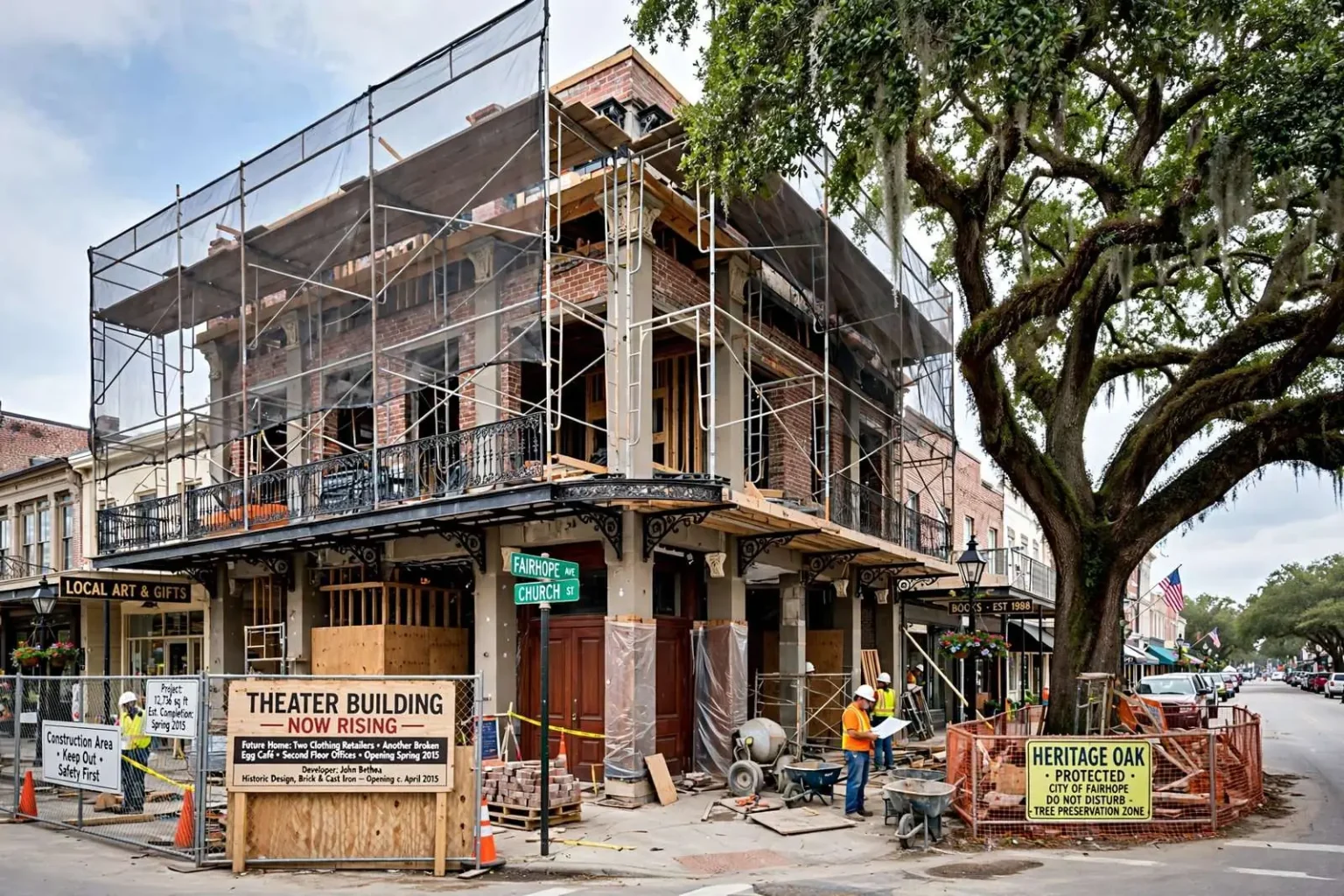
A new two-story building is taking shape on one of downtown Fairhope’s busiest corners, and the developer behind it says the finished project will look like it has stood there for generations. Construction is underway at the southeast corner of Fairhope Avenue and Church Street, where developer John Bethea is building what he calls the Theater Building. The ground floor will house two clothing retailers and a location of Another Broken Egg Cafe, while offices are planned for the second story.
The corner sits in the commercial heart of a downtown that has made walkability its calling card. Fairhope Avenue runs from the bluff above Mobile Bay up through the heart of the business district, lined with locally owned shops, galleries and restaurants that draw visitors from across Baldwin County and from Mobile across the bay. A freshly built corner at Fairhope and Church — steps from the city’s parks, the pier and the shopping streets that branch off the main corridor — is among the most visible pieces of ground in town.
A Design Meant to Look Older Than It Is
Bethea describes the design as New Orleans-influenced, with old brick, mahogany doors and heavy ironwork intended to evoke the look of a much older structure. “It’s going to look like a historic building when I finish with it,” he said. “It’s going to look like a building that’s been here for a couple hundred years.”
The aesthetic borrows deliberately from the architectural vocabulary of the Gulf Coast’s older cities. Cast iron galleries, deep-set brick facades and heavy wooden doors are signatures of New Orleans neighborhoods that grew up in the nineteenth century, and elements of that vocabulary already appear in older commercial blocks along the Eastern Shore. By reaching for those materials rather than a contemporary glass-and-stucco look, Bethea is betting that visitors and tenants alike respond to the texture of a building that appears to belong.
The approach also mirrors the way Fairhope has always presented itself. The city was founded in the 1890s as a utopian single-tax colony and grew into an artists’ colony and resort town whose identity is tied to its historic core. City leaders have spent decades nurturing that identity through streetscape improvements, festivals and a schedule of public events that keep the downtown streets busy nearly year-round.
A Partnership Rearranged
Bethea originally partnered with retired Baldwin County Circuit Court Judge James Reid to develop the site, but the two later worked out a property swap involving land on Magnolia Avenue that left Bethea as the sole developer moving forward. The rearrangement let each man pursue his own vision for the parcel he ended up with, while keeping the flagship corner project on track.
Land assembly in a downtown as built-out as Fairhope’s is rarely simple. Parcels at major intersections change hands infrequently, and projects that require multiple lots or cooperation among neighbors can take years to line up. The property swap was the kind of deal that small downtowns see when two owners with different plans find a way to trade toward the outcomes each wants without a prolonged fight.
A Site Burdened and Blessed by History
The new construction replaces a beloved but troubled piece of Fairhope history. A building on the same footprint burned in a 2010 fire, cutting short what had been a long run as a retail hub called Village Square. Before that, the site was home to the Magnet Theater, which opened in 1924 and operated as a movie house until 1974 — the inspiration for the new building’s name. The property had even been listed among the state’s historic “Places in Peril” in 2003, years before the fire finally forced its demolition.
The Magnet Theater era remains a touchstone for older Fairhope residents, part of the mid-century downtown remembered through Saturday movie matinees and storefronts along Fairhope Avenue. Its conversion to retail space kept the corner productive for decades, and Village Square’s shops made it a fixture for a later generation. By the time the 2010 fire ended that run, the aging structure had already spent years on the watch list of the Alabama Historical Commission’s Places in Peril program, which each year highlights significant historic properties threatened by neglect, weather or development pressure.
The loss was felt broadly in a town that prizes its landmarks, but it also created an unusual opportunity: a cleared, high-profile corner in the exact spot where a rebuilt downtown most needed investment. What rises there next will inevitably be measured against what stood before, which is part of why the developer has leaned so hard into a design meant to read as old Fairhope rather than new construction.
Saving the Oak
Fairhope Mayor Tim Kant said city inspectors determined after the fire that the structure was too compromised to save. “We had to work with the owner and have the building removed,” he said, adding that city crews and the developer have made a point of preserving a large heritage oak tree on the Church Street side of the property throughout construction.
The care taken with the oak says a great deal about Fairhope’s relationship with its trees. The city has long protected its live oaks and other mature canopy, and the tree-lined streets downtown are among the features residents cite first when describing what makes the city distinctive. Construction crews working tight downtown sites routinely route utility lines, stage materials and adjust building footprints to avoid damaging root systems, and the heritage oak at Fairhope and Church Street will now shade a corner occupied by businesses rather than a vacant lot.
What the Project Brings Downtown
Kant said the new building fits into downtown Fairhope’s identity as a walkable destination for shopping and dining. “It will add to our downtown experience,” he said. “We’ve always been great about having places to eat and shop, so any time we can have a major corner like that — where this is at — it will help bring more people downtown.”
The tenant mix reflects that strategy. A breakfast-and-brunch cafe with a regional following is expected to generate morning and midday traffic, while the two clothing retailers extend the shopping rows that already anchor the district. Second-floor offices add a weekday population that supports restaurants and shops during hours when pure retail districts can go quiet, and the combination of uses is intended to keep the corner active from early morning through the evening.
Downtown development of this scale also carries fiscal meaning for the city. Sales and property tax revenue from a rebuilt corner flow back into municipal coffers, and a finished building removes a visible gap in the streetscape that lingered since the fire. City officials have consistently argued that the best economic development tool available to a small downtown is a full storefront line — few things deter visitors faster than a shuttered block in the middle of a shopping district.
Timeline and Outlook
The project has been in the works since 2012 and will total roughly 12,736 square feet once complete. Bethea is targeting an opening around April 2015, though he cautioned that construction timelines can shift. He said the collaboration with city officials throughout permitting and construction has gone smoothly.
“It’s just going right along,” he said. “It’s exciting. Me and the city have been getting along pretty good.” For a project that has already outlived a partnership, a fire’s aftermath and years of planning, a smooth working relationship with City Hall may prove the least dramatic part of its story — and, if the opening lands as planned, the corner that once held a movie house and then a retail village will begin its third life at the center of downtown Fairhope.
Local builders say projects like this one ripple outward through the trades as well. Brick masons, millworkers, electricians and finish carpenters from across Baldwin County will spend months on the site, and the specialty work the design demands — salvaged brick laid in traditional patterns, ironwork fabricated to fit, mahogany doors hung and trimmed — calls on craft skills that newer construction rarely requires. Each such project keeps those trades busy and leaves another sample of their work in one of the county’s most visited downtowns. The steady flow of downtown reinvestment, planners note, is what keeps a small city’s core competitive with the strip retail corridors along the Eastern Shore’s highways.
When the doors open, the corner will complete a chapter that began in 1924 with the first reel shown at the Magnet Theater. The new building will not screen films, but its name will keep the memory attached to the ground it stands on — and, in a town that has always traded on its sense of place, that continuity may be the most valuable feature of all.