Real Estate Roundup: ThyssenKrupp Deeds Calvert Stainless Plant as RSA Closes Royal Street Deal
ThyssenKrupp deeded the stainless portion of its Calvert plant to TK Stainless in a transaction valued in the tens of millions, while RSA closed on downtown Mobile's Royal Street properties.
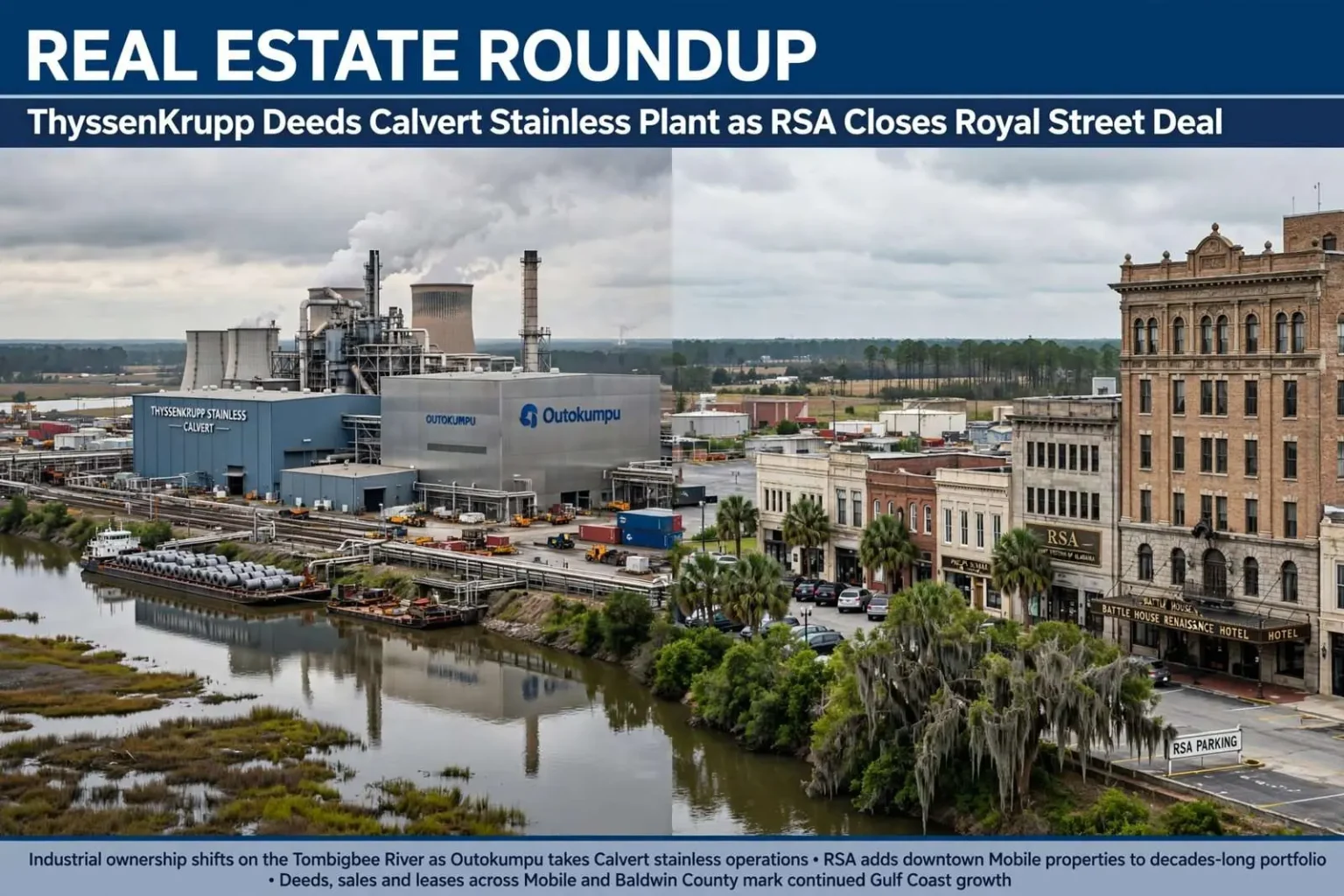
ThyssenKrupp Steel USA deeded the stainless-steel portion of its plant in Calvert to TK Stainless, with the assessed value of the land placed at more than $20 million, according to court records. Attorney Doug Anderson of Burr & Forman in Mobile represented both parties, and Surety Land Title handled the closing.
The deed transferred legal ownership of the stainless operation’s slice of one of the largest industrial sites ever built in Alabama. ThyssenKrupp’s Calvert complex, erected on a vast site along the Tombigbee River in north Mobile County, represented a multi-billion-dollar investment that ranks among the biggest in state history and transformed the economy of the surrounding rural communities with thousands of construction and permanent jobs. By carving the stainless operations into a separate corporate property, the company aligned its ownership structure with the reality of the steel market — and with the international deal that had reshaped the stainless side of the business.
TK Stainless had been purchased by the Finland-based stainless steelmaker Outokumpu in a deal valued at $3.6 billion earlier that year, while ThyssenKrupp’s carbon-steel facility continued operating in Calvert. The transaction folded the Calvert stainless plant into one of the world’s largest stainless producers, giving Outokumpu a U.S. manufacturing footprint at a time when American demand for stainless — from appliances to energy infrastructure — was recovering.
RSA Expands Its Downtown Holdings
The Retirement Systems of Alabama paid $3.35 million for a 16,000-square-foot law office owned by LPC Properties at 2 N. Royal St., along with an adjacent employee parking lot; the firm of Phelps Dunbar occupied the building.
RSA also paid $1.5 million for a parking lot owned by Royal St. Properties at 4 N. Royal St., next to the RSA-owned Battle House Renaissance Hotel. The acquisitions continued the pension fund’s long-running accumulation of downtown Mobile real estate, which includes office towers, hotels and parking infrastructure clustered around the city’s historic core. Under its chief executive, RSA has for decades used pension dollars to bankroll landmark properties across Alabama — from Montgomery’s capital complex to Gulf Shores’ resort golf courses — and downtown Mobile’s Royal Street corridor, anchored by the restored Battle House hotel and surrounding office stock, has been one of its signature holdings.
Marietta Urquhart of Heggeman Realty represented the sellers, and Brian Metcalfe of Metcalfe & Company worked for the buyers.
Separately, AWC, a manufacturer’s representative for industrial process controls, paid $785,000 for the 14,400-square-foot building it had been leasing at 3711 Lakeside Court in Mobile. The purchase converted a tenant into an owner — a common step for small industrial and commercial firms once lease payments approach the cost of ownership. AWC’s line of work connects it directly to the Gulf Coast’s industrial base, serving refineries, chemical plants, shipyards and other facilities that depend on process-control instrumentation to run safely and efficiently.
Restaurants and Neighborhoods
Restaurateur Harry Johnson opened Courtyard at 311 in a renovated two-story building at 311 Fairhope Ave. in Fairhope, a 3,500-square-foot space with a restaurant, bar and music venue built by Langenbach Construction. Johnson also owned Rosie’s Grill on U.S. 98 in Daphne.
The project added to the stretch of Fairhope Avenue where dining and entertainment have clustered in the walkable heart of the Eastern Shore’s best-known downtown. Renovations of historic two-story buildings into multi-use venues have been a signature of Fairhope’s commercial district, where upper floors long used for offices or storage have been pressed back into service as dining and event space.
In Gulf Shores, the owners of Bon Secour Village on the Intracoastal Waterway marketed a range of residential lots after winning rezoning approval, with prices ranging from $39,900 for interior lots to $395,000 for large waterfront parcels, according to Ken Montgomery of Charter Landing.
The offering tapped the enduring pull of water-oriented living along the Gulf Coast. Bon Secour Village sits along the Intracoastal Waterway, the protected shipping and boating channel that runs behind Alabama’s barrier coastline, where lots with direct water frontage command prices an order of magnitude above interior parcels. Waterfront property along the Intracoastal appeals to a particular buyer — boaters who want deep-water access without the price of beachfront — and the wide spread between the listed prices reflected exactly that premium.
Rezoning approvals of the kind the developers secured are a routine but consequential step in Baldwin County’s coastal communities, where land use has shifted steadily from camps and boatyards toward planned residential and mixed-use development. Gulf Shores’ building department reviews such requests against the city’s zoning map and comprehensive plan, with public hearings giving neighbors a chance to weigh in before the council votes.
Groceries and Homes
The Fresh Market prepared to open a 21,000-square-foot store in Cordova Commons on Airport Boulevard in Pensacola on Dec. 12, according to Charlie Sutherland of The Shopping Center Group in Mobile; the upscale grocer had just opened a 17,000-square-foot store in Jubilee Square near Hobby Lobby off U.S. 90 in Daphne.
The back-to-back openings put the North Carolina-based chain in two Gulf Coast markets within the same season, a signal of the grocer’s expansion strategy across the Southeast’s growing suburbs. The Fresh Market built its reputation on a specialty-grocery format — prepared foods, butcher and seafood counters, and European-style displays — aimed at shoppers willing to pay a premium over conventional supermarkets. Daphne’s Jubilee Square, along the U.S. 90 corridor that connects the Eastern Shore’s river towns, and Pensacola’s Cordova Commons, on the city’s main retail artery, both fit the profile of trade areas the chain has historically targeted.
For Baldwin County shoppers, the Daphne store marked another milestone in the county’s retail maturation. Once a bedroom county for Mobile, Baldwin’s explosive residential growth has pulled national chains across the bay, adding sales tax revenue for Eastern Shore cities and cutting the drive times residents once accepted to shop in larger markets.
Pensacola-based Walther Developers planned homes on 21 lots in the Osprey Landing subdivision on Baldwin County 8 in Gulf Shores, and CAG Claim Services leased office space on Government Boulevard in Mobile.
A Regional Market on the Move
Taken together, the transactions sketched the shape of the Gulf Coast’s commercial economy at the time: global heavy industry recalibrating its Gulf investments, an institutional landlord consolidating a downtown core, small firms buying the buildings they once rented, coastal developers subdividing waterfront land, and national retailers following rooftops south.
Deeds, leases and rezoning approvals like those recorded in this roundup are the paper trail of that growth. Each filing at the Mobile County and Baldwin County probate and records offices — the county sites where property transfers are formally recorded — marks not just a sale but a judgment by buyers and sellers about where the region’s economy is headed next.
From Calvert’s riverside steel complex to the lots along the Intracoastal and the grocery anchors of Airport Boulevard, the deals of the season traced a market whose activity spans heavy industry, downtown investment and the residential tide that keeps rising along Alabama’s coastal plain.
The steel deal deserves its own footnote in Alabama industrial history. When ThyssenKrupp first chose the Calvert site over competing locations, the decision set off one of the largest construction projects the state had ever seen, drawing welders, pipefitters and ironworkers from across the Gulf Coast and beyond to a rural stretch of north Mobile County. The plant’s presence reshaped everything around it — roads, schools, housing and the tax base of communities that had been largely agricultural for generations.
Dividing the site into separately owned carbon-steel and stainless operations marked the end of the original integrated vision and the start of a workable one. The stainless side, now under Outokumpu’s ownership, continued melting and finishing stainless for customers across North America, while the carbon-steel operation kept running under ThyssenKrupp’s flag. For Calvert and the surrounding towns, the practical effect was continuity: the jobs, the truck traffic and the industrial tax revenue remained, whatever the corporate charters said.
Commercial brokers in Mobile followed the RSA purchases with particular interest, since the pension fund’s behavior in a downtown market is often read as a signal of confidence. RSA’s holdings around Government Street and Royal Street had already set the tone for downtown’s revival — first with the Battle House restoration, then with the office towers that carry its name — and additional acquisitions of older law office stock and parking inventory suggested a long-term hold on the city’s core rather than a trading position.
The AWC purchase at 3711 Lakeside Court, meanwhile, belonged to a quieter but equally telling category of deal: the owner-occupant sale. Across Mobile, firms that spent years leasing warehouse and office space near the industrial corridors have periodically bought their buildings when interest rates, property prices and company cash flow aligned. Owning rather than renting gives such companies control over their facilities and a fixed cost base, and it removes the renewal risk that comes with leasing in a market where industrial space has grown scarcer.
On the restaurant side, Courtyard at 311’s combination of dining, bar and live music mirrored a trend visible across the Eastern Shore and downtown Mobile, where venue owners increasingly book acts to stretch weekend traffic beyond the dinner rush. The renovation by Langenbach Construction returned a Fairhope Avenue building to heavy use, and the project joined a string of older-structure conversions that have kept the town’s main street economically young even as its buildings age.
For all the variety in the season’s deals, the through line was growth capital finding its way to the Gulf Coast from every direction — a Finnish steelmaker consolidating in Calvert, an Alabama pension fund deepening its Mobile position, a Pensacola developer building in Gulf Shores and a national grocer planting flags in Daphne and Pensacola. Brokers like Sutherland and Montgomery, whose names appear throughout the filings, served as the connective tissue between those outside investors and the local properties they bought.
Each closing recorded at the courthouse adds to the ledger the region uses to measure itself. By that measure, the season’s ledger read plainly: the Gulf Coast’s real estate market, from heavy industry to neighborhood groceries, was moving.