True Midtown Kitchen: A James Beard-Nominated Chef’s Casual Mobile Flagship
True Midtown Kitchen pairs a two-time James Beard nominee with pre-Prohibition cocktails and modern Southern plates on Dauphin Street.
True Midtown Kitchen on Dauphin Street is the brainchild of brothers Wesley and Richard True — and Wesley holds a distinction no other Mobile chef can claim: he is the only chef in the city’s history nominated for a James Beard Award for Best Chef in the South, and he earned the nod two years running. In a dining scene that has grown steadily more ambitious, the restaurant remains the proof point that Mobile can sustain serious cooking without the white tablecloths.
The James Beard Awards, often described as the Oscars of the American food world, honor chefs by region, and the Best Chef: South category pits nominees against the best kitchens from the Gulf Coast to the Mississippi Delta. Two consecutive nominations put Wesley True in a national conversation that no Mobile chef had reached before him — recognition that reflected not a single dish but the consistent quality of a kitchen running at full speed in a midcity dining room.
From fine dining to midtown
Wesley’s resume explains the nominations. He spent two years as a sauce cook under James Beard winner John Currence at City Grocery in Oxford, Mississippi — a formative post in one of the South’s most respected kitchens — studied at the Culinary Institute of America, and interned at Danube, David Bouley’s Austrian-inspired New York restaurant. That path through classical technique, fine-dining discipline and New York intensity shaped a chef who returned home to Mobile with credentials few Southern cities could claim.
Brother Richard built his own restaurant résumé in New York before the pair returned home to Mobile, giving the operation a front-of-house and business partner with the same big-market grounding. The brothers originally ran two concepts: True, an upscale dining room, and the more casual True Midtown Kitchen. When the economy squeezed fine dining, they folded their energy into the rustic midtown spot — a decision that moved everything they knew about refined cooking into a room with sawdust-free floors and a shorter list of rules.
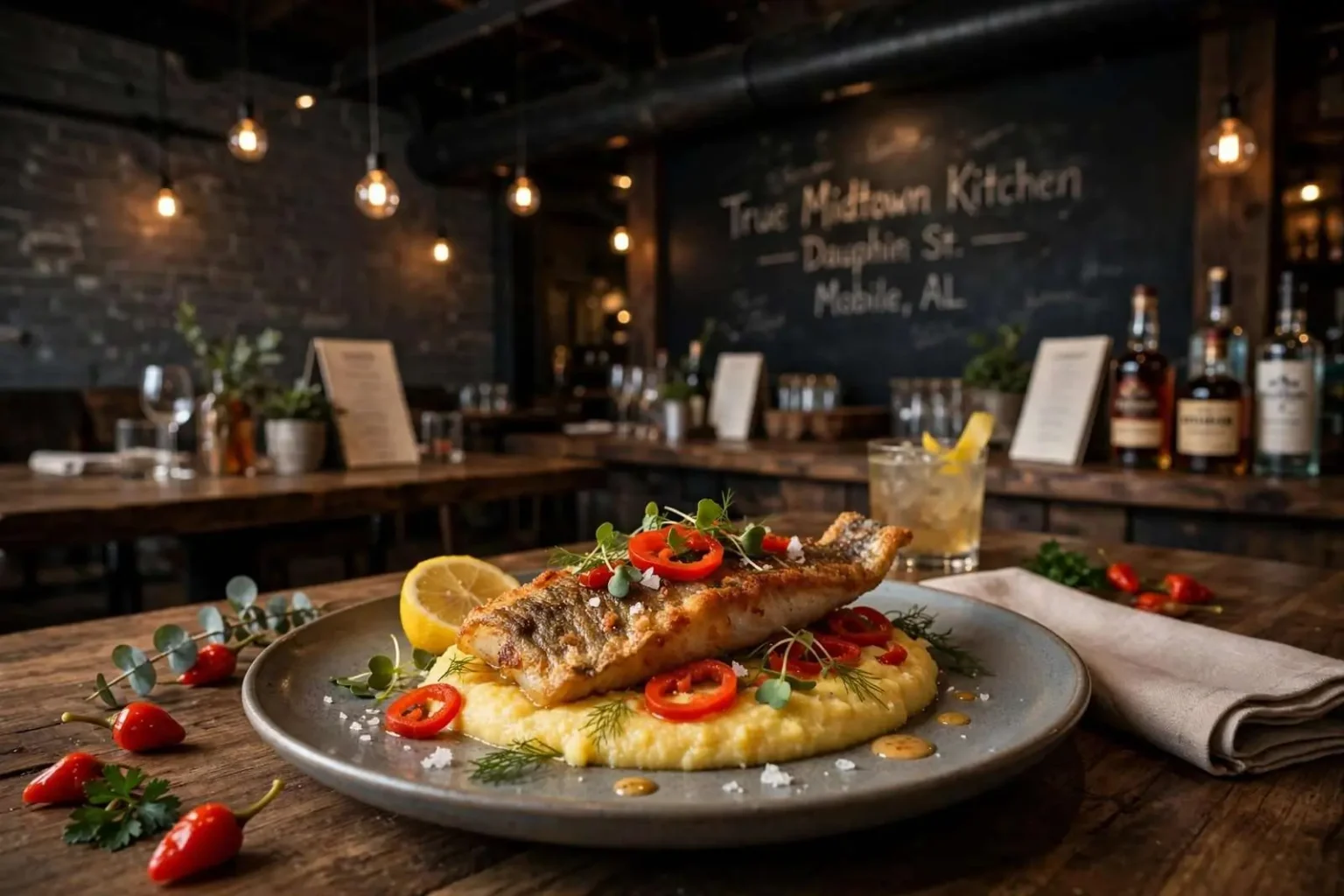
The result is a dimly lit, warehouse-styled space where familiar Southern plates get contemporary twists. Fried fish arrives over lemon confit polenta with pickled red peppers. Lamb meatloaf mixes in pork and comes with Waldorf slaw. Chicken and dumplings gets fried chicken bits and Italian gnocchi fritters. The menu reads like a translation exercise — taking the dishes Gulf Coast families grew up on and rendering them with technique and pairings borrowed from the fine-dining world the Trues came up in.
The kitchen took runner-up in a national seafood competition two years ago, a result that reinforced what the James Beard nominations suggested: the kitchen competes credibly on a national stage even while cooking in a converted midcity storefront.
A bar program with a century of history
The bar program reaches back before Prohibition, with rye- and gin-era recipes, a house-made tonic adapted from an 1800s formula, Lucid absinthe in a proper Sazerac, and the pecan-bourbon Japanese Cowboy. Wesley researched the era’s ingredients himself, resurrecting cocktail techniques that predate the drinking habits most modern bars assume. The approach made the bar a destination in its own right — the kind of program that draws customers who never look at the food menu.
Cocktail revivalism was still new when the program launched, and True’s version stood out for its research depth rather than showmanship. A Sazerac made correctly — absinthe-rinsed glass, properly chilled base, expressed peel — had become rare enough that Mobile’s version earned attention across the region, and the house-made tonic put an 1800s recipe to work in a gin drink built the long way.
Local sourcing on every plate
Local sourcing runs throughout the menu. Bread is baked by Heavenly Creations, vanilla ice cream comes from Cammie’s Old Dutch Ice Cream Shoppe churned denser to spec, Gulf Coast fish appears on nearly every plate, and the restaurant runs a collaboration brewing with Bill Finch of the Mobile Botanical Gardens. The partnerships tie the kitchen to Mobile’s small food economy — the bakeries, ice cream shops and growers who supply independent restaurants and give a city’s dining scene its local character.
The ice cream arrangement illustrates the level of detail involved: having Cammie’s churn the product denser to the kitchen’s specification means it holds up on the plate the way a pastry program needs, a small adjustment that turns a beloved local shop’s product into a restaurant dessert component. The Botanical Gardens collaboration, meanwhile, connects the bar and kitchen to Finch’s deep knowledge of Gulf Coast plants — the kind of partnership that produces ingredients and drinks no chain restaurant could replicate.
Gulf seafood is the through-line. In a port city where the boats dock minutes from the restaurant, serving local fish is both a quality decision and an identity statement — and it keeps the menu moving with the seasons and the catch, as Gulf kitchens have always done.
Recognition and reach
The 55-bottle wine list recently won a Nappie award, the Mobile Bay-area readers’ choice recognition that signals the restaurant’s standing with the local audience as much as with critics. A list that size, curated for a casual room, reflects a deliberate choice: enough depth to pair with the menu’s range without tipping into the intimidating encyclopedias that fine-dining rooms carry.
The restaurant has also catered for Google and Airbus events, taking the Trues’ cooking outside the dining room and into settings where corporate audiences from around the world encounter Mobile’s food scene. Airbus, whose final assembly line brought an international workforce to Mobile, made the connection particularly meaningful — local cuisine presented to visiting executives and engineers as part of the city’s hospitality.
An anchor for midtown dining
The restaurant’s presence on Dauphin Street in midtown has helped define that stretch of the corridor as a dining destination, part of the wave of independent restaurants that have spread Mobile’s eating scene beyond downtown. The casual format lowers the barrier — walk-ins, jeans, a burger-grade comfort level — while the kitchen and bar hold a fine-dining ceiling. That combination is what the James Beard judges and the national seafood competition both recognized.
For the Trues, folding the two concepts into one was a business decision that preserved what mattered: Wesley’s cooking, Richard’s operation, and a room where Mobile families celebrate alongside food travelers making the pilgrimage. The nominations, the competition runner-up finish, the Nappie and the corporate catering calls are the résumé; the nightly plate of fried fish over lemon confit polenta is the argument.
Reading the menu like a Mobile native
What makes True Midtown Kitchen distinctive is how closely it listens to the region’s palate before twisting it. Fried fish is the Gulf Coast’s default celebration meal, and serving it over lemon confit polenta with pickled red peppers keeps the crunchy, briny comfort of the original while adding brightness and texture that a paper-lined basket never offered. Lamb meatloaf — with pork mixed in for richness and a Waldorf slaw’s apple-and-walnut coolness on the side — takes a potluck staple and rebuilds it through a fine-dining lens. Even chicken and dumplings, the Southern sick-day classic, arrives reinterpreted with fried chicken bits and Italian gnocchi fritters standing in for the usual dough.
The through-line is technique in service of familiarity rather than novelty. Diners who want the flavors they grew up with find them; diners who want to see what a CIA-trained, Beard-nominated kitchen does with those flavors find that too. That double audience — the anniversary table and the Tuesday regulars — is the business model the brothers bet on when they folded the upscale True into the midtown spot, and the restaurant’s endurance has vindicated it.
Why the James Beard nominations mattered
The significance of Wesley’s back-to-back nominations goes beyond personal accolade. The James Beard Foundation’s regional categories are juried by food journalists and industry voters, and a nomination requires sustained excellence documented across a year of service — not a single viral dish. For Mobile, the nominations marked the city’s arrival in a conversation dominated by New Orleans, Atlanta, Birmingham and Nashville kitchens. They also raised the profile of every independent restaurant in the city: a national jury willing to look at Mobile for the first time meant the rest of the scene was being seen too.
The tristate Best Chef: South category draws from a vast region, and being the only Mobile chef ever nominated — twice — makes the midtown restaurant a permanent reference point in the city’s dining history. Younger cooks coming up through local kitchens now have a local career path to study, something the city’s dining scene lacked when Wesley True was learning his trade in Oxford and New York.
The weekend ritual
Rooms like True Midtown Kitchen run on regulars as much as recognition — the Saturday-night crowd that plans the week around a table, a Sazerac and whatever Gulf fish came off the boat. The dim warehouse room, the researched pre-Prohibition cocktails and the desserts built on Cammie’s ice cream give those regulars a place that could exist only here, supplied by Heavenly Creations bread, Bill Finch’s botanical collaborations and the port city’s daily catch. The James Beard nominations told the nation what Mobile’s diners already knew: the best kitchen in the South’s conversation was running quietly on Dauphin Street, no reservations about it.