Shannon Cauley Takes Over as Baldwin County School Board President
Norm Moore stepped down as Baldwin County school board president after a contentious tax referendum, with Shannon Cauley elected as his successor.
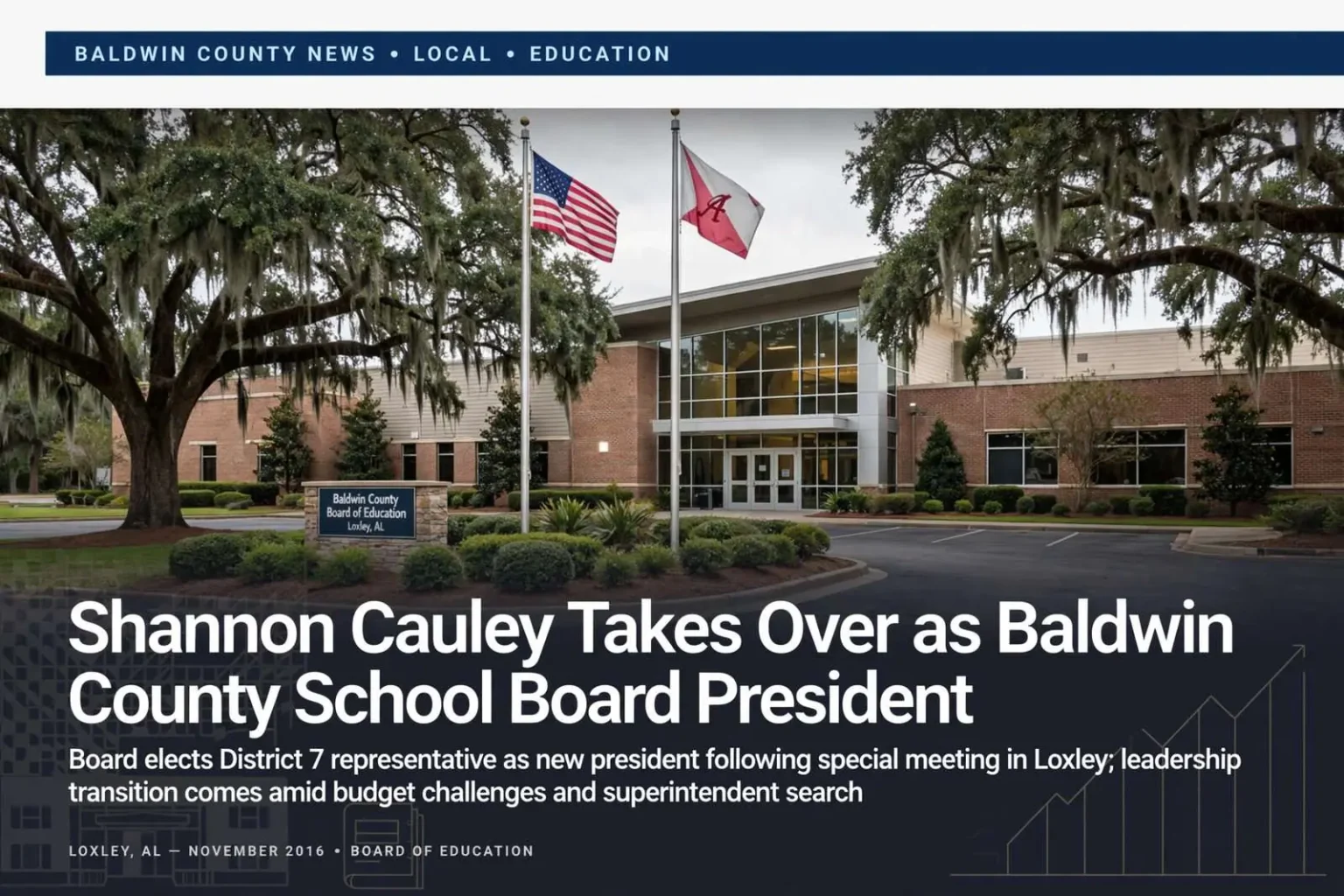
The Baldwin County Board of Education has a new president for the first time in more than two years after Norm Moore stepped down from the role during a special meeting held in Loxley. Board members unanimously elected Vice President Shannon Cauley, who represents District 7, to take over as president.
“I think we are going in a positive direction and I want to continue that,” Cauley said following the meeting.
Moore’s Tenure and the Tax Fight
Moore had led the board since November 2012, a tenure that grew increasingly difficult in its final months following the failure of a property tax referendum on March 31. That vote’s defeat left the school system facing a budget shortfall of nearly $8 million beginning in 2017, and some community members had publicly called for Moore to step aside in the aftermath.
The March referendum asked Baldwin County voters to approve an additional property tax dedicated to public schools — a measure the board and supporters argued was needed to keep pace with the county’s explosive enrollment growth. Baldwin County has been among the fastest-growing school systems in Alabama for years, adding students annually as families move into the county’s new subdivisions from Mobile, across the state line in Florida, and from farther afield. Classrooms in Spanish Fort, Daphne, Foley and Gulf Shores have swelled along with the population, and the system has relied on a patchwork of local taxes, state funding and periodic bond issues to build and staff new schools.
The referendum’s defeat — decided by a narrow margin at the polls on March 31 — left board members and administrators searching for ways to close the projected gap, with program cuts, staffing reductions and other measures on the table for future budgets. The vote followed months of public campaigning, community meetings and debate over who should bear the cost of the county’s growth, and it divided residents in communities that would have paid more under the new tax.
Moore, however, said his decision was unrelated to the board’s recent challenges. “This has to do with personal things that I have to accomplish in my life,” Moore said after the meeting. “They have really nothing to do with anything that’s occurring on the board.”
Moore read a letter to fellow board members and Superintendent Robbie Owen, submitted the day before the meeting, thanking colleagues for the opportunity to serve and saying he looked forward to continuing as a regular board member. He indicated he intends to serve out the remainder of his six-year term, which along with Cauley’s runs through 2016.
District 5 representative Angie Swiger was elected vice president following Cauley’s move to the board’s lead seat. “I would like to thank you, Mr. Moore, for your service to the board as president,” Swiger said. “You’ve taken us through some difficult times.”
District 2 representative David Tarwater echoed the sentiment and voiced confidence in Cauley’s leadership going forward.
Cauley’s New Role
Cauley, who has represented the district covering Spanish Fort since 2010, moved quickly into the board’s most pressing task: finding a new superintendent. Owen, who has served as superintendent, is set to depart the post, and the search for his successor will be among the first major undertakings of Cauley’s presidency.
The board presidency is a demanding role in any county school system, and Baldwin County’s is among the largest in Alabama, with tens of thousands of students spread across more than 40 schools from the delta communities of north Baldwin to the beach towns at the county’s southern tip. The board sets policy, approves budgets and hires the superintendent, while day-to-day operations fall to the system’s administrative staff in Loxley, where the central office and board meeting facility are located.
Cauley’s district places her at the center of the growth pressures that defined Moore’s final year. Spanish Fort, one of the Eastern Shore’s fastest-growing cities, has added students faster than many of the county’s older districts as subdivisions multiply along the U.S. 98 and Alabama 181 corridors. School capacity on the Eastern Shore has been a recurring topic at board meetings, with residents packing public sessions to press for new classrooms and relief from crowded campuses.
The Road Ahead for the Board
The leadership transition comes at a consequential moment for the system. The board must chart a budget course through the post-referendum shortfall, oversee a superintendent search, and continue planning for growth that shows no sign of slowing. Board members will also face their own elections in the years ahead, with the district lines drawn across the county’s cities and rural communities determining who represents each area’s schools.
For parents and taxpayers across the county, the change at the top of the board arrives with familiar questions: how the system will fund its schools after the tax referendum failed, whether new schools will be built fast enough to keep up with enrollment, and who will lead the system into the next phase of its growth.
How Baldwin County’s Board Works
The Baldwin County Board of Education consists of representatives elected from districts across the county, each representing a geographic area whose schools they advocate for at the board table. The board meets regularly at its Loxley facility, with sessions that draw parents, teachers and community members whenever major decisions — rezoning, budget cuts, new construction — are on the agenda.
The system is the economic and social centerpiece of much of the county. New subdivisions are marketed on school quality, home values track school performance, and the county’s municipal governments coordinate with the board on land use and school siting. That makes the board presidency more than a ceremonial post: the president presides over meetings, sets much of the agenda in practice, and serves as the board’s public face during contested seasons like the referendum campaign.
Moore’s resignation letter, read into the record the day before the special meeting, was described by colleagues as gracious — thanking the board for the chance to serve and pledging to remain an active member. His two-plus years as president spanned the period when the system’s growth pressures came to a head, culminating in the March tax vote that dominated the board’s public business.
A Positive Direction
Cauley’s assessment after the meeting — that the board is moving in a positive direction — reflected a tone colleagues described as forward-looking. With Swiger elected vice president and Tarwater voicing support, the board’s leadership team was set without dissent, an outcome that avoided the public divisions that have marked other Alabama school boards during difficult budget seasons.
The coming months will test that unity. The superintendent search, the budget shortfall and the growth question all have the potential to divide communities — north Baldwin against south, Eastern Shore against central county — because the costs and benefits of any solution fall unevenly across the county’s school districts. How the new leadership team navigates those pressures will shape the system for years to come.
For now, the board moves forward under new leadership with the same mandate it has always had: educating a growing county’s children, on a budget the voters have set, with the trust of the communities it serves on the line.
Growth as the Defining Challenge
Any discussion of Baldwin County schools eventually returns to the same force: growth. The county has consistently ranked among Alabama’s fastest-growing, and its school system has absorbed thousands of additional students over the past decade without a proportional expansion of classroom space in every district. Portable classrooms, rezoning battles and bond-funded construction have all featured in the county’s recent school history, and the pressures fall hardest on the high-growth corridors — the Eastern Shore cities of Daphne, Spanish Fort and Fairhope, and the south county communities of Foley, Gulf Shores and Orange Beach.
The failed March referendum was intended to give the system a stable local revenue stream dedicated to that growth. School advocates had argued that the county’s per-pupil local funding lagged behind comparable fast-growing systems in the state, and that without new revenue the board would be forced to choose between adding capacity and maintaining existing programs. Opponents of the tax organized around the burden on property owners, skepticism about how the money would be spent, and in some quarters a feeling that rapid development itself was creating the problem.
The aftermath left the board in an uncomfortable position that Cauley now inherits. With the referendum rejected, board members have few levers that do not involve tradeoffs among communities, and every budget decision will be scrutinized through the lens of the March vote. Community groups that campaigned on both sides of the referendum remain organized, and board meetings on budget questions have drawn crowds reflecting that lingering engagement.
The Superintendent Search
The superintendent search looms as the board’s most immediate responsibility. Alabama school systems typically conduct searches through the state superintendent’s office, advertising the position, screening applicants through a board committee and holding public interviews or forums in some cases. The choice will set the direction of the system on everything from construction priorities to curriculum and personnel, and parents across the county will be watching closely.
Whoever takes the post will lead one of the state’s largest and fastest-changing school systems, with the county’s demographic split — older rural communities in the north, booming suburbs on the Eastern Shore, resort towns in the south — requiring a superintendent to balance constituencies that do not always agree on priorities. The board’s ability to recruit strong candidates may depend in part on how it resolves its funding outlook, since leading a system facing an $8 million shortfall is a different proposition than leading one with a stable budget.
Between the leadership change, the search and the budget, the months ahead promise to keep the board in the public eye in a way the presidency change itself did not. Cauley, Swiger and their colleagues will preside over all of it, starting with their next regularly scheduled meetings in Loxley.