BP Oil Spill Claims Deadline Prompts Extended Hours at Mobile Office
Mobile's BP oil spill claims office extended weekend hours ahead of a June 8, 2015 deadline as area businesses rushed to file economic damage claims.
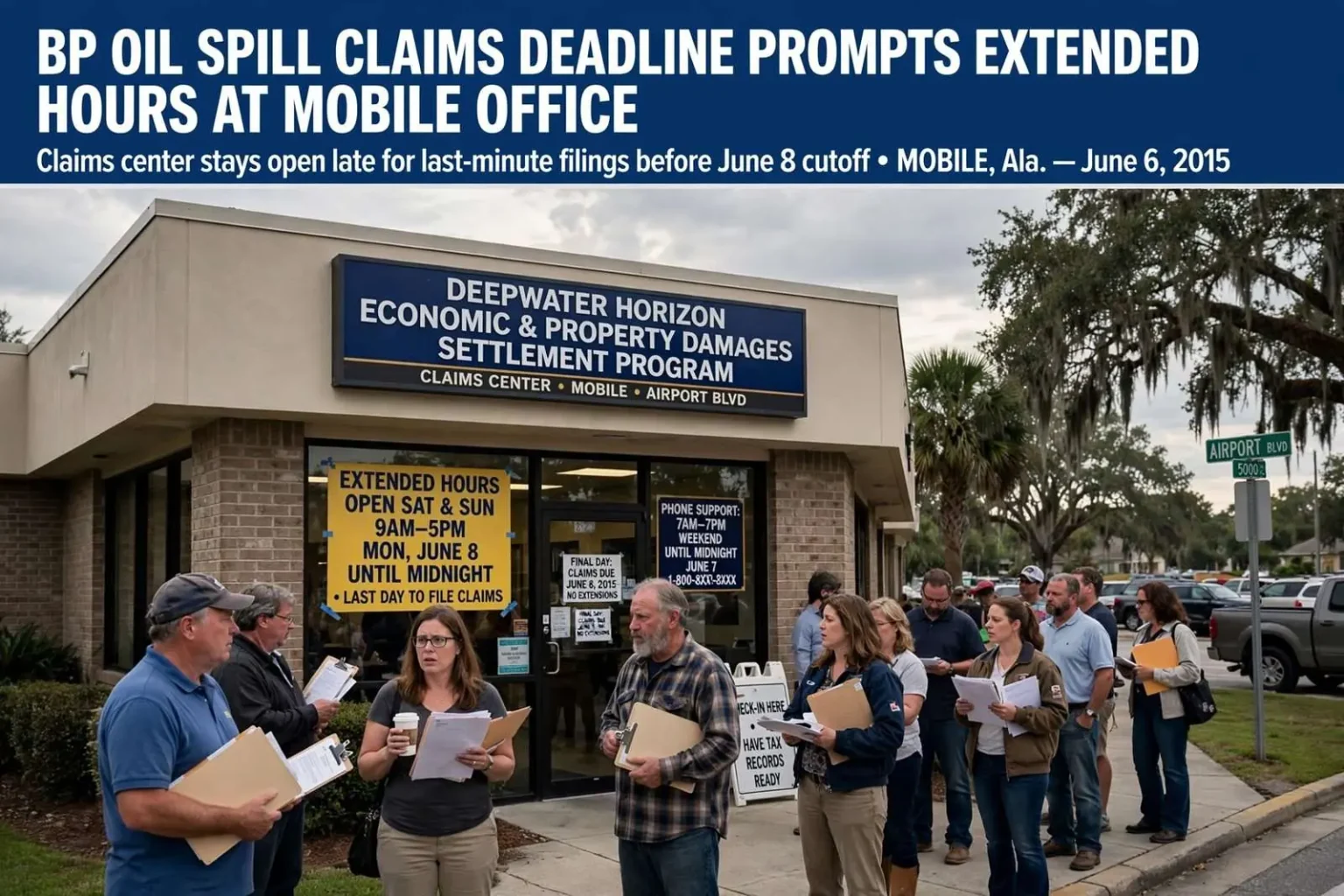
More than five years after the Deepwater Horizon disaster fouled Gulf Coast waters, the property and economic damages portion of BP’s massive settlement program was set to close its claims window in early June 2015, prompting the claims center serving Mobile to extend its hours ahead of the deadline.
The Deepwater Horizon Economic and Property Damages Settlement Program set June 8 as the final day for eligible businesses and property owners to file claims. Program administrator Patrick Juneau said his office expected a rush of last-minute filings, a pattern he said has held true across other major class-action settlements he has overseen.
To accommodate the anticipated surge, the claims center on Airport Boulevard in Mobile extended its weekend hours, staying open from 9 a.m. to 5 p.m. on the Saturday and Sunday before the deadline. On the final day itself, the office planned to remain open until midnight to give claimants every opportunity to submit paperwork before the cutoff.
A five-year process drawing to a close
The settlement program traced its origins to the April 2010 explosion of the Deepwater Horizon drilling rig, which killed 11 workers and triggered the largest oil spill in U.S. history. For 87 days, oil flowed from the damaged Macondo well into the Gulf of Mexico, closing fishing grounds, emptying beaches and disrupting commerce across the Gulf Coast as the disaster unfolded through the spring and summer tourism seasons.
Court-supervised settlement programs later replaced the earlier claims facility, and under the framework approved by a federal judge, businesses and property owners across Gulf Coast states could claim compensation for economic losses and property damage tied to the spill without having to prove their claims in individual lawsuits. The program, administered by Juneau’s office, became the main channel through which that compensation flowed, paying out billions of dollars to claimants across Alabama, Mississippi, Louisiana and Florida.
Similar extended hours applied at sister offices along the Gulf Coast, including locations in Biloxi, Mississippi; Clearwater, Florida; and Metairie, Louisiana. The coordinated weekend push reflected the scale of the expected final rush, with claimants from across the northern Gulf Coast descending on the nearest offices in the days before the window closed.
Extended hours and phone support
Phone support also expanded during the final push, with call centers open from 7 a.m. to 7 p.m. over the weekend and stretching to midnight the day before the deadline, giving claimants additional options beyond visiting an office in person. Program staff fielded questions about eligibility, documentation and filing procedures, and officials urged callers not to wait until the final hours to begin the process.
For many Mobile-area businesses and property owners who suffered economic losses tied to the 2010 spill, the deadline marked one of the last chances to formally join the settlement process, which had already distributed billions of dollars to Gulf Coast claimants in the years since the disaster.
Mobile’s claims office on Airport Boulevard had served as a regular stop for Gulf Coast claimants since the settlement’s early days, processing everything from seafood industry losses to hotel revenue shortfalls. Airport Boulevard, one of the city’s main commercial arteries running west from the center of the city, put the office within easy reach of claimants from Mobile and Baldwin counties alike.
The economic reach of the spill in the Mobile area extended well beyond the waterfront. Charter fishing operators along Mobile Bay, seafood processors and docks, restaurants that depended on Gulf harvests, hotels and condominium rentals that lost bookings during the summer of 2010, and suppliers across the region all filed claims under the program. For a coastal economy that depends on the water, the weeks when fishing grounds closed and tourists stayed away produced losses that rippled through trucking, retail and service industries far inland.
Local officials and business advocates had encouraged eligible claimants throughout the spring to gather documentation early rather than wait until the final days, though the extended hours reflected an acknowledgment that many would do exactly that. Accountants and attorneys along the Gulf Coast reported steady demand in the final weeks as business owners assembled five years of tax returns, profit-and-loss statements and other records needed to support their claims.
How the claims were evaluated
Claims under the economic and property damages settlement were evaluated according to formulas set out in the settlement agreement, which used revenue patterns to identify losses attributable to the spill. Businesses located in zones closest to the coast qualified under lighter evidentiary standards, while claimants farther inland had to demonstrate the connection between their losses and the disaster. The framework was designed to speed compensation by avoiding the case-by-case litigation that would otherwise be required, and its administration — including eligibility debates that reached the U.S. Supreme Court — was closely watched across the region.
The payments distributed through the program ran into the billions of dollars before the claims window closed, making the Deepwater Horizon settlement one of the largest class-action resolutions in American history. Individual awards ranged from modest amounts for small property owners to substantial sums for major fishing and tourism businesses, and the money circulating through Gulf Coast communities became a measurable part of the region’s economic recovery in the years after the spill.
The Mobile office’s role in processing the region’s claims put it among the busier facilities on the northern Gulf Coast, and staff there handled a cross-section of the coastal economy: shrimpers and oyster harvesters, boat dealers and marinas, fishing guides who lost charter bookings, and retailers whose sales collapsed when the region’s beaches and waters were closed or shunned.
The deadline applied to the property and economic damages portion of the settlement, but other parts of the litigation continued separately. BP faced additional liabilities through environmental restoration programs, state and federal settlements, and individual claims handled outside the class framework, meaning the June 8 cutoff did not end the legal aftermath of the disaster so much as close its largest single channel for private claimants.
Filing by the deadline preserved a claimant’s place in the process, but it did not guarantee immediate payment. Claims submitted in the final rush faced a review queue, and administrators cautioned that evaluation could take months for complex business claims requiring verification of financial records. Claimants were advised to keep copies of everything submitted and to respond promptly to any follow-up requests from program staff, since incomplete documentation was the most common reason for delays.
Across the Gulf Coast, the closing of the claims window marked a symbolic turning point five years after the disaster. Coastal communities had watched cleanup crews and claims adjusters become fixtures of daily life in 2010, and the gradual winding down of the settlement process removed one of the last institutional reminders of the spill — even as restoration projects funded through separate penalties and settlements continued reshaping shorelines from Alabama’s beaches to the Louisiana marshes.
For Mobile, the extended hours at the Airport Boulevard office were a fitting bookend to the city’s role in the disaster’s aftermath. Mobile Bay’s seafood industry, charter fleets and tourism businesses sat at the edge of the spill’s impact zone, and the steady stream of claimants who visited the office over five years reflected how deeply the disaster reached into the region’s economy — from the docks on the bay to accountants’ offices and bank branches across the city.
Program officials said claimants who missed the deadline would generally be unable to join the settlement later, making the June 8 cutoff final for the overwhelming majority of eligible businesses and property owners. Those who had already filed were reminded that their claims would continue to be processed under the program’s procedures, with payments issued as reviews were completed in the months that followed.
The June 2015 deadline had been set years earlier as part of the settlement’s implementation schedule, and administrators had extended similar grace periods at prior milestones as claims volumes fluctuated. By the final spring, however, program officials made clear that no further extensions were coming, and the countdown to June 8 dominated conversations in coastal business circles across Alabama, Mississippi and the Florida Panhandle.
Claims consultants who had worked with Gulf Coast businesses since 2010 described a final-season mix of clients: some assembling claims for the first time after years of hesitation, others supplementing earlier filings with updated documentation, and a sizable group seeking help understanding what the deadline meant for claims already in progress. The prospect of leaving money on the table drove many owners to file even when they were unsure whether their losses qualified.
Along the Alabama Gulf Coast, the settlement’s payouts had already become part of the region’s recovery story. Baldwin County’s beach communities, which watch tourist revenue swell each summer, saw claims from rental agencies, restaurants and attractions that lost the 2010 season at the height of the spill’s media coverage. In Mobile, the bayfront industries and working waterfront filed alongside small retailers with no direct connection to the water, their claims resting on the economic drag the disaster imposed across the entire coastal region.
The last weekend before the deadline drew lines at the Airport Boulevard office, where staff processed walk-in filings through the extended Saturday and Sunday hours. Similar scenes played out in Biloxi, Clearwater and Metairie as the four offices absorbed the final surge, and the midnight closing on June 8 gave last-minute filers a full final day to complete their submissions.
When the window closed, the program’s attention shifted to the backlog, with Juneau’s office committing to work through the final claims under the same review standards that had governed the process since its start. For the Gulf Coast, the milestone closed a chapter five years in the making — one that began with an explosion 40 miles off the Louisiana coast in April 2010 and ended with thousands of business owners across the region filing their last paperwork in a Mobile claims office open until midnight.