Inside the Blowout: What It Would Take to Stop the Oil a Mile Beneath the Gulf
A plain-language guide to the Deepwater Horizon spill: why the blowout preventer failed, the three plans to stop the leak, how crude behaves at sea, and how this spill compares to the worst on record.
Two weeks after the Deepwater Horizon exploded and sank, the oil is still coming, and the vocabulary of the disaster — blowout preventers, containment domes, relief wells, dispersants — has moved into everyday conversation along the Alabama coast. What follows is a plain-language guide to what is actually happening a mile below the surface of the Gulf, and what it will take to stop it.
Why the Well Is Still Open
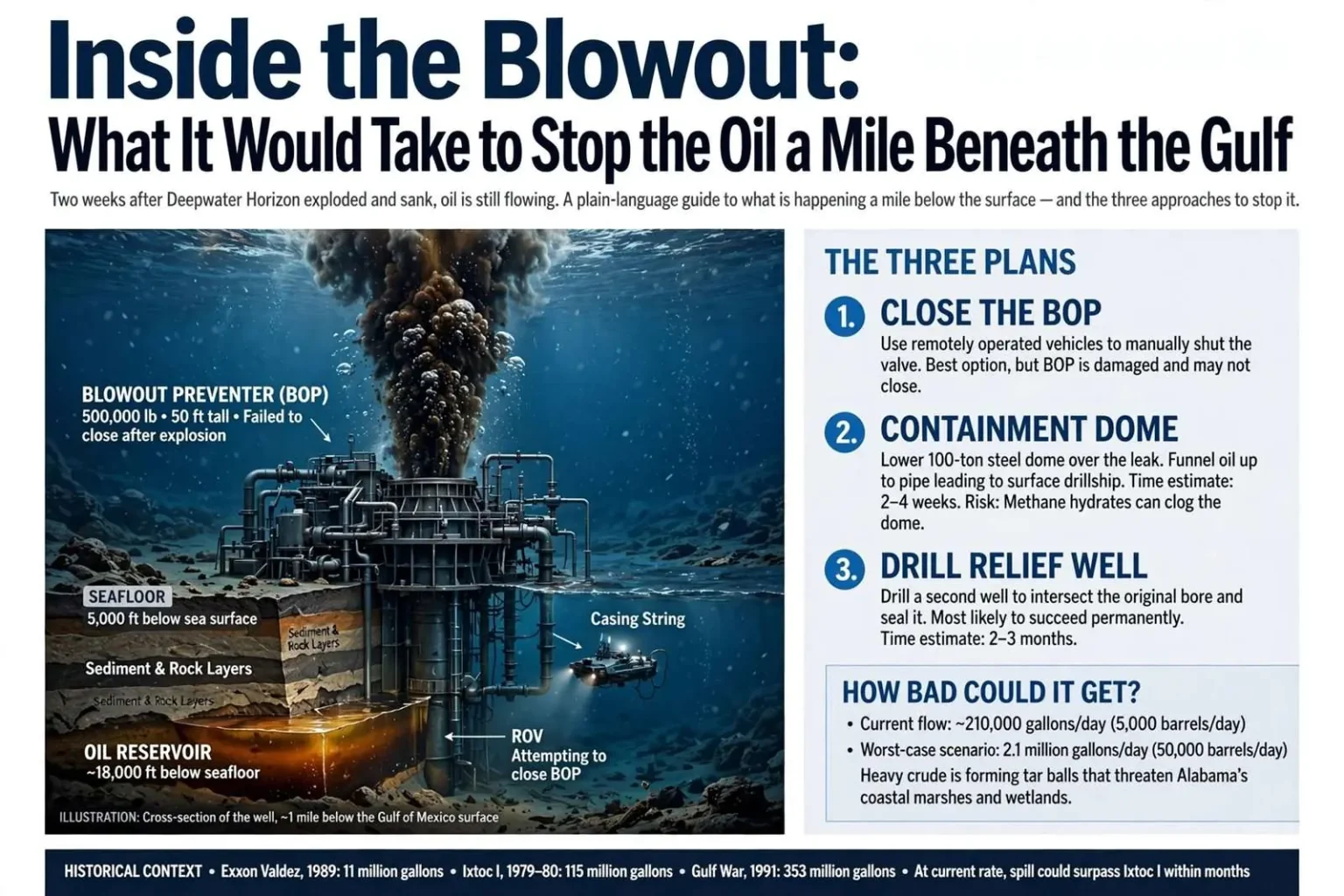
The Deepwater Horizon was a drilling rig working roughly 5,000 feet below the surface of the water. The well itself extends from the seafloor down to a reservoir some 18,000 feet beneath the surface.
Sitting on the wellhead at the seafloor is a device called a blowout preventer, or BOP. These are enormous machines — up to 500,000 pounds and 50 feet tall — bolted to the top of the well.
In an emergency, a BOP is designed to cut off the flow of oil and prevent exactly the kind of uncontrolled gusher now underway. It can be triggered by a switch on the rig, is supposed to activate automatically in a major failure, and in some configurations can be triggered acoustically from a ship on the surface.
When the rig exploded on April 20, the BOP did not close.
The Three Plans
Three approaches are being pursued.
- Close the BOP. The preferred option is to use remotely operated deep-water robots to shut the device from the seafloor. The obvious difficulty: the BOP failed to close on its own, and a robot may not be able to force it closed after the fact.
- Lower a containment dome. BP has ordered three 100-ton steel structures — giant box-shaped inverted funnels roughly 14 feet wide and 40 feet tall — to be lowered over the well and the two other leak points. Oil would flow up the funnel into a pipe leading to a drillship on the surface that can store and transport it. The technology has worked in shallower water. Fabricating the custom piping is expected to take two to four weeks.
- Drill a relief well. A second well would be drilled to intersect the existing one, giving the oil an alternate path and allowing the original to be sealed. This is the option most likely to work permanently — and the slowest, requiring an estimated two to three months. A relief well will probably be needed eventually regardless of which stopgap succeeds.
A fourth suggestion — ringing the surface expression of the leak with booms and pumping oil and water aboard a storage ship — founders on scale: the affected area is large, and the volume of water collected alongside the oil would be enormous.
The Cement Question
Halliburton, which provided oil services to the rig, has said it completed cementing of the final production casing string in accordance with the well design roughly 20 hours before the explosion. Cementing is done to keep the wall of the hole from caving in. The company said tests demonstrating the integrity of the casing string had been completed, and that operations had not yet reached the point requiring the final cement plug that would have allowed the well’s planned temporary abandonment.
How Bad Could It Get
A National Oceanic and Atmospheric Administration emergency operations document dated April 28 shows the Coast Guard preparing for a worst case in which the flow becomes an unchecked gusher — releasing not 210,000 gallons (5,000 barrels) a day but 2.1 million gallons (50,000 barrels) a day. The flow is currently being restrained by kinks in the damaged piping.
The concern is that sand, an integral part of the formations that hold the oil, is effectively sandblasting through that pipe. The formation being drilled is reported to hold tens of millions of barrels.
“The loss of a wellhead, this is totally unprecedented,” said Ron Gouget, a former oil spill response coordinator for NOAA. “How bad it could get from that, you will have a tremendous volume of oil that is going to be off-gassing on the coast. Depending on how much wind is there, and how those gases build up, that’s a significant health concern.”
How Oil Behaves at Sea
Crude is measured in barrels; one barrel holds 42 gallons. “Sweet” crude is low in sulfur. “Light” crude flows freely like water and is highly volatile, degrading quickly in sunlight and responding well to dispersants. “Heavy” crude is thicker, more like tar.
The oil from this well appears to be on the heavy end. Once spilled, crude partially evaporates, losing between 20 and 40 percent of its mass and becoming denser and more resistant to flow. A small share dissolves. Some sinks with suspended particles. The rest eventually congeals into sticky tar balls that weather slowly — and the tars in the residue can take years to disappear entirely.
Containment relies on booms, skimmers and dispersants, and works best in light seas, low tides and light winds. Heavy seas and high winds make collection nearly impossible, though they do help break the slick up naturally. Oil that reaches a sand beach is far easier to clean than oil that reaches marshland, grassland or lagoon — which is precisely what lines much of the Alabama coast.
Measured Against History
For scale, the worst spills on record:
- Gulf War, 1991 — roughly 353 million gallons, after Iraqi forces opened well valves and pipelines while retreating from Kuwait. The slick reached 101 miles by 42 miles, five inches thick.
- Ixtoc I, 1979-80 — about 115 million gallons, after a Gulf of Mexico platform exploded, caught fire and collapsed roughly 600 miles from Texas. It leaked for nine months.
- Exxon Valdez, 1989 — about 11 million gallons, the worst in United States history, and not among the ten worst worldwide.
At the current estimated rate of 0.2 million gallons a day, the arithmetic is uncomfortable. At the worst-case rate of 2.1 million gallons a day, it is worse still.
What happened next
None of the quick fixes worked as hoped. The first containment dome was lowered in early May but could not be used after icy methane hydrates formed inside it, and a string of other attempts followed through the spring. The flow was finally stopped on July 15, 2010, when a tighter-fitting cap was bolted onto the well, 87 days after the explosion. A relief well then intersected the original bore, and on Sept. 19, 2010, federal officials declared the well permanently sealed.
The early estimate of 5,000 barrels a day also proved far too low. A government scientific team later put the flow at roughly 53,000 to 62,000 barrels a day, above even the worst case described in the April 28 document, and estimated total releases at about 4.9 million barrels, far more than Ixtoc I. Oil and tar balls came ashore on Alabama’s beaches that June.