Gregory Signals Yes: Mobile Councilwoman Agrees to One-Cent Sales Tax in Deal With Jones
Councilwoman Gina Gregory announced she would supply the fifth vote for a temporary one-cent sales tax increase, in exchange for a written commitment to an efficiency study and a list of cost concessions.
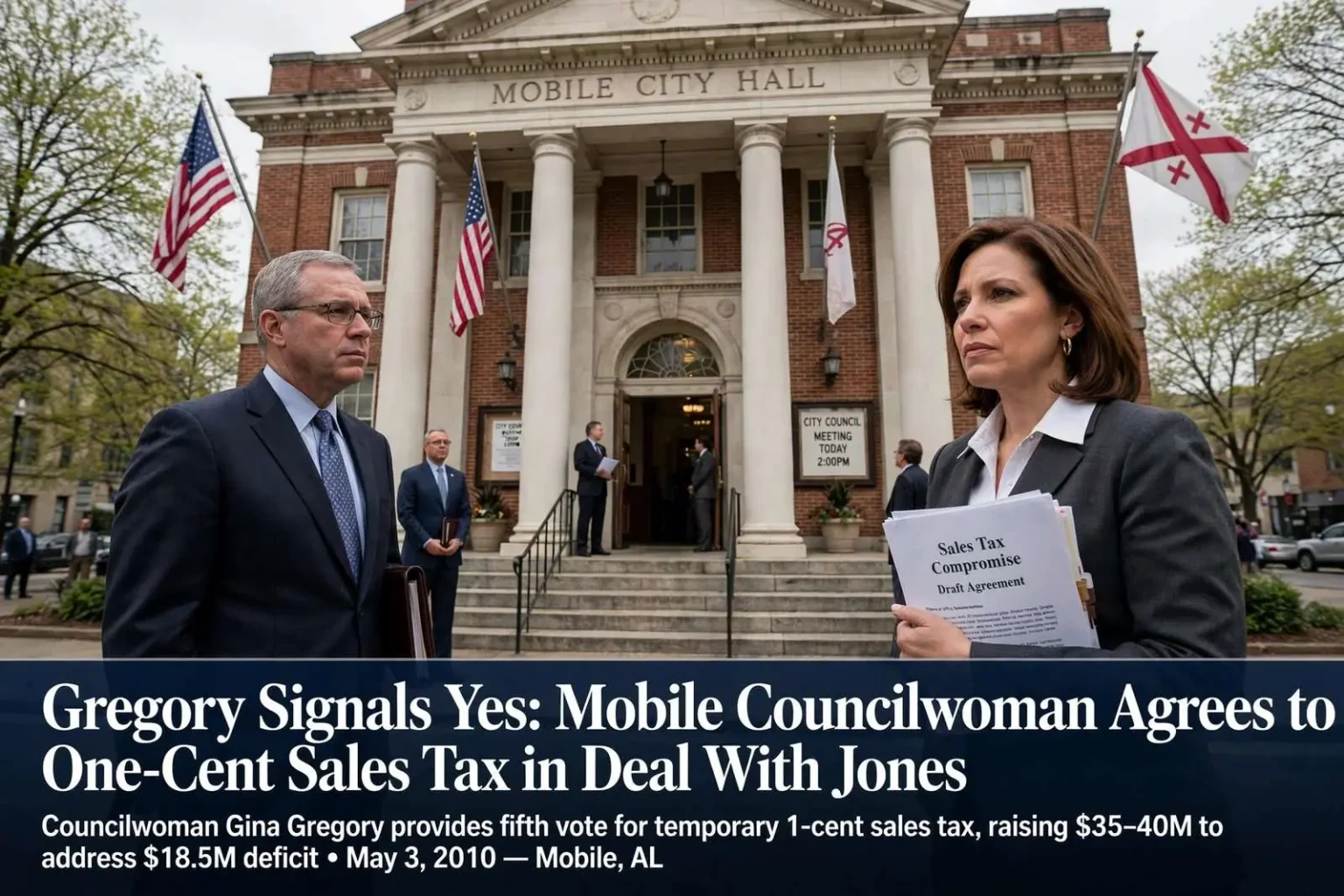
In a high-stakes contest of political nerve, Mayor Sam Jones appears to have prevailed. Mobile City Councilwoman Gina Gregory disclosed Monday that she will vote for a temporary one-percent increase in the city’s sales tax, supplying the fifth vote the mayor has sought for weeks and clearing the way for an increase expected to raise $35 million to $40 million.
The move would lift the city’s rate from four cents on the dollar to five, bringing the combined state, county and municipal rate in Mobile to 10 percent.
The End of Limbo
Gregory has spent weeks as the acknowledged swing vote — a characterization she has resisted — caught between Jones and Council President Reggie Copeland, who called the tax the only viable answer to the city’s deficit, and Councilmembers Connie Hudson and John Williams, who argued that tighter spending controls were the sounder course.
The city faces an $18.5 million deficit in the current fiscal year, though officials have reduced the immediate need to about $5 million through transfers and other stopgap measures. A wider gap is projected for fiscal 2011 in a budget of roughly $209 million.
The Numbers Behind the Tax
If imposed immediately and left in place through Sept. 30, 2011, as Gregory has pledged, the increase should generate $35 million to $40 million over nearly 17 months, according to city budget officials.
A one-cent sales tax once produced about $30 million a year in Mobile; in the current recession it projects to roughly $28 million. The city expects to collect only about $7 million from the new tax during the remainder of this fiscal year — a conservative figure that reflects the weakness of summer retail activity relative to the holiday season.
How She Got Here
Jones first proposed a 10 percent across-the-board pay cut for city employees. Workers rose up and descended on City Hall en masse. The mayor reversed course and called for the sales tax instead, leaving the council to make the decision. Gregory never entirely ruled out the full one-cent increase. She said repeatedly that the public wanted a greater demonstration of spending restraint before any new revenue. An earlier version of the proposal would have rolled the tax back to a half-cent for an additional year in 2012 before expiring in fiscal 2013.
In her statement, Gregory framed the outcome as a compromise. What she secured was not a smaller tax, but a written commitment to change how the city spends.
What She Got
“It’s time to compromise, stop the bleeding, and give ourselves some breathing room to make needed changes in how we do our business,” Gregory said in her statement. She said the agreement would prevent layoffs and salary reductions while requiring “a laundry list of concessions to reduce costs.” The centerpiece is a top-to-bottom efficiency study of city government. Gregory pointed to comparable reviews elsewhere — a team currently working at Austal, the Lean Six Sigma approach adopted in Irving, Texas, and Montgomery’s engagement of the Public Affairs Research Council of Alabama.
Other commitments include:
- Continuation of the hiring and promotion freeze
- No travel or training by city employees unless deemed essential
- Work with the Personnel Board to amend rules and give the city more flexibility
- A study of an updated fee-based revenue structure
- Reduction or elimination of take-home cars
- A reduced city holiday schedule
Why Not Layoffs
Gregory explained her reasoning in terms of the constraints the city actually operates under. Because Mobile falls under the rules of the Mobile County Personnel Board, it cannot implement salary reductions, furloughs or layoffs the way a private business can. If layoffs came, she said, public safety and public works would necessarily be hit, because they represent the largest share of the city’s operating costs.
Fire stations are already understaffed, some remain closed, and police officers are resigning. “Raising sales taxes, in my opinion, is a last resort,” she said. “But with our current time constraints, and limitations on how we are able to implement layoffs and salary reductions, we’ve reached that point.”
She acknowledged that many constituents remain adamantly opposed, and listed the difficulties still ahead: insurance costs under the new federal health care law, the liability in the police and fire pension fund, the method of collecting business license fees, and the unknown economic impact of the Gulf oil spill.
Not Everyone Is Persuaded
Copeland’s earlier remark that the council needed one more member with “the courage” to vote for the tax rankled at least one resident, an engineer who attended a Murphy High School historic district meeting and afterward wrote to the council president and Councilman William Carroll.
The three members who voted against the tax, he argued, were also voting with courage and conviction, and had never proposed cutting police or fire. “Do not mistake the current showing of support for our hard working police and fire as support for ANY tax increase,” he wrote, urging the council to examine waste, outside contracts and even the city’s suites at Ladd stadium before reaching for the taxpayer. “It’s time for real change.”
The council is expected to take up the measure Tuesday.
What happened next
The council approved the increase 5-2 on Tuesday, May 4, 2010, with Williams and Hudson voting no. It took effect June 1 and was set to expire Sept. 30, 2011, raising the combined sales tax inside the city limits to 10 cents on the dollar: 5 cents for the city, 4 for the state and 1 for the county. In a separate 7-0 vote, the council called on Jones to work with the Personnel Board on rule changes giving the city more flexibility with its workforce and to hire an outside group to evaluate the efficiency of city operations.
The Personnel Board Gregory cited is the civil service system for public employees in Mobile County. Created by state law rather than by the city, it sets rules for hiring, promotion, discipline and layoffs for employees of the county, the City of Mobile and other participating local governments.