Governor Candidate Urges Guard Tankers Be Used to Spray Dispersant on Gulf Slick; State Says No
Republican gubernatorial candidate Bill Johnson called for mobilizing Alabama's KC-135 refueling wing to drop chemical dispersant on the Gulf oil slick. A state general dismissed the idea in two words.
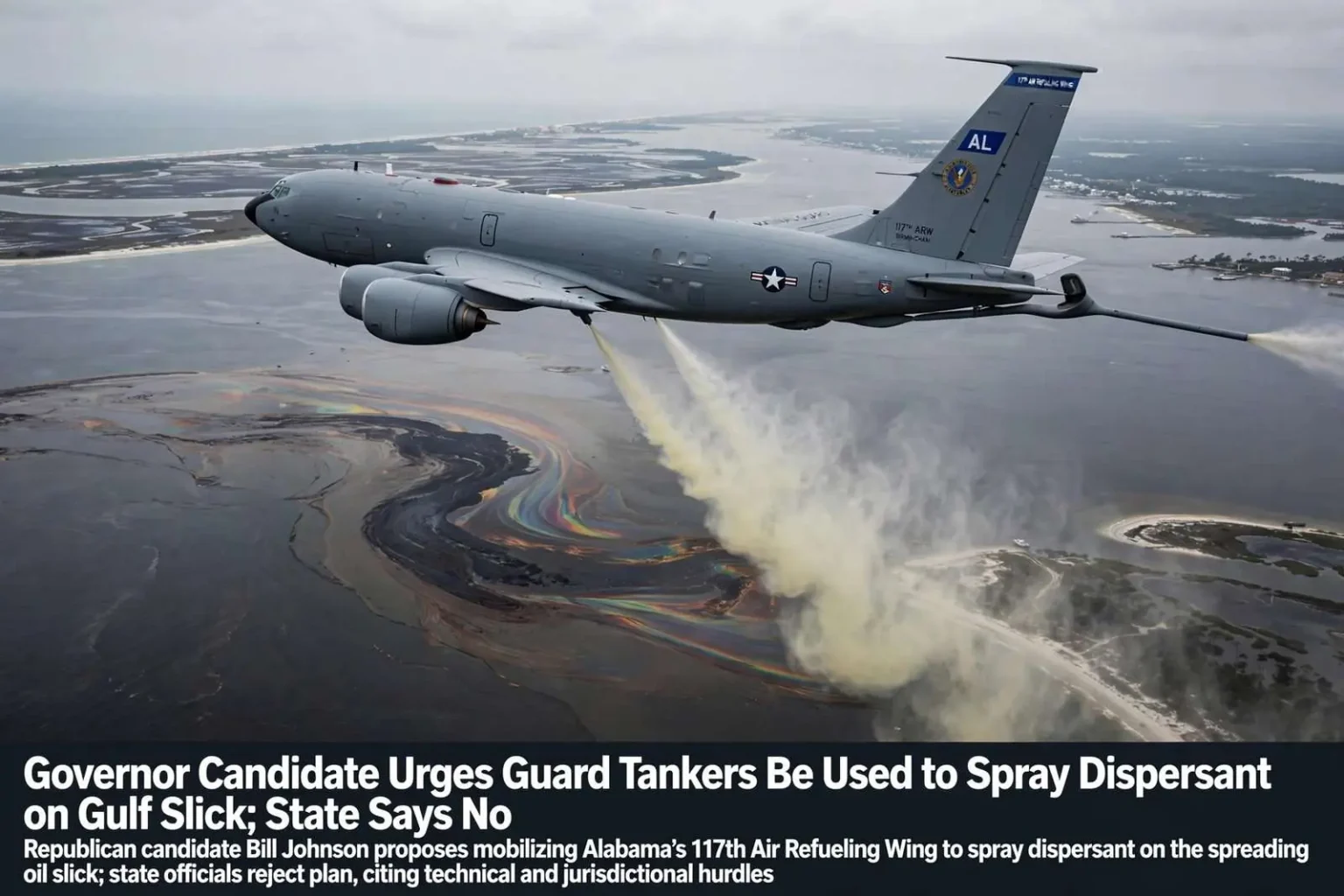
Republican gubernatorial candidate Bill Johnson on Saturday called for mobilizing Alabama’s Air National Guard refueling tankers to fight the Gulf oil spill now threatening the state’s coastal waters and resources. State officials rejected the proposal almost immediately.
“It is already apparent that oil booms and traditional containment methods are not effective against the oil spill threatening Alabama’s coast line,” Johnson said. “We need to consider an aggressive use of aerial chemical dispersants by our KC-135 refueling tankers.”
The Proposal
In an e-mail to Gov. Bob Riley, Gen. A.C. Blalock and Conservation Commissioner Barnett Lawley, Johnson asked the state to explore mobilizing the 117th Air Refueling Wing, based in Birmingham, to deliver chemical dispersant onto the slick spreading toward Alabama’s $2 billion seafood industry and its tourism economy — with the height of the season only weeks away.
The math, as Johnson laid it out, was the argument. Two C-130 aerial tankers had already been assigned from Ohio’s 910th Air Wing, but those aircraft can deliver roughly 6,000 gallons of dispersant per day. The well was then estimated to be leaking about 210,000 gallons per day. The 117th operates nine KC-135 tankers, each with a delivered capacity of 31,725 gallons.
“With the capacity of the planes in the 117th we could easily deliver 200,000 gallons of dispersant a day to the slick,” Johnson said. “They just need to start now — once the oil reaches the shore, wetlands, beaches, estuary, it will be a true disaster.”
The proposal put a gubernatorial candidate in the unusual position of drafting operational suggestions for a response then being managed by federal and state authorities. It also placed Alabama’s own Guard units — ordinarily discussed in the state’s politics in terms of deployments overseas — at the center of a debate over how aggressively the state could act on its own behalf while the response remained federally directed.
‘Won’t Work’
Blalock’s response, according to Johnson, was that the plan “won’t work.” No further explanation was offered.
Johnson, who holds a degree in chemistry, said he understood there were legitimate obstacles — and, unusually for a candidate, listed them himself: The dispersant is more viscous than jet fuel and may not pump through equipment designed for fuel; The tanks may not be separable, meaning dispersant could mix with the fuel the aircraft needs to fly; The aircraft are roughly 50 years old, and none may be operational at present.
He suggested the tanks could be cleaned or replaced, and that dispersant pumped out through the refueling boom would likely be scattered effectively enough by altitude and jet wash. But his complaint was less technical than procedural.
“Given the gravity of the situation, I just think the public deserves more than a bureaucratic answer of that ‘won’t work,'” Johnson said. He noted that the $39.5 million cost of a single aircraft was small against the $2 billion at stake for Alabama’s economy.
What dispersants do
Controlled burns, skimming, containment booms and chemical dispersants have all been deployed against the spill, and the joint federal-industry response team has said the chemicals have so far proven the most effective tool.
Dispersants are detergent-like compounds that break a surface slick into smaller droplets, which can then be broken down by bacteria and other natural processes in the water column. They also help keep droplets from recombining into new slicks. They have been available for spill response since the mid-1980s.
Their use is not without controversy, since the oil is dispersed into the water rather than removed from it — a trade-off that would be debated at length as the response continued. For fisheries managers and coastal scientists, the question was never simply whether dispersants worked, but what they traded: oil on the shoreline and in coastal marshes, where recovery can take years, versus oil diluted into offshore waters, where its effects are harder to see and measure.
Those trade-offs gave proposals like Johnson’s a double edge. Massive aerial application offshore could, in theory, break up the slick before it reached the passes and bays that feed Mobile Bay, Bon Secour and the Perdido system — but the same scale of application would put unprecedented volumes of chemical into the water column that supports the state’s oyster reefs, shrimp grounds and fishing fleets.
The coastal stakes
Alabama’s coastal economy is built on a narrow strip of barrier island, bayou and mainland shoreline that supports a seafood industry valued alongside a tourism trade measured in billions. The height of the season was only weeks away when the proposal was made, meaning the state’s beaches and charter fleets were preparing for the weeks that account for a disproportionate share of the year’s revenue.
The timing shaped the politics as much as the engineering did. Every day the slick remained offshore was a day of uncertainty for businesses booking summer reservations, for oystermen watching the reefs of the bay, and for processing houses along the waterfront that had survived previous downturns. The demand for visible, aggressive action carried weight in coastal communities regardless of the technical merits of any particular proposal.
For state officials, the difficulty was jurisdictional as much as practical. Deepwater well response, dispersant approval and airspace management all ran through federal authorities, and state hands were largely limited to protective measures inside state waters: boom placement at the bay’s passes, fisheries closures when warranted, and preparation of staging areas along the coast.
About the candidate
Johnson is the former director of the Alabama Department of Economic and Community Affairs and served as the state’s delegate to both the 13-state Appalachian Regional Commission and the eight-state Delta Regional Authority.
A native of Birmingham and the son of a career military man and civil servant, he lives in Prattville with his wife, Kathy, and their three children. He is one of several Republicans seeking the party’s nomination for governor in the June 1 primary.
His tenure at ADECA — the agency that channels federal grants to state and local governments for everything from water systems to law enforcement — gave him a résumé built around exactly the kind of intergovernmental coordination the spill response demanded, and he framed the tanker proposal as an extension of that experience rather than a campaign gesture.
The 117th’s place in Alabama’s Guard
The 117th Air Refueling Wing, headquartered at Birmingham’s airport, is one of the state’s most decorated Air Guard units, flying KC-135 tankers that refuel other aircraft in flight. Its aircrews had long rotated through overseas deployments, and its aircraft were maintained to federal standards under Guard and active-duty oversight — a fact that made rapid modification for chemical delivery anything but a local decision.
That is precisely the gulf between the proposal and the rejection. A governor and an adjutant general can volunteer Guard resources, but aircraft modification, dispersant certification and mission authorization for the kind of spraying Johnson envisioned would involve federal aviation authorities, the response’s unified command and the aircraft’s manufacturer. The three-day answer Johnson received — “won’t work” — compressed what is, in practice, a months-long approval process into a single phrase, which was the substance of his complaint.
The C-130s already flying dispersant missions for the response had been configured and certified for the work over years of prior use, including duty fighting wildfires with modular airborne firefighting systems. The KC-135 fleet has no comparable dispersant role, and equipping nine tankers with separable tanks, compatible pumps and approved spray gear would have been an engineering program in its own right.
Campaign politics meets crisis response
The episode also illustrated how an unfolding catastrophe reshapes a primary campaign. Candidates for governor in the June 1 primary were suddenly being asked what they would do about the spill, and Johnson — a former state agency director with technical training — chose to answer with specificity, complete with aircraft capacities and cost figures.
His willingness to enumerate the proposal’s own weaknesses was a calculated contrast with opponents who offered general demands for accountability. The argument he advanced was not that the 117th could certainly do the job, but that the state owed its coastal residents a demonstrated explanation of why its own heavy aircraft could not be part of the effort — and that a two-word answer did not meet that standard.
State officials, for their part, continued to press the federal response for more booms, more skimmers and faster approvals of the protective measures actually within reach. The dispute over the tankers faded as the response’s scale grew, but it left behind a durable question for Gulf Coast politics: when the next crisis threatens a $2 billion economy, how much can a state do on its own — and who answers when the answer is simply “won’t work”?