State Official Says Mobile County’s Slow Progress on $700,000 Grant Debt ‘Not a Surprise’
Mobile County Emergency Management owes more than $700,000 after failing to meet deadlines on a federal grant meant to fund a new operations center.
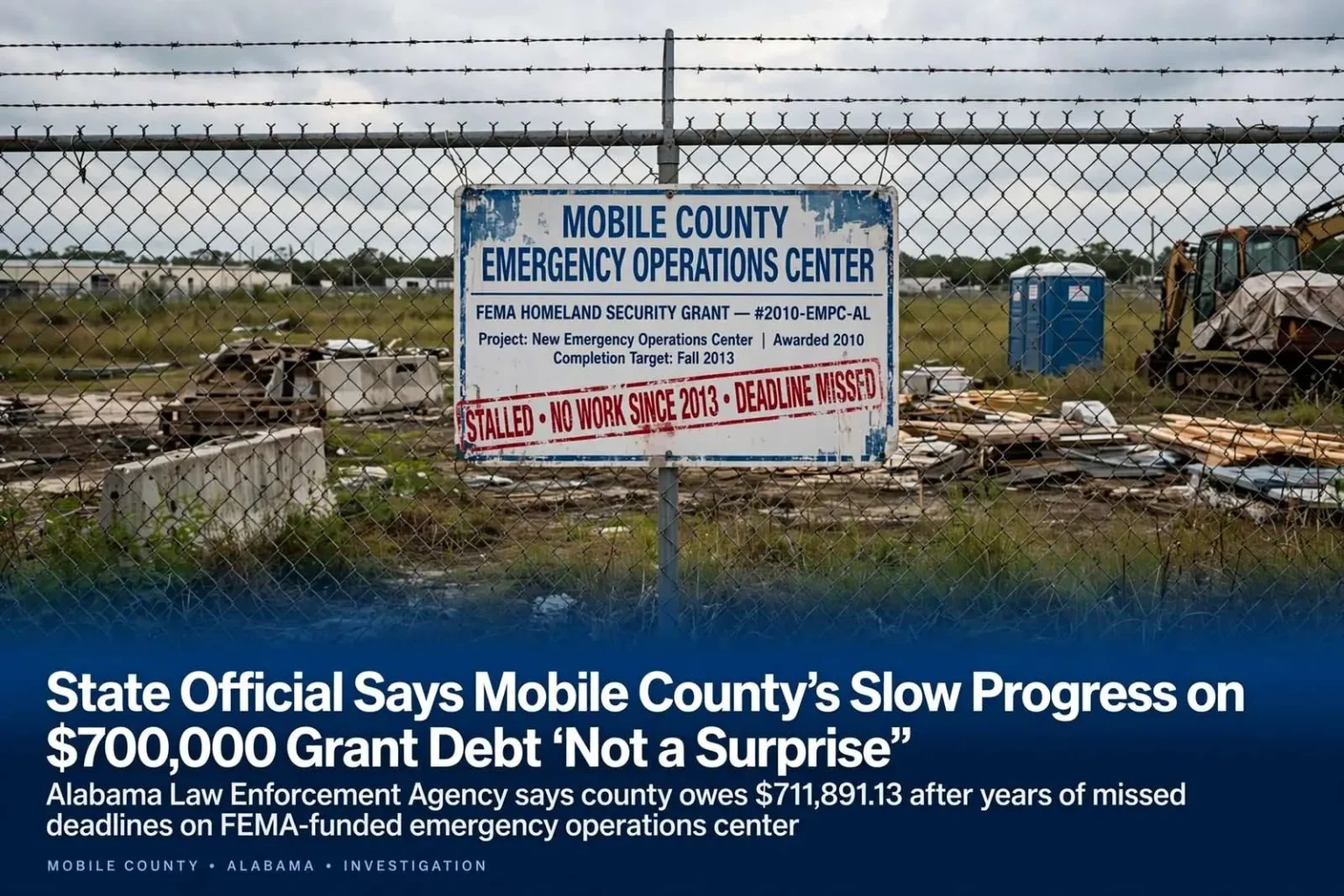
Mobile County’s Emergency Management Agency faces a repayment deadline of more than $700,000 after failing for years to break ground on a federally funded emergency operations center, a situation the state’s top law enforcement official says has been building for some time. The Alabama Law Enforcement Agency, which is responsible for enforcing the terms of federal homeland security grants, said Mobile County Emergency Management owed $711,891.13 under the terms of a FEMA grant originally awarded in 2010 to build a new emergency operations center.
The grant carried a three-year performance cycle, but the county missed its original deadlines and was granted two one-year extensions, yet still had not broken ground on the project years later. ALEA’s secretary said representatives from the agency’s Homeland Security division had repeatedly warned Mobile County officials about the grant’s status in the years leading up to the deadline, providing correspondence dating back roughly five years, including the county’s original grant application, which had targeted a completion date in the fall of 2013.
Despite those warnings, the secretary said, the county made little tangible progress on the project. An emergency operations center is the physical hub from which a county coordinates disaster response, the room where sheriffs’ deputies, fire chiefs, utility representatives, and elected officials gather when a hurricane approaches or a major emergency unfolds. For a Gulf Coast county as exposed to hurricanes as Mobile, the failure to build one carried consequences beyond the money.
How a Grant Becomes a Debt
Federal preparedness grants work on a reimbursement and performance model. A recipient county is awarded funds for a specific project with a defined performance period, and the money must be spent, and the project completed, within that window. When deadlines pass without progress, the granting authority has two options: extend the deadline or claw the money back. Extensions are the courtesy; repayment is the enforcement.
Mobile County received the courtesy twice, in the form of two one-year extensions beyond the grant’s original three-year cycle. When even those additional years passed without groundbreaking, the state agency responsible for enforcing federal grant terms had no further discretion. The $711,891.13 owed under the award became a debt the county would have to repay, and the clock started running on the consequences.
A Mobile County commissioner told fellow officials at a recent Emergency Management meeting that the county was not rushing to repay the debt, saying local officials viewed avoiding losing the grant altogether as the best-case outcome. That framing, preserving access to future funding as the goal rather than finishing the project, captured how far the situation had drifted from the original ambition of a new operations center.
What the County Loses While It Owes
Under the grant’s terms, Mobile County will remain ineligible for future homeland security funding, including grants for firefighting equipment and SWAT team resources, until the debt is repaid, though disaster relief funding tied to events like hurricanes would not be affected.
That distinction matters enormously on the Gulf Coast. The excluded categories, homeland security and preparedness grants, are the programs that equip fire departments, sheriff’s offices, and emergency planners with the specialized gear and training that local budgets rarely cover. The protected categories, disaster relief streams tied to declared events, remain available because federal law ties them to emergencies rather than to a county’s standing in the grant system.
Still, for a county whose emergency management agency needs a functioning operations center and whose first responders routinely apply for federal equipment grants, the freeze on future homeland security funding represented a rolling penalty. Every grant cycle that passed with the debt outstanding was another cycle in which Mobile County fire departments and law enforcement agencies could not compete for dollars their peers across the state received.
In addition to the principal amount owed, the grant carries a 6 percent interest rate that could compound annually, adding further pressure on county finances. Interest compounding on a $711,891.13 debt adds up quickly, and each year without resolution increased the eventual bill the county’s taxpayers would shoulder.
Appeals to Montgomery and Washington
County officials reached out to state legislators earlier this year requesting intervention and a 36-month extension, though the state’s homeland security adviser said he had never seen an extension granted over such a long timeframe and indicated that resolving the matter would likely require action at the congressional level rather than the state level.
The request for a three-year extension revealed how far the project was from reality. Extensions in the grant world are measured in months, granted when a recipient shows concrete progress and a near-term path to completion. A 36-month request implied the county needed years merely to get back to a position where construction could begin, an admission that the original project had effectively stalled out.
Alabama’s congressional delegation, including members representing the Mobile area, has been in contact with FEMA regarding the county’s request, though no formal repayment schedule or extension had been announced as the deadline approached. Congressional intervention in grant disputes is a recognized last resort, since members of Congress can make inquiries with the federal agency that state officials cannot, but it rarely produces quick results, and FEMA’s grant enforcement rules leave little administrative room for forgiving completed-cycle awards.
The state’s homeland security adviser’s candid assessment also drew a boundary between state and federal authority. ALEA enforces federal grant terms; it did not write them, and its secretary’s office could not rewrite them. If Mobile County wanted relief, the pathway ran through Alabama’s senators and representatives in Washington, not through Montgomery.
The Stakes for the Gulf Coast
The episode is particularly pointed in a county with Mobile’s hurricane history. The Gulf Coast’s experience with major storms has shaped federal preparedness funding for two decades, and the money that flows through programs like the one Mobile County failed to use exists precisely because the region’s exposure is well documented. A county that cannot complete its own emergency operations center risks more than ineligibility; it risks the question of what would happen in the next hurricane season if the debt remains unpaid and the center remains unbuilt.
Emergency operations centers have become standard infrastructure for counties of Mobile’s size. The facility consolidates communications, planning, and command functions under one roof during an activation, replacing the improvised conference rooms and phone trees that characterized disaster response in earlier generations. The center planned under the 2010 grant was intended to give Mobile County that capability, and the fact that the funds sat unspent while deadlines lapsed frustrated officials at every level of the system.
County officials say they continue to work toward a resolution that would preserve the county’s access to future homeland security and emergency preparedness funding. Whether that resolution takes the form of a negotiated repayment schedule, congressional relief, or a renewed attempt to complete the project, the deadline’s approach forced the issue after years in which the grant drifted through extensions and warnings without ever producing the operations center Mobile County was promised.
What remains clear is the cost of delay. The county owes $711,891.13 and rising under a 6 percent interest rate, stands frozen out of homeland security grants until the debt clears, and still lacks the emergency operations center the 2010 award was meant to build. The final chapter, written in Washington, Montgomery, or Mobile, will determine whether those costs are the end of the story or merely its beginning.
The five-year paper trail ALEA cited is a central element of the dispute. Correspondence dating back roughly five years, including the county’s own grant application with its fall 2013 completion target, documents that state officials were not springing the deadline on Mobile County. Each missed milestone generated warnings; each warning was acknowledged; and each extension carried an implicit promise of progress that never materialized on the ground.
Grant enforcement officials describe this pattern as the most difficult kind to resolve. A recipient that actively defrauds a program is rare, but a recipient that simply fails to execute, missing milestone after milestone while pursuing extensions, consumes administrative patience and public money without ever presenting a clean trigger for termination. The result is exactly what Mobile County now faces: years of warnings, then a sudden ultimatum with interest accruing.
The county’s pursuit of legislative help reflects the reality that no county government budgets for repaying a federal grant it never expected to owe. The $711,891.13 was not an appropriation in any Mobile County budget; it became one only when the performance period closed. County commissioners weighing the commissioner’s advice not to rush the repayment were, in effect, weighing how to absorb an unbudgeted six-figure liability alongside the county’s other obligations.
The ineligibility freeze extends beyond the county government itself, which is one reason the issue drew attention from fire services and law enforcement across Mobile County. Federal homeland security grant programs typically flow through the county as the recipient, with municipal fire departments and sheriff’s units as sub-recipients and beneficiaries. When the county’s standing is suspended, the equipment purchases those departments planned around can be held up, stretching the consequences of the Emergency Management agency’s unfinished project into fire stations and precincts far from the administration building.
SWAT team resources and firefighting equipment are the categories officials cited, and both speak to real needs on the Gulf Coast. Mutual aid agreements across the county’s municipalities depend on interoperable equipment, and grant programs have historically been the mechanism for keeping smaller departments equipped to federal standards. Losing access, even temporarily, degrades that planning.
The disaster relief carve-out provides the crucial reassurance. Hurricane recovery funding, the streams that flow after a named storm under federal disaster declarations, operates on a separate legal footing, and the county’s grant debt does not touch it. In a hurricane-prone county, that distinction separates an uncomfortable fiscal problem from a genuine public safety crisis, though officials at every level have been careful to note the protection applies to disaster relief, not to preparedness and equipment programs.
As the deadline approached, the county’s options had narrowed to negotiation, legislation, or payment. County officials continued working toward a resolution that would preserve future funding access, the congressional delegation continued its inquiries with FEMA, and the interest meter continued running at 6 percent, a quiet toll on a project that was supposed to have been completed in the fall of 2013.