Defense Lawyers Second-Guess Nodine’s Missteps After Murder Indictment
With Steve Nodine jailed on a $500,000 bond, Mobile criminal defense attorneys, speaking anonymously, listed the choices they say a suspect should never make.
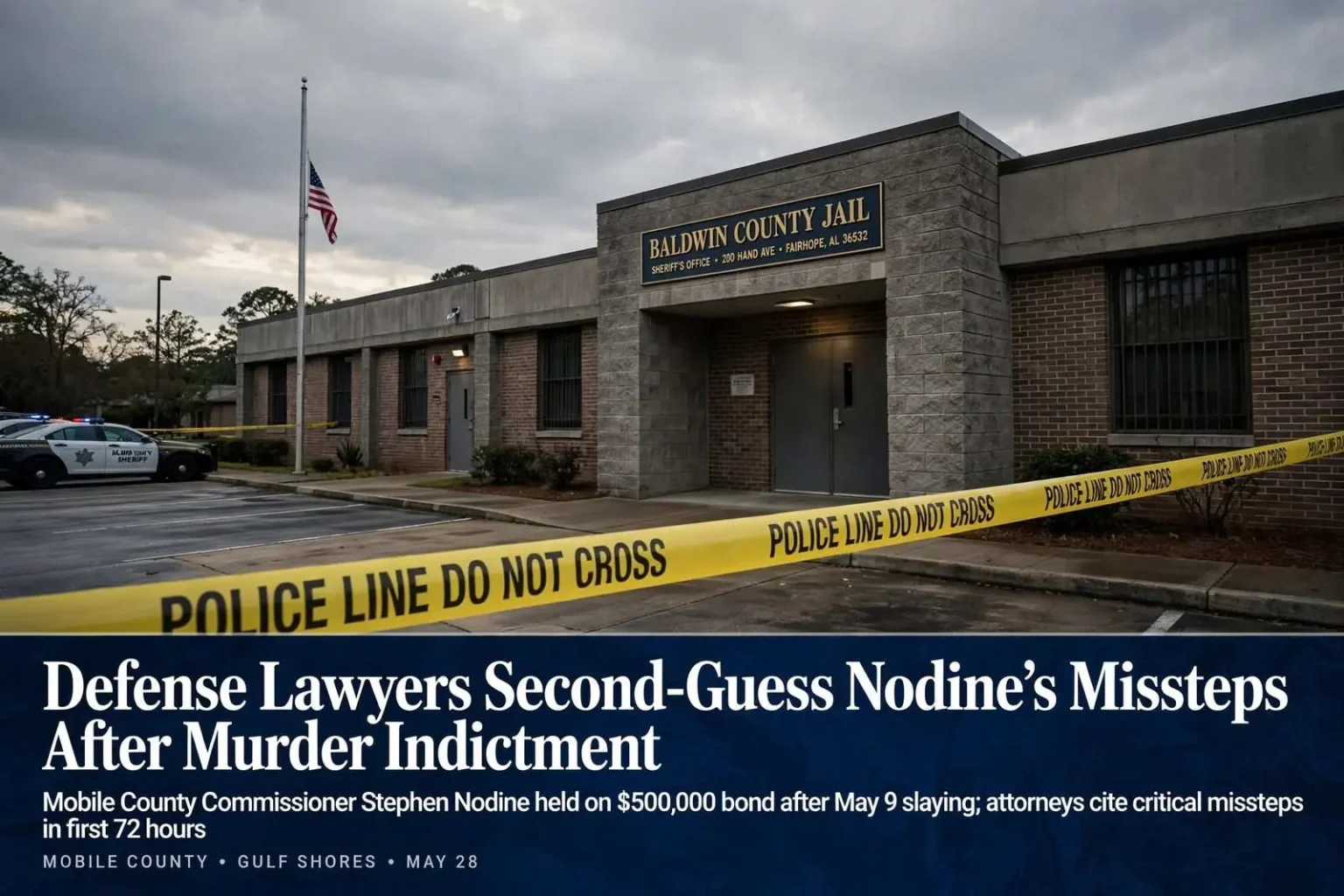
Mobile County Commissioner Stephen Nodine, apparently not expecting to be in jail on June 1, never arranged to vote by absentee ballot in the party primaries, according to his attorneys, who remained hopeful he would post bond before the Memorial Day weekend. “We hope to be at the polls next Tuesday,” said Dennis Knizley, his defense attorney.
From the perspective of the criminal defense bar, the missed ballot was the least of Nodine’s problems. Now a defendant charged in the May 9 slaying of Angel Downs, and held on a $500,000 bond in the Baldwin County Jail, he had, in the view of veteran attorneys, made a long series of choices that no lawyer would have advised — choices that began in the first hours after the shooting and compounded week by week.
The timeline, as reported
Downs, 45, was shot through the head and died in the driveway of her Fort Morgan Road townhouse in Gulf Shores at about 7:55 p.m. on Sunday, May 9, with a 9mm Kel-Tec pistol and one spent cartridge nearby. Neighbors reported seeing a red Ford pickup with government plates leave the scene, and police issued a lookout for Nodine, whose county-issued truck matched the description.
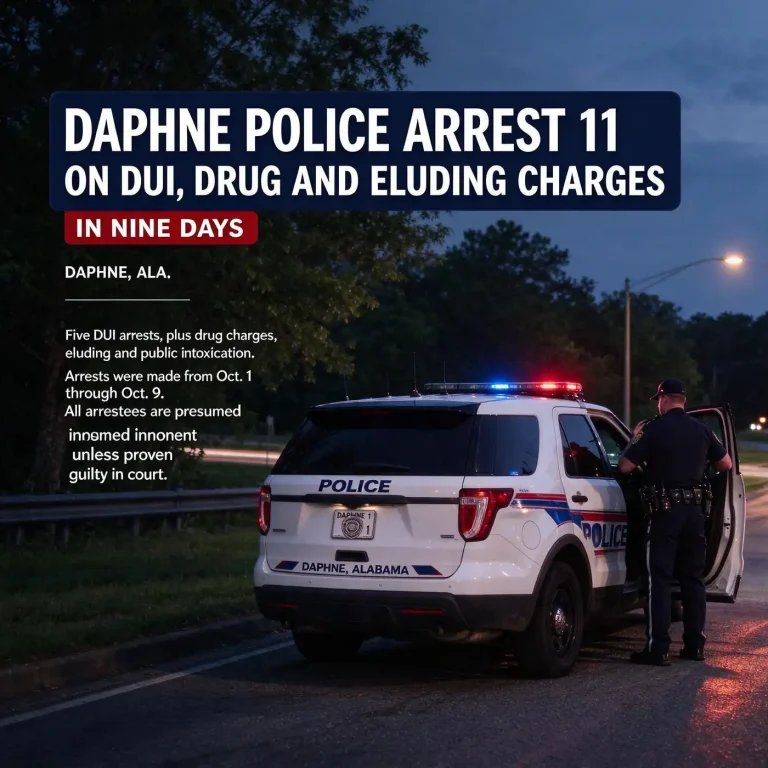
Nodine went to a restaurant in Daphne, where he continued taking and placing cellphone calls — conduct that defense lawyers across the region would later describe as the first unrecoverable mistake. In the hours after a homicide in which you are the named suspect, every call creates a record, every location creates a witness, and every movement becomes a fact for the state’s reconstruction.
At about 11 p.m., having changed clothes at some point in the interval, he met with Baldwin County investigators for nearly four hours, accompanied by his then-attorney, Matt Green. A session of that length, on the night of the shooting, before any investigation had clarified its own evidence, is the kind of encounter defense attorneys routinely advise against: nothing a suspect provides can help him, and everything can be tested, compared and used.
The days that followed
The next morning, county attorneys Jay Ross and Mark Erwin drove to Nodine’s home after receiving a text message that concerned them. Erwin described Nodine as “a basket case.” At the urging of Nodine’s wife, Kimberlee, the lawyers removed firearms from the house and passed them to Green, who turned them over to Baldwin County authorities — an act of prudence that nonetheless placed additional weapons, potentially, inside the perimeter of the investigation.
Later that day Nodine was admitted to the psychiatric unit at Mobile Infirmary, where he stayed nearly four days. Blood tests taken during that stay registered positive for marijuana and opiates — results that, once in the record, would attach to every other fact the state assembled, and that would have been impossible to explain away from a jail cell.
On Friday, May 14, a Mobile County grand jury returned a bill of impeachment stemming from the December discovery of marijuana and prescription drugs in his county-owned truck, formally beginning the process that would seek his removal from the commission. Within five days of the shooting, the commissioner was facing a homicide charge, an impeachment proceeding, a suspended political life and a medical record he could not control.
Veteran defense lawyers reading the sequence saw a cascade. Each step — the phone calls, the clothing change, the four-hour interview, the firearms transfer, the hospital admission with its toxicology results — was individually defensible as a human response to crisis. Together, they built the prosecution’s timeline for it.
What the defense bar would have done
The second-guessing from other lawyers was immediate and unsparing, though none of it was offered lightly — every criminal defense attorney knows the defendant in the first hours of a tragedy does not consult the playbook. Still, the consensus was clear. A lawyer counseling a client in Nodine’s position would have said: stop making calls, retain one attorney and one only, say nothing to investigators, and go nowhere near firearms, phones or the scene.
The four-hour interview was the episode most cited. Statements made in the first night of a homicide investigation are almost always harmful, because the client knows less than the police do about where the case is heading, and any detail he offers — a time, a place, a meeting — can be contradicted later by records he has not seen. Counsel present at such a session spends the next year managing its contents.
The hospital admission created a different species of problem. Toxicology results from a psychiatric stay are medical records, but in Alabama they can reach the prosecution through the ordinary machinery of subpoenas and criminal discovery, and they land in the case file with the authority of laboratory science. A defendant whose blood tests positive while he is under investigation for a shooting hands the state a character exhibit it could never have obtained on its own.
The firearms transfer, likewise, was the correct instinct executed in the wrong channel. Lawyers removing guns from a client’s house and routing them to another attorney before surrendering them to police invite questions about custody and condition that a clean, documented surrender to the investigating agency would have avoided.
The political wreckage
Meanwhile the institutional consequences accumulated on their own schedule. The May 14 impeachment bill put Nodine’s commission seat in play, his county truck and expenses became evidence, and his absence from the board’s meetings left District 2 without an advocate while he sat in the Baldwin County Jail. His lawyers’ hope that he could make bond and vote in the June primaries captured how completely the legal emergency had displaced the political one: the man whose attorneys were fighting for his liberty was also, technically, still an elected official with a primary ballot waiting.
For the county’s Republican establishment, the wreckage forced a standing rearrangement. Endorsements were withdrawn or quietly shelved, committee assignments shifted, and colleagues on the commission governed around the empty chair. Whatever the criminal courts decided, the political career that had survived a drug scandal in December did not survive May.
Defense attorneys watching the case drew the professional lesson that gets repeated at every bar conference: the hours after a catastrophic accusation are the most dangerous of a client’s life, and the mistakes made there cannot be litigated away later. Nodine’s case, they said, would be taught not for its outcome but for its first seventy-two hours.
The bond fight and the calendar
By the first week of June, Nodine remained in the Baldwin County Jail on the $500,000 bond, with his attorneys working to arrange his release before the Memorial Day weekend — a target that slipped, then passed, then became the missed absentee ballot that confirmed how little of his ordinary life remained under his control. A jailed commissioner cannot vote in person; Alabama’s absentee process requires an application, a signature and an excuse, all of which demand attention and paperwork that a homicide defense was unlikely to spare.
The bond question itself carried strategic weight. A defendant free on bond can assist in his defense, appear composed at hearings and demonstrate to the court a stability the state’s narrative denies; a defendant in jail arrives at every hearing in the state’s custody, wearing the state’s clothes. Nodine’s lawyers understood that every week inside weakened both the defense and the man.
What the county watched
For Mobile County, the spectacle was unprecedented in living memory: a sitting commissioner charged with murder in a neighboring county, impeached over the December drugs found in his county truck, and held on a bond most constituents could not comprehend. County staff continued the business of roads and drainage, but the commission’s public sessions became press events, and every procedural step in Baldwin County — arraignments, bond hearings, depositions scheduled and cancelled — made the Mobile County Courthouse docket a sidebar.
The case also drew the scrutiny of every elected official in the region who kept a county vehicle or a campaign account. The December drug discovery that started Nodine’s institutional trouble had already prompted questions about oversight of county property; the May charges turned those questions into policy conversations about vehicle tracking, take-home privileges and the process for removing an official who will not resign.
Prosecutors, for their part, proceeded methodically through the record Nodine’s first days had given them: the call logs from a restaurant in Daphne, the four-hour interview, the toxicology report from Mobile Infirmary, the firearms passed through a lawyer’s office, the clothing. Defense attorneys’ second-guessing was, in effect, a public preview of the defense’s own problem — the state would tell the story of those first seventy-two hours, and the timeline was already written.
What remained contested was everything that followed: what happened at the townhouse on Fort Morgan Road, whose pistol was the murder weapon, and what the relationship between the commissioner and the real estate agent had become in its final weeks. Those were the questions a jury would eventually face. The mistakes of May 9 and 10 were no longer in dispute — only their meaning.