Baldwin County and State Officials Meet in Robertsdale to Discuss Hurricane Readiness
State and Baldwin County emergency management officials gathered in Robertsdale to review storm readiness at the start of the 2015 hurricane season.
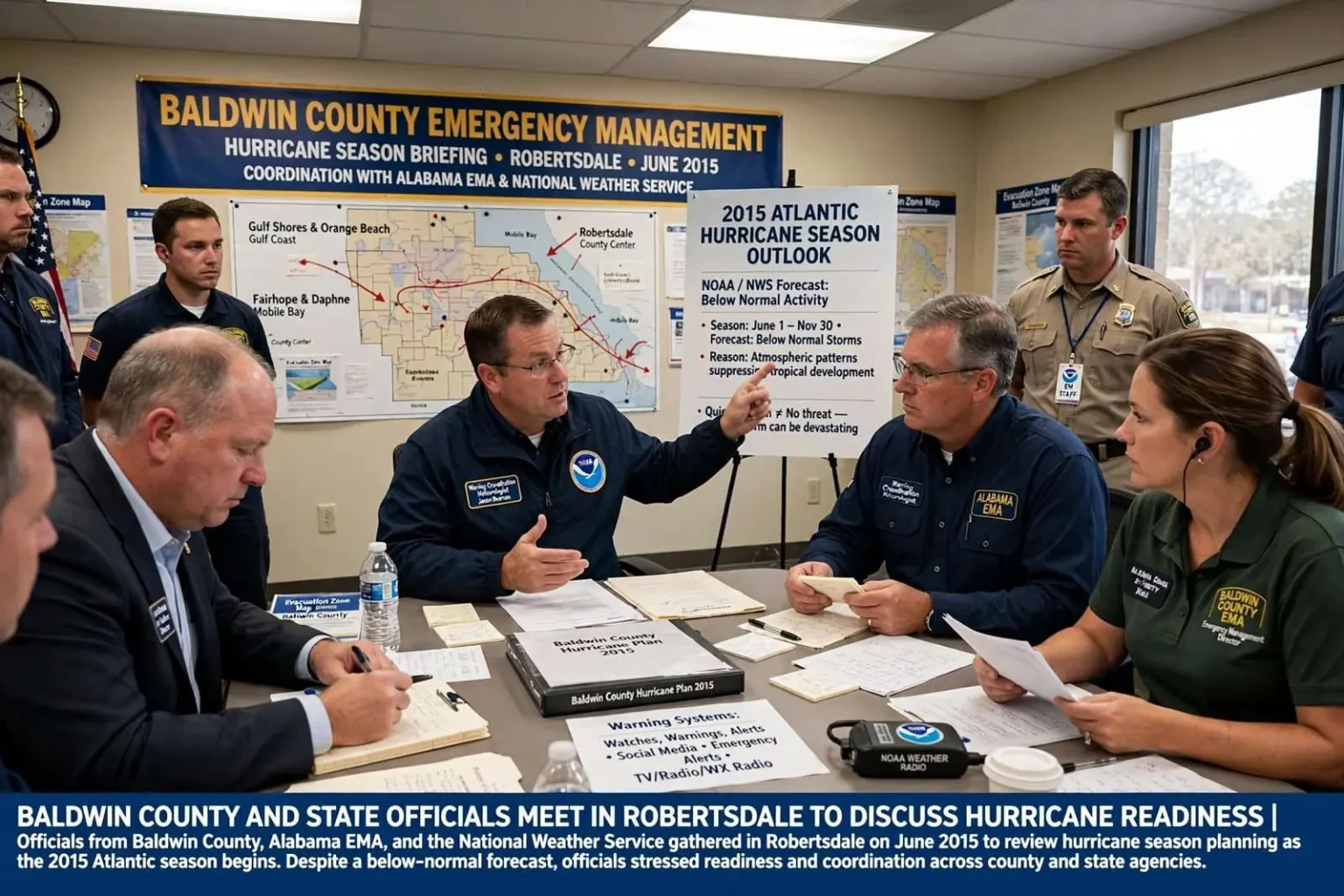
Baldwin County officials gathered in Robertsdale for a hurricane season briefing, bringing together state and local emergency management leaders just days after the 2015 Atlantic hurricane season began. The meeting assembled the officials who would manage a storm response from every level — county emergency management staff, state agency leaders and weather forecasters — under one roof in central Baldwin County, a location that puts the briefing within reach of responders from both the bay side and the beach communities along the county’s Gulf frontage. The season, which runs from June 1 through November 30, was forecast by the National Weather Service to be below normal in activity. Forecasters attributed the expected quiet season to large-scale atmospheric patterns that tend to suppress tropical development in the Atlantic basin.
Jason Beaman, the agency’s warning coordination meteorologist, told officials that a quiet outlook does not mean the county can afford to be complacent. Seasonal forecasts describe broad activity levels across an entire six-month season, but they say nothing about where any individual storm will strike, and a single landfall can make a quiet season devastating for one community. He noted the Gulf Coast is struck by a major hurricane roughly once every ten years on average, meaning the region could be due for another significant storm regardless of a mild seasonal forecast. The Gulf Coast’s last Category 3 hurricane was Wilma in 2005.
That math carries particular weight in Baldwin County, whose residents have lived through the consequences of major hurricane landfalls in living memory. The county’s coastline along the Gulf of Mexico and Mobile Bay places communities from Gulf Shores and Orange Beach on the barrier side to bayfront towns like Fairhope and Daphne within the reach of storm surge and destructive winds. Longtime residents recall major storms that reshaped the county’s coastline and economy, and emergency managers build each season’s plans with those historical strikes in mind rather than betting on the forecast.
Beaman walked officials through the range of warning systems the National Weather Service uses to alert residents to approaching storms, including its expanding use of social media to push out real-time updates during active weather events. The agency’s forecast office for the central Gulf Coast issues watches, warnings and advisories across multiple media channels, and the growth of social platforms has added a direct line to the public that operates in real time as a storm approaches. Officials were briefed on how those tools fit alongside television, radio, weather radio and emergency alert systems in getting timely information to residents who need it.
State emergency management’s role in a Baldwin County storm
Representatives from the Alabama Emergency Management Agency also addressed the gathering, pledging continued coordination between the state and local agencies before and during storms. AEMA executive operations director Jeff Byard emphasized that local impacts are treated as state impacts, describing Alabama’s emergency response as a unified effort rather than a patchwork of separate county responses. The philosophy matters in practice, because a major hurricane striking Baldwin County would quickly exhaust local resources, and the state’s commitment to treating the event as a shared responsibility determines how fast outside help arrives.
Under Alabama’s emergency management structure, counties remain the front line of response, with local directors managing operations from their own emergency operations centers while the state mobilizes resources from Montgomery. A storm severe enough to trigger a state of emergency brings state agency assets into the field, from National Guard personnel to highway crews and law enforcement support, all coordinated through the state emergency operations center. Byard’s message to Baldwin County officials was that the state’s machinery is designed to activate alongside local responders from the earliest hours of an event.
Baldwin County’s three priorities for the season
Baldwin County’s emergency management leadership outlined three priorities for the coming season: keeping the county prepared before storms arrive, building the county’s emergency management agency toward greater self-sufficiency, and restoring normal operations as quickly as possible after any disaster strikes. The first priority covers the full range of pre-storm work, from public education campaigns to evacuation planning, generator readiness and communication drills. Baldwin County’s population growth in recent decades has added thousands of new residents who have never experienced a major hurricane, making public preparedness an ongoing task rather than a one-time message.
The self-sufficiency priority reflects a hard lesson from past disasters: outside help takes time to arrive, and the first hours and days after a storm belong to local responders. Baldwin County’s emergency management agency has worked to strengthen its own capabilities, from its emergency operations center to the equipment and training of county staff, so that the community can manage immediate needs even while state and federal resources are still mobilizing. The goal is to close the gap between the moment a storm passes and the moment outside assistance reaches the field.
Recovery — restoring normal operations as quickly as possible — rounds out the county’s priorities, and it is often the longest and costliest phase of a disaster. Debris removal, power restoration, road repairs and the reopening of schools and businesses all determine how quickly life returns to normal after a strike. Baldwin County’s experience with past storms has shaped a recovery playbook that begins before the storm arrives, with damage assessment teams staged, debris contracts in place and coordination channels to state and federal recovery programs already established.
What residents should take from the briefing
Officials closed the meeting by urging continued communication and preparation across the county in the months ahead, noting that readiness efforts work best when residents and agencies stay engaged well before a storm is on the horizon. Emergency managers across the Gulf Coast use the opening weeks of hurricane season each year to remind families to review their own plans, from evacuation routes and supplies to communication arrangements for family members who might be separated when a storm approaches.
For Baldwin County residents, preparedness starts with knowing whether they live in an evacuation zone, since storm surge along the Gulf beaches, Mobile Bay and the county’s waterways drives the evacuation decisions emergency managers make as a storm nears. The county’s highway network, including the interstate corridors that run through the county, forms the backbone of any evacuation moving residents inland or out of the storm’s path. Officials urge families to prepare enough supplies to be self-sufficient for days after a storm, when power outages and disrupted services are common even in areas that escape the worst damage.
The briefing in Robertsdale closed on the same note that opens every hurricane season on the Gulf Coast: the forecast is uncertain, but the responsibility to be ready is not. A below-normal outlook may mean fewer storms across the Atlantic basin, yet the officials gathered in Baldwin County left the briefing with the same operating assumption they carry into every season — that the county must be prepared for the one storm that matters, whenever it comes.
AEMA director Art Faulkner detailed changes the agency has made to its structure since the April 27, 2011 tornado outbreak, when the agency’s response exposed inconsistencies and what he described as ineffective coordination tactics. The 2011 outbreak stands as one of the deadliest tornado disasters in American history, cutting a path across central and north Alabama and straining every layer of the state’s emergency response system. Faulkner said the agency had since established regional divisions across the state aimed at delivering faster, more effective support to counties hit by disasters, so that local emergency managers are not left to manage a crisis alone.
The regional division model reorganized how the state deploys its field staff, placing AEMA personnel closer to the counties they serve and giving local directors a consistent point of contact before, during and after disasters. For a coastal county like Baldwin, the reform means a standing relationship with state coordinators who know the county’s plans, its vulnerabilities and its people before the first tropical wave of the season ever forms.
Robertsdale’s place in the county’s emergency network
The choice of Robertsdale as the briefing site reflects the city’s position near the geographic center of Baldwin County, where major routes from the beach communities and the bay shore converge. The city hosts county services and sits within reach of emergency facilities serving the entire county, making it a practical gathering point for officials who would need to coordinate across a county that stretches from the Gulf of Mexico to the North Alabama line traffic corridors. Central locations like Robertsdale have long served as meeting points for the county’s police, fire and emergency services leadership, whose agencies must work seamlessly together when a storm threatens.
Baldwin County is Alabama’s largest county by land area, and its geography presents emergency managers with distinct challenges in a hurricane scenario. The barrier island communities of Gulf Shores and Orange Beach face the earliest and most severe impacts from Gulf landfalls, including surge that can cut off access routes to the mainland. Communities along Mobile Bay and the county’s rivers face their own flooding risks, while inland areas deal with wind damage and the challenges of recovery across a sprawling road network. Planning for all of it requires the kind of coordination the Robertsdale briefing was designed to reinforce.
The meeting also gave county officials a chance to hear directly from the forecasters and state leaders they will work with during any storm, building the familiarity that pays off during an actual event. Emergency management professionals emphasize those relationships as a core element of disaster readiness, since communication channels that are already open before a storm move information faster when minutes count. With the 2015 season now underway, Baldwin County’s emergency management leadership enters the peak months of the season with its priorities defined and its partnerships with state agencies and the National Weather Service reaffirmed.